01 — At a Glance
Government’s Missile Machine: A Tale of Lumpiness
- 52-Week High / Low₹2,097 / ₹1,088
- TTM Revenue₹3,739 Cr
- TTM PAT₹580 Cr
- Full-Year EPS (TTM)₹15.82
- Annualised EPS (Q3×4)₹7.96
- Book Value₹115
- Price to Book11.8x
- Dividend Yield0.34%
- Debt / Equity0.00x
- Order Book (Mar 25)₹22,814 Cr
The Lumpy Business Problem: BDL’s Q3 FY26 revenue crashed to ₹567 crore from ₹1,147 crore in Q2. Quarterly profit tumbled ₹216 crore to ₹73 crore. Meanwhile, YTD (Apr–Dec FY26) revenue hit ₹1,962 crore, up 25% YoY. So the quarter was weak. The year is strong. The orderbook is enormous. Welcome to defence manufacturing, where quarterly earnings tell you nothing and fiscal-year planning tells you everything. P/E 85.8x is not a typo. It’s what happens when one quarter costs ₹1.99 per share.
02 — Introduction
Meet the Boring Explosives Company That Everyone Suddenly Cares About
Bharat Dynamics Limited (BDL) is a Government of India enterprise that manufactures guided missiles, anti-tank weapons, surface-to-air missiles, and underwater platforms for the Indian Armed Forces. It is, essentially, your tax money converted into precision instruments that go boom in very specific directions.
Founded in 1970 in Hyderabad, BDL has been quietly doing its job for 56 years: take DRDO designs, manufacture them at three plants (Hyderabad, Visakhapatnam, Bhanur), and deliver them to the Ministry of Defence on fixed-contract terms with minimal profit margins because, well, national interest trumps shareholder returns in a PSU.
Then 2024 happened. India’s defence capex cycle accelerated. Export demand exploded. China flexed. And suddenly, the stock that had been trading in the ₹400–600 range for two years touched ₹2,097. From pandemic lows, a 5-year CAGR of 49%, a 3-year CAGR of 42%. Not bad for a company whose entire business model is “wait for MoD tenders and bid at breakeven.”
Q3 FY26 results came in weaker than expected, triggering the usual “BDL is a bubble” hot takes. But the orderbook is now estimated at ₹26,000 crore (up from ₹22,814 crore in Mar 2025). Exports hit ₹1,270 crore in FY25 — a 7x jump. MoD is expected to place ~₹20,000 crore in fresh orders over the next 2–3 years. The company is expanding to six manufacturing facilities (three new, three existing). And the government is pushing indigenous missile capability because buying from abroad is expensive and slow. This is the story. Weak quarter, strong fundamentals. Lumpy earnings, solid orderbook. Let’s unpack it.
Defence Budget Context: India’s defence capex (capital expenditure) is expected to grow 9–10% annually. Missile spend specifically is rising faster as the shift from imports to indigenous production accelerates. BDL is the sole domestic supplier for several critical systems.
03 — Business Model: WTF Do They Even Manufacture?
They Turn DRDO Blueprints Into Things That Make Enemies Regret Their Life Choices
BDL’s business is elegantly simple on paper but hellishly complex in execution. The Ministry of Defence floats a tender for a weapon system. DRDO has already designed it (sometimes). BDL bids for the manufacturing contract. MoD awards it at a price that barely covers costs plus a razor-thin profit margin. BDL manufactures for 3–5 years, delivers on schedule or faces penalties, and repeats.
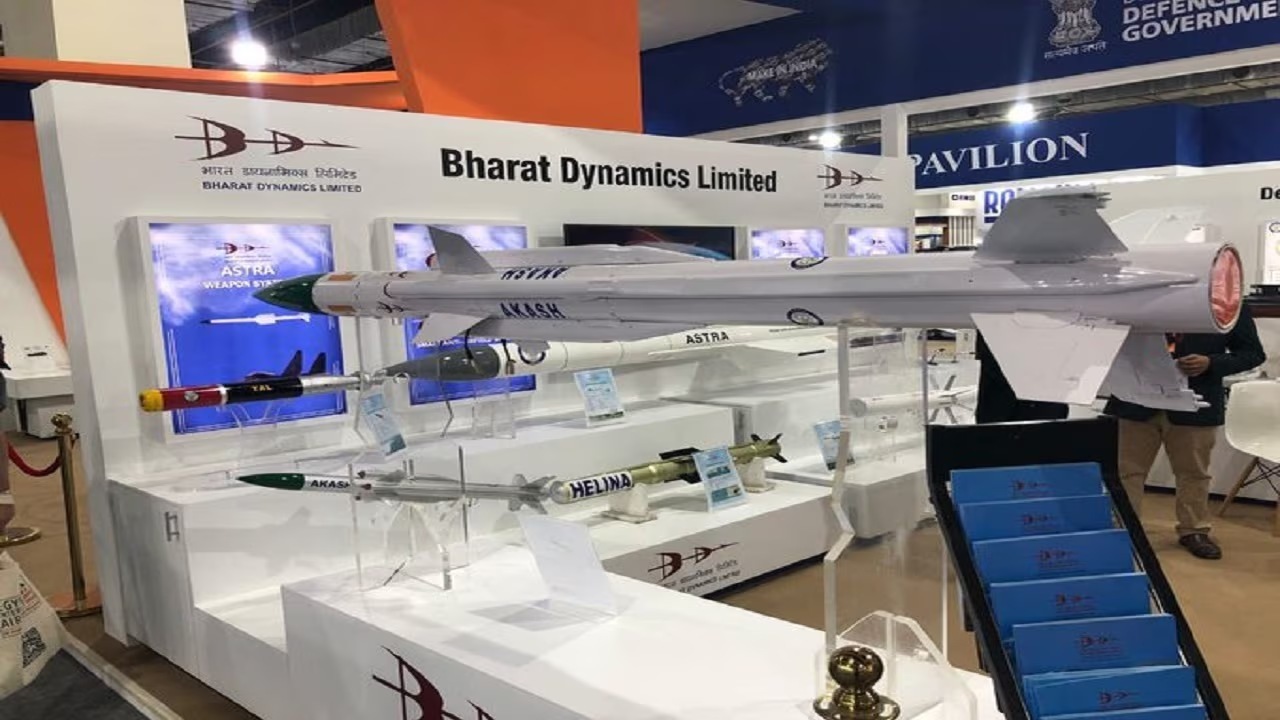
The company makes Surface-to-Air Missiles (Akash, MRSAM), Anti-Tank Guided Missiles (Konkur, Nag, now Invar), Air-to-Air Missiles, torpedoes, launchers, counter-measure systems, and increasingly, support for exporting these systems to friendly nations. In FY25, exports were 38% of revenue (₹1,270 crore). Government of India was 50% (down from 66% in FY23). Others (maintenance, overhaul, data centre fluids) were 12%.
The company is rapidly expanding capacity at three new manufacturing sites: Amravati (Maharashtra), Jhansi (Uttar Pradesh), and Ibrahimpatnam (second facility in Telangana). These are not revenue-generative yet. They’re infrastructure investments for future orders. Capex in FY25 was ₹283 crore. Plan is ₹200 crore annually for the next 3 years. The company has also begun R&D on advanced propellants, AI-guided systems, and indigenous missile subsystems — spending 6–7% of revenue on R&D (₹223 crore in FY25).
SAMs & AAMs~30%of Orderbook
ATGMs~50%of Orderbook
Torpedoes & Others~20%of Orderbook
Export Orderbook₹1,167 Cr5% of Total
Indigenization Push: The company has raised indigenization levels to 80–90% for ToT (Transfer of Technology) products and >90% for DRDO-designed systems. Only critical, complex subsystems are still imported. This reduces vulnerability to sanctions and makes export easier (fewer approvals).
💬 Defence contracts are famously slow to execute. Do you think BDL’s time and cost overrun risks are priced into the 85.8x P/E, or is the market ignoring delivery risk entirely?
04 — Financials Overview: The Lumpiness Explained
Q3 FY26: Why The Weak Quarter Doesn’t Matter
Result type: Quarterly Results (Q3 FY26) | Q3 EPS: ₹1.99 | Annualised EPS (Q3×4): ₹7.96 | TTM EPS: ₹15.82
| Metric (₹ Cr) |
Q3 FY26
Dec 2025 |
Q3 FY25
Dec 2024 |
Q2 FY26
Sep 2025 |
YoY % |
QoQ % |
| Revenue | 567 | 832 | 1,147 | -31.9% | -50.6% |
| Operating Profit | 26 | 127 | 188 | -79.5% | -86.2% |
| OPM % | 5% | 15% | 16% | -1000 bps | -1100 bps |
| PAT | 73 | 147 | 216 | -50.4% | -66.2% |
| EPS (₹) | 1.99 | 4.01 | 5.89 | -50.4% | -66.2% |
The Context Matters: Q3 is typically BDL’s weakest quarter because large deliveries (Akash, MRSAM, ATGM contracts) cluster around Q4 (Mar year-end) when orders get executed to hit fiscal year targets. YTD (Apr–Dec FY26) revenue is ₹1,962 crore, up 25% YoY. The 9-month operating margin is 8.6% (down from 11.1% in 9M FY25) due to elevated R&D spend and contract mix changes. This is not a quality deterioration. This is an investment cycle. Think of Q3 as the “quiet quarter before delivery season.”
05 — Valuation: But At What Price?
Is 85.8x P/E Justified, or Just Peak Euphoria?
Join 10,000+ investors who read this every week.