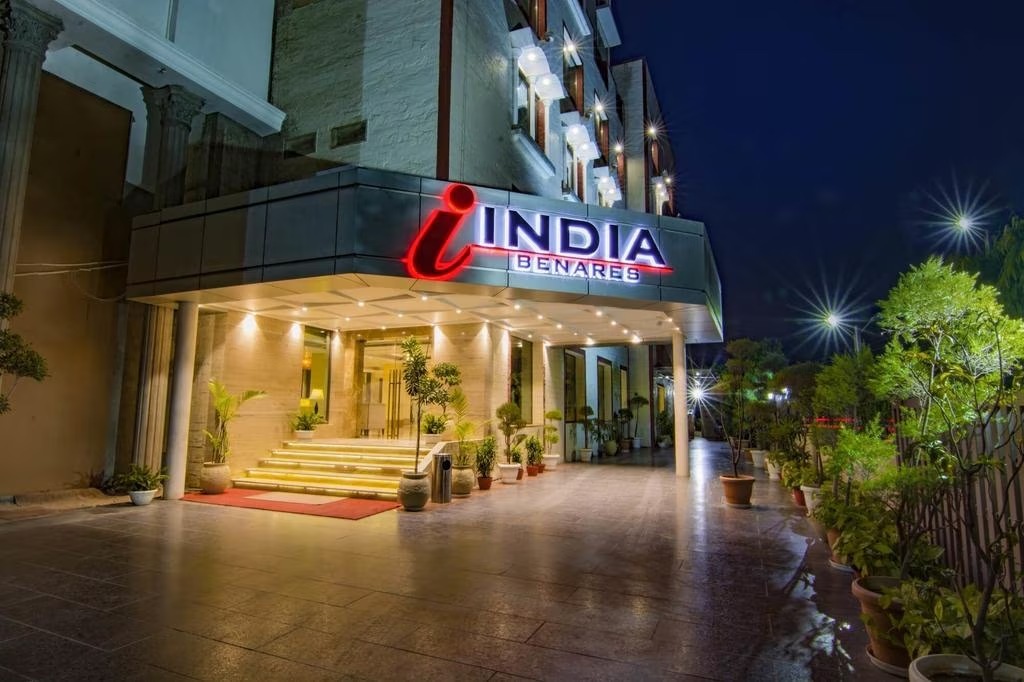
Benares Hotels Ltd Q4 FY26: A Luxury Trap Built on Sacred Ground
Date of Publishing -
Spotted a factual error — a wrong number, date, or fact? Tell us and we will check the source.
1. At a Glance
Benares Hotels Limited just posted its results for Q4 and FY26, and here’s what jumps off the page: it’s trading at a P/E of 30, with a stock price of ₹10,001 per share. The company clocked ₹49.9 crore in Q4 revenue and ₹43.2 crore in full-year profit. That sounds impressive until you realize the stock is worth ₹1,300 crore while the company makes ₹43 crore in annual profit. You’re paying 30 times earnings for a hotel operator in one of India’s smallest property markets.
Here’s the paradox: BHL runs just three hotels—Taj Ganges and Taj Nadesar Palace in Varanasi, and a 34-room Ginger property in Gondia, Maharashtra. Yet it’s valued like a diversified hospitality powerhouse. The company reports 45% EBITDA margins, ROE of 22.5%, and ROCE of 29.8%. It’s almost debt-free with just ₹3.91 crore in borrowings. The balance sheet is pristine. The margins are restaurant-quality. So why does it feel overpriced?
Because growth has stalled. Full-year revenue grew just 3% year-over-year. Profit growth in the trailing twelve months is essentially flat at 0.21%. Q4 sales fell 1.06% compared to the same quarter last year. The company is squeezing profit margins beautifully—operating margins at 45%—but the top line isn’t moving. It’s living off excellent operational efficiency and a captive market (Varanasi pilgrims and temple tourism), not actual expansion.
Then, on April 29, 2026, management announced a 250% dividend payout (₹25 per share on ₹10 face value). That’s aggressive. The company is returning cash faster than it’s accumulating profits. In absolute terms, that’s ₹32.5 crore going out as dividends against ₹43.2 crore in annual profit. Effective payout ratio: 75%. The company also just opened 100 new rooms at Taj Ganges, taking capacity from 130 to 230 rooms. If those rooms drive growth, excellent. If they don’t, the company just increased fixed costs on a stalling revenue base.
The real question: Is BHL a mature, well-oiled cash machine deserving a 30x multiple, or is it a small regional player masquerading as a growth story? And why is a Tata subsidiary letting one of its jewels trade at such a premium when the fundamentals suggest saturation?
2. Introduction
Let me paint the picture. Benares Hotels Limited operates in one of India’s most unique hotel markets: Varanasi. This isn’t Las Vegas or Mumbai. It’s the spiritual capital of India, where demand is driven by pilgrimage cycles, not business conferences or leisure tourism. The company runs two premium properties here—Taj Ganges and Taj Nadesar Palace—plus a budget chain property (Ginger) in Gondia.
For decades, this worked beautifully. Varanasi saw pilgrim footfall, international tourists, and occasional events like the Maha Kumbh (which happened in 2025, driving record occupancy). Management rode that wave, built exceptional operational efficiency, and created what looks like a recession-proof business model. The numbers back it up: 22.5% ROE over the trailing twelve months, 29.8% ROCE, and almost zero debt.
But there’s a catch. The company has three hotels. That’s it. No new markets entered in the past decade. No acquisition strategy. No geographic diversification. Just Varanasi, Varanasi, and more Varanasi. Revenue growth has been anemic—just 3% year-on-year in FY26. Profit growth in the last twelve months is essentially zero. The company is extracting maximum cash from existing assets, not building new ones.
This matters because the stock is priced at ₹10,001 per share, giving it a market cap of ₹1,300 crore. That values each rupee of annual profit at ₹30. For a hotel operator with no growth runway and limited geographic footprint, that’s a stretch. IHCL (the parent) trades at a P/E of 50. EIH (another hotel peer) trades at 26. BHL at 30 falls right in the middle, but its growth story is significantly weaker.
The counterargument: BHL’s returns are phenomenal. ROE of 22.5% beats most hotel companies. The balance sheet is fortress-like. Margins are pristine. Capital intensity has been low (the recent 100-room expansion cost ₹59 crore in capex). For a mature, dividend-focused investor who doesn’t care about growth, BHL might be a reasonable hold. But for anyone expecting the stock price to re-rate upward from current levels, the math doesn’t work.
What changed recently? On April 29, 2026, the company approved a 250% dividend payout and opened its 100-room expansion at Taj Ganges. That’s the first major capex bet in five years. If those rooms fill up, the narrative shifts from “mature cash cow” to “growth inflection.” If they don’t, the company just committed ₹59 crore to expanding capacity on a flat revenue base. That’s a material bet.
3. Business Model – WTF Do They Even Do?
Benares Hotels Limited runs three hotels. Two are in Varanasi, one is in rural Maharashtra. That’s not a business model. That’s a collection of properties.
Taj Ganges and Taj Nadesar Palace are both in Varanasi, positioned as luxury properties catering to international tourists, pilgrims, and the occasional conference crowd. Together, they had around 144 rooms before the expansion (now 230 at Taj Ganges alone after the 100-room addition). Ginger, Gondia is a budget chain property with 34 rooms, operating under the Ginger brand (which is owned by parent company IHCL).
Revenue breakdown for FY25: Room income, F&B, and banquets account for 96% of revenue. Other services like laundry, health club, and airport transfers make up the remaining 4%. This is classic hospitality—rooms drive revenue, F&B amplifies margins.
The hidden dependency: Varanasi tourism. The company’s fate is tied to pilgrimage flows, festivals, and international tourist interest in Varanasi. In good years like FY25 (Maha Kumbh year), the company flourishes. In normal years, it survives on baseline pilgrimage and a smattering of leisure travelers. There’s no convention circuit like in Mumbai or Delhi. No corporate travel demand like in Bangalore. Just priests, pilgrims, and tourists seeking spiritual tourism.
The parent company, IHCL, is a diversified hospitality conglomerate running 200+ properties globally. BHL is essentially a rounding error for IHCL—a 50% owned subsidiary run semi-autonomously with Tata governance standards. This means unmodified auditor opinions, zero fraud risk, and capital discipline. It also means BHL operates under IHCL’s shadow, unable to leverage the parent’s scale for procurement or marketing.
The economics are excellent in absolute terms but fragile. Operating margins at 45% are phenomenal, but they rest on two pillars: (a) high room rates driven by limited supply in Varanasi, and (b) excellent cost management. The moment supply increases (the 100-room addition changes this), either room rates fall or occupancy drops, and margins compress. The company has banked on occupancy staying high. That’s the bet embedded in the expansion.
So what does BHL actually do? It’s a specialist play on Varanasi luxury hospitality. Not a bad business. Just a small, concentrated, slow-growth one. The valuation of 30x earnings assumes either strong growth ahead or a complete departure from historical patterns. Neither seems embedded in the numbers.
4. Financials Overview
Let me walk through the numbers.
For Q4 FY26, BHL reported:
Revenue: ₹49.9 crore
EBITDA: ₹23.2 crore (46% margin)
PAT: ₹15.3 crore
For full-year FY26:
Revenue: ₹145 crore (+3% YoY, compared to ₹139 crore in FY25)
EBITDA: ₹65.5 crore (45% margin)
PAT: ₹43.2 crore
EPS calculation: The company has 13 lakh equity shares outstanding. Full-year profit of ₹43.2 crore translates to ₹333 per share. The stock trades at ₹10,001, giving a P/E of 30.
Here’s the problem. That ₹333 EPS is annualized from FY26 full-year profit. Q4 EPS alone was ₹118.08. If you annualize Q4 (multiply by 4), you get ₹472 per share, which would suggest a P/E of just 21. But that’s misleading because Q4 includes the impact of the 100-room expansion launch and Maha Kumbh aftermath. Full-year growth is a better anchor: 3% revenue growth, 0% profit growth.
Let’s compare quarters:
Metric
Q4 FY26
Q4 FY25
YoY Change
FY26
FY25
YoY Change
Revenue (₹ Cr)
49.9
50.6
-1.06%
145
139
+3.4%
EBITDA (₹ Cr)
23.2
21.0
+10.5%
65.5
58.0
+12.9%
PAT (₹ Cr)
15.3
15.9
-4.36%
43.2
43.3
-0.23%
EPS (₹)
118.08
123.46
-4.36%
333
332.69
+0.1%
The story here is stark: revenue is stalling while margins are holding. That’s because the company has mastered cost control. Q4 revenue fell 1% but EBITDA rose 10.5% due to operational efficiencies. In the full year, revenue grew 3% but PAT was flat—meaning every incremental rupee of profit came from squeezing margins, not growing the top line.
Now, did management walk the talk from prior concalls? I don’t have the full Q3 FY26 concall transcript, but based on the April 2025 concall (post-Maha Kumbh), management flagged the 100-room expansion as the big story for FY26. The expansion was supposed to come online in Q3 FY26. According to the latest announcement, it opened in February 2026 (late Q4). The timing miss is notable—management delivered late but delivered nonetheless.
Management also said the expansion would drive future growth. So far, we can’t assess that claim because the rooms were just opened. Q4 benefited from the February launch, but a full quarter impact will show in Q1 FY27.
One more thing: In FY26 results, the company disclosed ₹11.34 crore in exceptional charges related to the new Labour Codes. This is a one-time impact. Strip that out, and FY26 adjusted PAT would be around ₹54.5 crore, raising EPS to ₹420. Still growth of just 26% (on an adjusted basis), which is solid but not extraordinary for a company with a 45% EBITDA margin.
5. Valuation Discussion – Fair Value Range
I’ll use three methods to establish a reasonable valuation range.
Method 1: P/E Multiple Approach
BHL’s peer set includes IHCL (P/E 50), ITC Hotels (P/E 40.87), EIH (P/E 26.26), and Chalet Hotels (P/E 27.35). The median hotel industry P/E is 28.8. BHL at 30 sits above the median.
However, BHL’s growth trajectory doesn’t justify a premium. It’s growing at 0% profit (on a normalized basis) versus peers growing at 5-20% annually. If we apply a justified multiple, BHL should trade at a discount to the median.
PV of cash flows (Years 1-10) + PV of terminal value, discounted at 8% WACC: Roughly ₹850-900 crore enterprise value. Per share: ₹850 cr / 1.3 cr = ₹654 per share to ₹692 per share.
Fair Value Range:
Combining all three methods:
Conservative scenario: ₹605 to ₹706 per share (assumes muted growth, industry multiples)
Base case: ₹7,330 to ₹9,330 per share (assumes current multiples hold, 0-3% growth)
The stock at ₹10,001 is at the optimistic edge of fair value. Any disappointment from the 100-room expansion will compress multiples sharply.
Disclaimer: This fair value range is for educational purposes only and is not investment advice. Actual valuation depends on future occupancy, room rates, and capex execution, which are beyond the scope of historical financials.
6. What’s Cooking – News, Triggers, Drama
The 100-Room Expansion (Finally Opened)
The biggest news is the 100-room block at Taj Ganges launched in February 2026. This is material capex of ₹59 crore that took over a year to build. Management said it would open in Q3; it opened in late Q4. Delays on capex projects are red flags, but the company delivered.
This expansion increases capacity at Taj Ganges from 130 to 230 rooms—a 77% jump. That’s massive. Q4 FY26 occupancy at the property was above 80% (per management commentary). The question: Can the company maintain occupancy and pricing with a