General information and entertainment, not investment advice. The author is not a SEBI-registered adviser or research analyst. No recommendation, no promised returns. Markets carry risk including loss of capital. Figures may not be current. Consult a registered adviser before acting.
1. At a Glance
Balu Forge’s FY26 revenue touched ₹1,107 crore—up 19.9% from ₹924 crore in FY25. Net profit landed at ₹259 crore (22.7% margin), a 27% jump.
The real story lives in the portfolio shift. Defence, aerospace, and railways now account for ~50% of the order book, up from ~36% of FY26 revenue. The company signed a 5-year ammunition MOU and secured its first aerospace order in May 2026.
A ₹152 crore debt load against net worth of ₹1,595 crore means leverage is lightweight. But working capital grabbed 182 days—debtor days alone run 140 days. This tension between margin strength and cash-conversion slack frames what you’re looking at.
2. Introduction
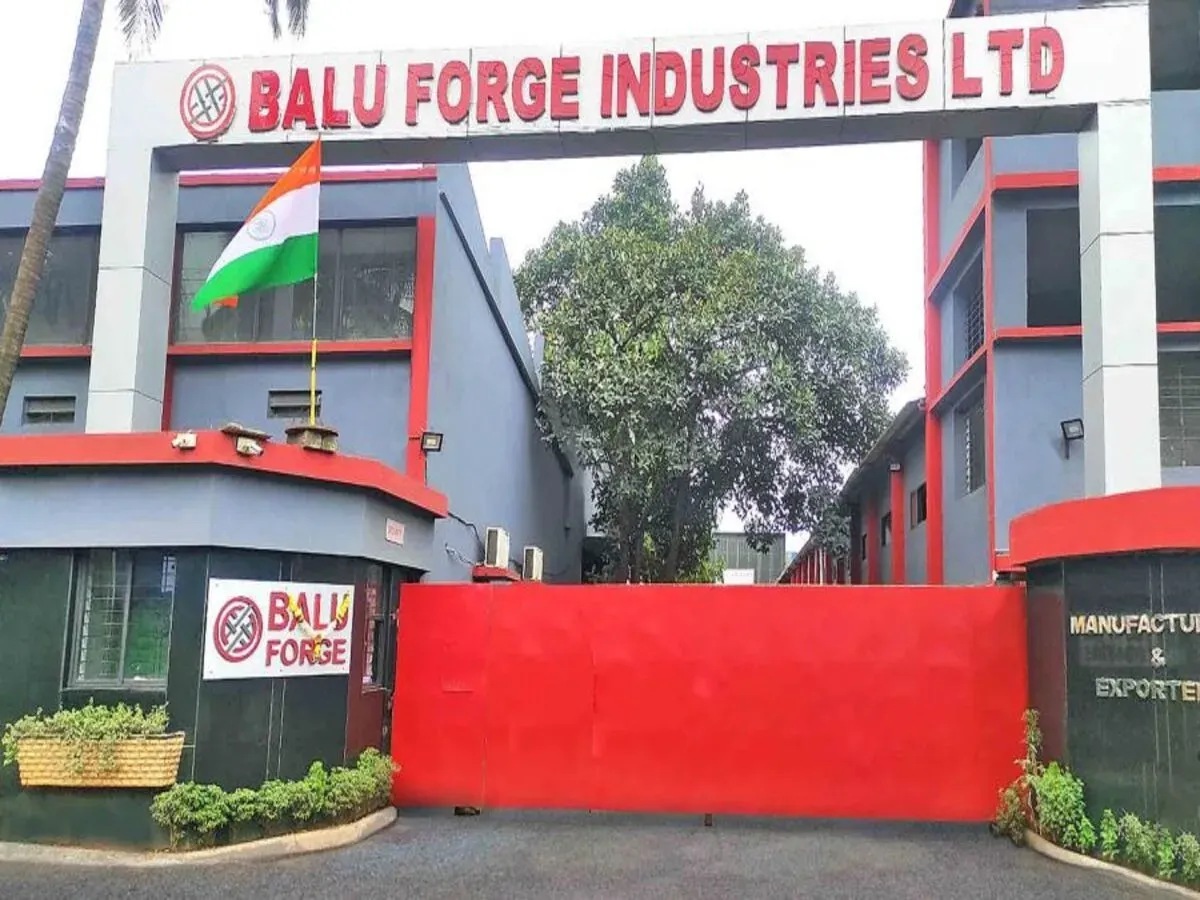
Balu Forge started in 1989 as a three-person shop making crankshafts in Karnataka. By the late 1990s it was exporting. Thirty-seven years later, it operates four facilities (three in India, one in the UAE) serving 25 OEM customers across 80 countries.
The company listed via reverse merger in August 2020 on a platform of steady cashflow and modest debt. The business model was simple: buy old equipment from bankruptcies and closed plants (Poland’s Ursus in 2006, France’s Thyssenkrupp in 2010, Germany’s Mercedes truck unit in 2022), refurbish it, and deploy it to make crankshafts, rail wheels, and hydraulic motors for anyone who paid.
FY26 marked a deliberate pivot. The company poured capital into a 46-acre greenfield campus at Belgaum—now housing a 25-ton hydraulic hammer (India’s largest), a fully automated ammunition line (360,000 shells per year capacity), and 7-axis and 11-axis CNC machining. Capex ran ₹354 crore; the machine-heavy shift has only just begun.
3. Business Model: WTF Do They Even Do?
Balu forges, machines, and assembles precision metal parts for vehicles, railways, defence, and energy sectors. The product list reads like an engineering catalogue: crankshafts, under-carriage links, brake hubs, railway axle sets, hydraulic motors, lifting hooks. All are commodity-adjacent and margin-thin in their base form.
The company’s early play was the automotive supply chain—crankshafts for commercial vehicles and agricultural tractors, sold on ex-works terms. Customers arrange transport; Balu avoids freight cost drag. Gross margins hover around 26–28% because the work is high-volume, low-touch, and fiercely priced.
The new play is defence and precision segments. Empty artillery shells (155mm, 152mm) attract 30–40% gross margins because qualification is a moat, geopolitical tension sustains orders, and competition remains thin. Aerospace components sit higher still. The company already holds approvals for 180+ defence items.
The revenue mix in FY26 was agriculture 36%, commercial vehicles 20%, heavy engineering 16%, defence 13%, power 10%, oil & gas 5%. By order book, defence spiked to 50%.
This is a margin migration strategy dressed as a diversification story. The company is chasing higher-revenue-per-ton through technical depth, not volume growth alone.
4. Financials Overview
Figures are consolidated, in ₹ crore.
Metric
Q4 FY26
YoY
FY26
YoY
Revenue
264
-2.3%
1,107
+19.9%
EBITDA
60
-20%
299
+19.3%
PAT
66
+4.9%
259
+27.0%
EPS (full year)
0.64
+10.6%
2.13
+24.2%
Q4 was soft—revenue slipped 2.3% YoY to ₹264 crore due to Middle East geopolitical disruption affecting the UAE unit. EBITDA fell 20% to ₹60 crore (22.7% margin). But the full-year story dominated: revenue up ₹184 crore, net profit up ₹55 crore.
The ammunition MOU (signed Feb 2026, disclosed May) supplied no FY26 revenue but changes the forward narrative. The company will supply large-calibre rounds—₹315 per unit, 5-year term, scalable beyond 100,000 annual units. At announced volumes, this alone could add ₹45–50 crore annual revenue by FY27–28.
5. Market Expectations & Historical Multiples
This section describes how the market is currently pricing the company and how that compares with its own history and peer group. It is descriptive, not predictive.
Metric
Current
5-Year Average
Peer Median (20 cos)
P/E
21.0
31.6
26.1
EV/EBITDA
16.6
—
—
ROE
19.6%
22.3%
13.1%
ROCE
22.7%
—
15.7%
The market currently pays 21x earnings against a 5-year average of 31.6x and a peer median of 26.1x. The multiple has compressed—the stock traded as high as ₹722 in the past 52 weeks