01 — At a Glance
₹657 Crore Quarterly Revenue. Consistent Profit. Zero Drama.
- 52-Week High / Low₹238 / ₹157
- Q3 FY26 Revenue₹657 Cr
- Q3 FY26 PAT₹65.7 Cr
- TTM EPS₹15.62
- Annualised EPS (Q3 Avg × 4)₹15.56
- Book Value / Share₹114
- Price to Book1.43x
- Debt to Equity0.12x
- Interest Coverage10.4x
- Operating Margin12.8%
Flash Summary: Balmer Lawrie delivered Q3 FY26 PAT of ₹65.7 crore, up 3.30% QoQ. The stock is at ₹162, yielding 5.24% in dividends. At 10.4x P/E (vs. industry median of 23.2x), this PSU is trading at a 55% discount to peers. With near-zero debt (D/E: 0.12x), a fortress balance sheet, and revenues from seven diversified business units — this is what “boring but beautiful” looks like. The stock is down 6.96% over 3 months, yet somehow has returned 13% over 3 years. Welcome to the PSU dividend factory.
02 — Introduction
The 158-Year-Old Conglomerate That Does Everything Except Excite Anyone
Imagine a company founded in 1867 — when India had just suffered a famine, the British were still figuring out how to run the subcontinent properly, and nobody had heard of dividends. Fast forward 158 years. Balmer Lawrie still exists, still makes money, and still pays you to own its shares. That is either the most boring success story in Indian markets, or the most underrated one. Probably both.
Balmer Lawrie & Company Ltd is a Central PSU under the Ministry of Petroleum & Natural Gas. It’s not a single-play business. It makes steel barrels, greases, lubricants, leather chemicals, runs logistics operations, manages cold chains, books airline tickets, and processes oily sludge from refineries. Yes, you read that correctly. If it doesn’t fit into one business, Balmer Lawrie probably has a division for it.
The portfolio is genuinely diversified. Industrial Packaging (40% of revenue), Greases & Lubricants (21%), Logistics Services (22%), Travel & Vacation (3%), and emerging segments like Cold Chain Services and Refinery & Oilfield Services. The government owns 61.80% through Balmer Lawrie Investments Limited. The balance sheet has been fortress-like since 2020. And the dividend yield? 5.24%. In today’s world of zero-interest returns, that’s more intoxicating than a whiskey neat.
CARE Rating (Dec 2025): CARE AA+; Stable / CARE A1+ — reaffirmed. CARE explicitly notes “robust capital structure, healthy debt coverage indicators, and strong liquidity position.” Translation: this company is not going bankrupt. Ever. The real question is whether it’s going to grow or just exist forever with a dividend cheque.
03 — Business Model: A 158-Year-Old Octopus
Seven Different Businesses, One Balance Sheet, Zero Strategy Clarity
Balmer Lawrie’s beauty (or curse) is its sheer diversification. Let’s unpack the creature:
Industrial Packaging (40% revenue): Manufactures steel drums and containers catering to diverse industries. They own 6 manufacturing plants across India. They’re the #34 market leader in the 210L MS drums category. Which is great, until you realize that “market leader” in a commodity business means “we sell a lot at thin margins.”
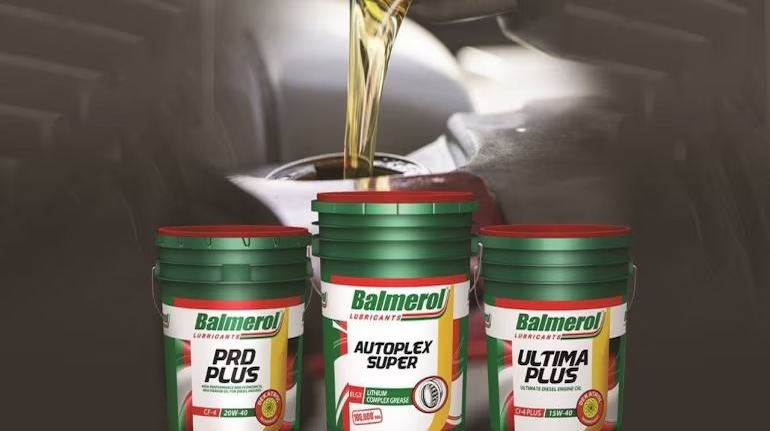
Greases & Lubricants (21%): Makes motor oils and industrial greases under the brand “BALMEROL.” Three manufacturing plants, pan-India operations, and a business that’s increasingly commoditized. Base oil prices are volatile. Competition is fierce. Their market share is lower than competitors’. This is the definition of “not great, not terrible.”
Logistics Infrastructure (9%): Container Freight Stations, warehousing, and Integrated Check Posts. This segment is under pressure because of the Direct Port Delivery (DPD) disruption. Volumes are down. They’re pivoting to warehousing. It’s a classic “legacy business trying to reinvent” story.
Logistics Services (22%): Freight forwarding, project logistics, and 3PL solutions. They’ve retained major PSU and CPSU customers. Growing slowly. Not exciting.
Travel & Vacation (3%): Air ticketing and related services. Had a massive pandemic-hit. Is recovering. Faces intense competition from OTAs. Contributes 83% from government entities, so it’s basically booking flights for civil servants and defence personnel.
Cold Chain Services & Refinery Services: Newer divisions. Tiny contributions. Could be meaningful in 5 years. Could be closed in 2 years. The company is literally exploring every corner of the diversification universe.
Industrial Packaging40%of revenue
G&L21%of revenue
Logistics Services22%of revenue
Other SBUs17%combined
The magic potion here is government relationships. 30% of revenue comes from government departments and PSUs. Travel division gets 83% from government. Logistics Services gets 66% from government. This is actually a strength — governments pay their bills, eventually. The risk is that government entities can be slow, deliberate, and sometimes redirect you to “priority sectors” where margins don’t exist.
04 — Financials Overview
Q3 FY26: Steady As She Goes. Boring as Toast.
Result type: Quarterly Results | Q3 FY26 EPS: ₹3.89 | Avg Q1–Q3 EPS: (₹4.03+₹3.31+₹3.89)/3 = ₹3.74 | Annualised EPS: ₹14.96
| Metric (₹ Cr) |
Q3 FY26
Dec 2025 |
Q3 FY25
Dec 2024 |
Q2 FY26
Sep 2025 |
YoY % |
QoQ % |
| Revenue | 657 | 630 | 635 | +4.28% | +3.47% |
| Operating Profit | 86 | 84 | 67 | +2.38% | +28.36% |
| OPM % | 13% | 13% | 11% | flat | +200 bps |
| PAT | 65.7 | 63.6 | 55.0 | +3.30% | +19.45% |
| EPS (₹) | 3.89 | 3.77 | 3.31 | +3.18% | +17.52% |
What We’re Seeing Here: Revenue up 4.28% YoY (that’s basically inflation + 1.28% volume growth). Operating profit up 2.38%. PAT up 3.30%. This is the financial equivalent of watching paint dry while someone describes it to you on a video call. The margins are stable at 13% OPM. The PAT increased, mainly because of lower tax rate (28% in Q3 vs 29-35% historically). This is what consistency looks like — boring, predictable, and exactly what a dividend investor wants.
But Wait, Here’s The Twist: Profit growth is 1.00% over 5 years (TTM). Sales growth is 3.91% (TTM). And the company is actively investing in new ventures like Cold Chain Services. Meanwhile, established segments like Logistics Infrastructure are under pressure from DPD. It’s a company managing decline in some areas while tentatively exploring growth in others. Not exactly thrilling.
💬 At 10.4x P/E with a 5.24% dividend yield and a fortress balance sheet, why hasn’t Balmer Lawrie re-rated to at least 15x like diversified peers? Is it the PSU stigma, low profit growth, or just bad investor relations? Share your theories.
05 — Valuation Discussion
Is It Cheap or Just Unloved?
Method 1: P/E Based
TTM EPS = ₹15.62. Industry median P/E = 23.2x (but that includes high-growth outliers like 3M at 111x). For a diversified PSU with 14% ROE and low growth, a 12x–15x P/E is reasonable. Current P/E: 10.4x.
→ 12x × ₹15.62 = ₹187.4 15x × ₹15.62 = ₹234.3
Range: ₹187 – ₹234
Method 2: Price to Book Value
Book Value = ₹114. Current P/BV = 1.43x. For a diversified company with 14% ROE, ROCE of 14.8%, and stable cash generation, a 1.4x–1.8x P/BV is justified.
→ 1.4x × ₹114 = ₹159.6 1.8x × ₹114 = ₹205.2
Range: ₹160 – ₹205
Method 3: Dividend Discount Model (Simple)
Annual dividend (TTM-based): approximately ₹8.6 per share. Dividend yield expectation: 4.5%–5.5%. This implies fair value of ₹156–₹191. Conservative assumption since dividend payout is 55% and may not grow aggressively.
→ ₹8.6 / 0.045 = ₹191 ₹8.6 / 0.055 = ₹156
Range: ₹156 – ₹191
Consolidated View: Across all three methods, the fair value converges around ₹156–₹234, with the bulk of reasonableness in the ₹170–₹205 range. The current price of ₹162 is actually at the lower bound — suggesting the market is pricing in either: (a) structural slow growth, (b) PSU execution risk, or (c) legitimate investor indifference. At 10.4x P/E with 5.24% dividend yield, this is objectively cheap on most valuation metrics. But valuations are cheap for a reason, usually because growth is low.
⚠️ EduInvesting Fair Value Range: ₹170 – ₹220. This fair value range is for educational purposes only and is not investment advice. Please consult a SEBI-registered investment advisor before making any financial decision.
06 — What’s Cooking: News, Triggers & Drama
Board Fines, Leadership Changes, And The Refinery Unit Exit