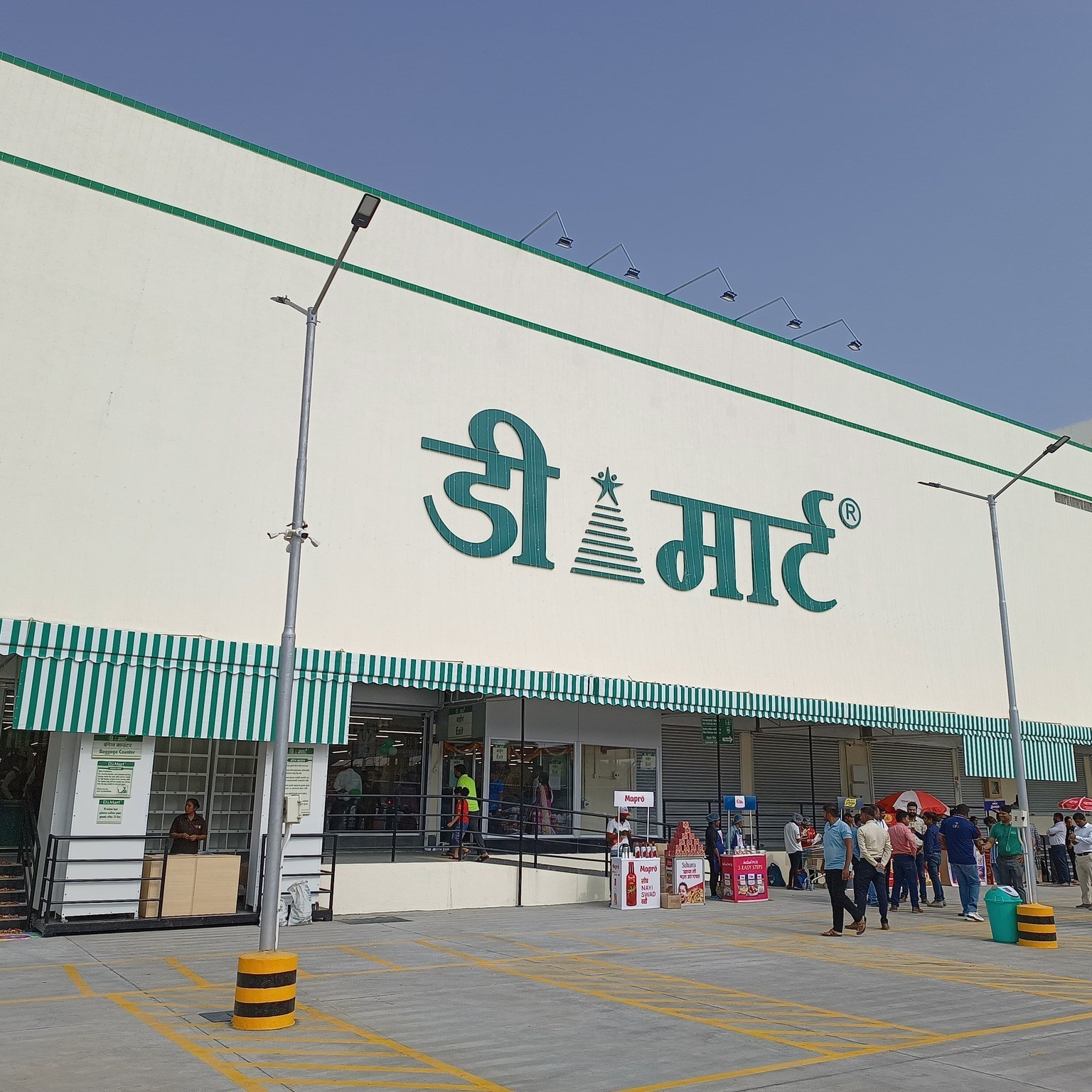
Avenue Supermarts (DMart):
₹18,101 Cr Quarterly Revenue. P/E 88x.
Retail King Prices Like It Owns The Kingdom.
442 stores. 15% YoY volume growth. ₹856 crore quarterly PAT. Stock valued at 11x book. The most expensive groceries chain in India—and somehow still everyone shops there.
The Grocery Store That Became a Stock Market Unicorn
- 52-Week High / Low₹4,950 / ₹3,529
- TTM Revenue₹66,009 Cr
- TTM PAT₹2,865 Cr
- TTM EPS₹44.03
- Current EPS (Q3 ×4)₹52.60
- Book Value₹352
- Price to Book11.0x
- Stores (Live)442
- Debt / Equity0.07x
- Retail Area (Mn Sqft)18.3
Radhakishan Damani’s Billion-Dollar Grocery Bet That Actually Worked
Let me paint a scene. It’s 2002. A man named Radhakishan Damani opens his first supermarket in Mumbai. The concept: sell essential goods (rice, flour, oil, toothpaste) at prices lower than what kirana shops charge, but with the reliability and consistency of a proper retail operation. No haggling. No shortcuts. Just everyday low prices.
Twenty-three years later, Avenue Supermarts Limited—trading as DMart—operates 442 stores across 18.3 million square feet of retail space. Market cap: ₹2.52 lakh crore. Stock price: ₹3,876 per share. Your neighbourhood kirana aunty is now worth more, on paper, than entire multinational corporations.
But here’s the twist: the stock is priced like it’s guaranteed to double every five years. DMart’s P/E of 88x is not a typo. The company pays zero dividends. Returns 0%. Earnings growth is decelerating into single digits. Yet the stock remains one of the most-owned names in India—in MF portfolios, in Boomer WhatsApp groups, in those “safe bets for 10 years” conversations at dinner tables.
Q3 FY26 delivered the highest quarterly revenue in the company’s history. All 442 stores are humming. The expansion playbook is dialled in. Margins are defended. But the valuation conversation has moved beyond logic into pure belief. We’re here to break down the belief, examine the numbers, and ask the awkward questions everyone else is afraid to ask about India’s most beloved grocery chain.
Buy Low, Sell Lower. Repeat. Become A Gazillion-Crore Unicorn.
DMart’s business model is so boring it puts sleep-deprived accountants to sleep. You walk into a 40,000 sq ft store. You see foods (57% of revenue), FMCG non-foods (20%), and general merchandise (23%). You buy your rice, your shampoo, your socks. You pay, you leave. No experience. No frills. No Instagram moments. Just value.
The magic is in the unit economics. Gross margins hover around 15%—deliberately low—because DMart’s entire flywheel is built on volume. Buy in bulk from manufacturers. Skip intermediaries. Operate stores you own (not lease). Run logistics through 75 distribution centres. Turn inventory every 10 days. Collect cash instantly. Pay suppliers 80 days later. Basically, you’re operating a massive interest-free loan from your suppliers every single day.
Like-for-like growth (stores open >24 months) sits at 10.3% in Q3. Meaning: same stores are growing double digits organically, without any new-store cannibalization. That’s the definition of a brand that’s completely anchored in customer behavior. Open 40-50 stores a year, all cluster-based in existing geographies. Let the locations compound. Watch your per-sq-ft productivity increase. Repeat until you’re the largest food retailer in India by footfall.
E-commerce play (DMart Ready) exists in 25 cities, still loss-making, still being funded. Management’s candid approach: it’s a strategic hedge against future competition. Quick commerce (Blinkit, Zepto) eats their lunch in some metros. But rural India has no such alternatives yet. That’s where the real TAM is.
Q3 FY26: The Numbers Don’t Lie. But They’re Expensive.
Result type: Quarterly Results | Q3 FY26 EPS: ₹13.15 | Annualised EPS (Q3×4): ₹52.60 | TTM EPS: ₹44.03
Source table
| Metric (₹ Cr) | Q3 FY26 Dec 2025 |
Q3 FY25 Dec 2024 |
Q2 FY26 Sep 2025 |
YoY % | QoQ % |
|---|---|---|---|---|---|
| Revenue | 18,101 | 15,973 | 16,676 | +13.3% | +8.5% |
| Operating Profit | 1,463 | 1,217 | 1,214 | +20.2% | +20.5% |
| OPM % | 8.1% | 7.6% | 7.3% | +50 bps | +80 bps |
| PAT | 856 | 724 | 685 | +18.3% | +24.9% |
| EPS (₹) | 13.15 | 11.12 | 10.53 | +18.3% | +24.9% |
Fair Value Range: Can The King Afford Its Own Crown?
Method 1: P/E Based
TTM EPS ₹44.03. Retail sector median P/E: 36x. DMart’s justified premium for brand moat + LFL growth (10.3%): 1.8x–2.2x sector median (accounting for limited growth acceleration).
Range: ₹2,800 – ₹3,500
Method 2: EV/EBITDA Based
FY25 EBITDA: ₹4,543 Cr. Current EV: ₹2,51,820 Cr. EV/EBITDA: 55.4x. Organized retail globally trades at 12x–16x EBITDA. Indian high-growth retail typically 20x–28x. DMart at 55x is… heroic.
Fair EV/EBITDA (25x–32x): ₹1,13,575 Cr – ₹1,45,376 Cr → Per share:
Range: ₹2,150 – ₹2,750
Method 3: DCF Based
Base FCF (FY25): ₹2,463 Cr. Growth assumption: 11% years 1–3, 8% years 4–5 (decelerating from current ~15% sales growth). Terminal growth: 4%. WACC: 10%.
→ Terminal Value (4% growth / 6% cap rate): ~₹62,500 Cr
→ Total EV: ~₹82,300 Cr (minimal net debt at ₹-400 Cr cash)
Range: ₹1,850 – ₹2,500
CEO Change, Expansion Acceleration, And The Question Nobody Asks
🟠 Leadership Transition In Swing
Long-time MD Ignatius Navil Noronha steps down Jan 31, 2026 after leading the company through hypergrowth. Anshul Asawa takes over as CEO Feb 1, becoming MD from April 1. Both are internal promotions—Asawa was VP. Disruption risk: low. Continuity risk: also low. But new leadership always brings scrutiny around capex discipline and expansion pacing. Watch the FY27 store count guidance carefully.
✅ Expansion Continues
- • 442 stores as of March 6, 2026 (latest store: Ullal, Dakshina Kannada)
- • Added 25 stores in 9M FY26
- • Cluster-based approach in South India showing best ROI
- • DMart Ready expanded to 25 cities (still loss-making)
- • Management guidance: 40-50 stores/year baseline
⚠️ GST Demands & Compliance Risk
- • Sep 2024: Company + subsidiary received ₹80.56 Cr GST demand
- • Oct 2024: Subsidiary received additional ₹68.78 Cr GST demand
- • Total contingent liabilities now material
- • Typical outcome: 50% reversal after appeals, 50% settled
- • Still, it’s drag on quarterly profitability if accrued
The Fort Stands Unshaken. Possibly Too Unshaken.
Source table
| Item (₹ Cr) | FY23 | FY24 | FY25 | Sep 2025 |
|---|---|---|---|---|
| Total Assets | 18,105 | 21,172 | 24,313 | 26,914 |
| Net Worth (Eq + Reserves) | 16,078 | 18,698 | 21,428 | 22,889 |
| Borrowings | 643 | 592 | 820 | 1,609 |
| Other Liabilities | 1,383 | 1,882 | 2,065 | 2,415 |
| Total Liabilities | 18,105 | 21,172 | 24,313 | 26,914 |
Borrowings ₹1,609 Cr include lease liabilities ₹1,344 Cr. True debt is only ₹265 Cr. The company runs on internally generated cash. No external leverage. This is a fortress balance sheet.
Fixed Assets grew from ₹11,340 Cr (Mar 2023) to ₹17,652 Cr (Sep 2025). That’s stores, warehouses, equipment. CWIP (capital work in progress) at ₹1,525 Cr indicates heavy pipeline.
Net worth ₹22,889 Cr ÷ market cap ₹2,52,211 Cr = Price-to-Book of 11x. This is extreme for a retail chain. For reference: TCS P/B is 5.5x, Reliance is 1.8x.
Operating Cash is Strong. Capex is Brutal. Growth Is Self-Funded.
Source table
| Cash Flow (₹ Cr) | FY23 | FY24 | FY25 |
|---|---|---|---|
| Operating CF | +2,630 | +2,746 | +2,463 |
| Investing CF | -2,313 | -2,468 | -2,185 |
| Financing CF | -205 | -148 | -259 |
| Net Cash Flow | +112 | +130 | +18 |
Profitability Is Decent. Returns Are Overstated. Valuation Is Fantasy.
Annual Trends — FY22 to FY25 (TTM)
Source table
| Metric (₹ Cr) | FY22 | FY23 | FY24 | FY25 (TTM) |
|---|---|---|---|---|
| Revenue | 30,976 | 42,840 | 50,789 | 66,009 |
| Operating Profit | 2,502 | 3,639 | 4,106 | 4,931 |
| OPM % | 8.1% | 8.5% | 8.1% | 7.5% |
| PAT | 1,492 | 2,378 | 2,536 | 2,865 |
| EPS (₹) | 23.04 | 36.69 | 38.97 | 44.03 |
Here’s the problem: Revenue is growing at 24% CAGR. Profit is growing at 22% CAGR. But margins are compressing. OPM fell from 8.5% (FY23) to 7.5% (TTM). This is textbook deceleration—revenue growth is outpacing profit growth, which means each new rupee of revenue is less profitable than the last. At grocery-level margins (7-8%), tiny compression erodes stock returns.
DMart vs The Scrappy Challengers (Who Stand No Chance)
Source table
| Company | TTM Revenue | TTM PAT | P/E | ROCE % | MCap/Revenue |
|---|---|---|---|---|---|
| Avenue Supermarts | ₹66,009 Cr | ₹2,865 Cr | 88.0x | 18.0% | 3.82x |
| Vishal Mega Mart | ₹12,340 Cr | ₹786 Cr | 66.5x | 13.1% | 4.23x |
| V-Mart Retail | ₹3,599 Cr | ₹119 Cr | 34.6x | 8.5% | 1.14x |
| Shoppers Stop | ₹4,898 Cr | -₹5 Cr | N/A | 7.96% | 0.70x |
| Spencer’s Retail | ₹1,776 Cr | -₹252 Cr | N/A | -9.72% | 0.16x |
DMart trades at 1.3x Vishal Mega Mart’s P/E despite superior ROCE (18% vs 13%). Shoppers Stop and Spencer’s are essentially dead. Retail in India is a two-horse race, and the second horse is running but far behind.
Radhakishan Damani: The Quiet Billionaire Who Built a Supermarket Empire
- Promoters (Damani Family)74.65%
- Public7.75%
- DIIs8.83%
- FIIs8.71%
Pledge: 0.00%. Shareholders: 5.99 lakh. Promoter is deeply long—no dilution, no secondary sales. The entire upside is internally reinvested.
Radhakishan Damani: The Visionary
Born into a textile trading family in Kutch, Damani visualized the concept of “Everyday Low Cost” in Indian retail way before Walmart or Amazon arrived. Founded DMart in 2002 with the first store in Mumbai. Family wealth estimated at ₹150,000+ crores. Zero media, zero PR. Classic Indian entrepreneur profile.
Bright Star Investments & Co
Multiple Damani family entities hold stock. Radhakishan directly: 23.03%. Bright Star Investments: 13.64% (Gopikishan). Various family trusts and entities: rest of 74.65%. The promotional structure is complex but clean—all insiders, zero external pressure.
The Board Is Competent. The Disclosure Is Minimal. The Dividend Is Nonexistent.
✅ The Strengths
- ✓ Clean audit history—no material qualifications since IPO
- ✓ Auditor: Deloitte (Big 4)—no revolving-door concerns
- ✓ Board composition: Mix of independent directors and insiders
- ✓ Quarterly concalls with detailed operational metrics
- ✓ All statutory disclosures filed on time
- ✓ Zero promoter pledge on collateral
- ✓ Zero leverage (debt of ₹1,609 Cr is mostly leases)
⚠️ The Concerns
- ⚠ Zero dividend payout despite ₹2,865 Cr annual PAT
- ⚠ All capex is self-funded with zero external pressure
- ⚠ Promoter decisions are board decisions—minimal accountability
- ⚠ GST demands of ₹150 Cr+ in past 18 months
- ⚠ E-commerce losses continue unabated
- ⚠ Expansion guidance is vague (“40-50 stores/year”)
India’s Food Retail Battlefield: Where Organized Retail Fights The Kirana Godfather
India’s organized food & grocery retail market is estimated at ~₹2.5–3 lakh crores annually (TTM). DMart’s ₹66,009 crore suggests ~2-3% market share—despite being the largest player. The reason: 95% of Indian food retail is still unorganized (kirana shops). These shops aren’t dying. They’re thriving. They have relationships. They give credit. They know you by name. DMart offers value but no relationship.
🏪 The Kirana Threat: Underestimated and Overblown
DMart has cannibalized some kirana footfall, but kirana isn’t going anywhere. Why? Relationship economics. A kirana gives credit for a month. DMart demands cash. A kirana delivers to your door. DMart requires you to drive. A kirana is an institution in the neighbourhood—your teenager’s tuition might be paid by a kirana loan. DMart is a transaction. The two will coexist indefinitely. DMart’s TAM is fixed by the size of urban India who shops organized retail—perhaps 100-150 crore rupees of addressable market, not more.
⚡ Quick Commerce: The Real Threat DMart Can’t Ignore
Blinkit, Zepto, and Big Basket deliver groceries in 10–30 minutes. Millennials are adopting this at scale. DMart’s response: DMart Ready—launched in 25 cities, still loss-making. The unit economics of quick commerce are terrible (delivery costs exceed gross profit on small baskets). But consumer behaviour is shifting. DMart Ready is a hedge. Strategic necessity. But it also bleeds cash and distracts management from the core business.
💰 The Margin Pressure Vortex
Food inflation in India is real. Raw material costs are up. Labour costs are up. Rental costs for new stores are up. DMart’s response: hold the line on gross margins (15%) by negotiating harder with suppliers and improving logistics. But there’s a limit to how much you can squeeze. OPM compression from 8.5% to 7.5% in two years tells the story. Next frontier: aggressive cost cutting. But cost cutting has limits in a labour-intensive business.
🌐 The Expansion Math Is Getting Harder
DMart’s first 300 stores took 18 years. The next 142 stores took 5 years. Each new store in a new geography takes longer to breakeven—geographic expansion dilutes returns. At ₹50–60 crore per store capex, and payback periods stretching to 4–5 years in new cities, expansion ROI is declining. Management claims 40-50 stores/year, but actual guidance is ambiguous. Watch FY27 plan closely—it’ll reveal whether growth deceleration is beginning.
Competitive dynamics summary: DMart is a monopoly in organized F&G retail, but that “organized” segment is only 5–10% of total F&G consumption in India. Kirana owns 90%+. Vishal Mega Mart is growing, but from a base 1/5th the size. Quick commerce is a structural threat that DMart can’t ignore and can’t own (the unit economics are incompatible with their margin model).
Macro outlook: India’s real wage growth, rural electrification, and highway connectivity will slowly push more of the unorganized retail base into organized channels. DMart’s market can grow 8–10% annually in the long run. But the stock is priced for 15–20% growth. That’s the gap.
The Valuation Reckoning
DMart is an exceptional business trading at an exceptional price. 23 years without a loss. 442 stores. 18.3 million sq ft. 74.6% promoter ownership. Zero debt. ₹2,865 crore annual profit. But a business that compounds at 15% annually is not worth 88x earnings. The math doesn’t work. The stock has already priced in a century of perfect execution.
The Case for DMart (At Current Price): If you believe Indian organized retail will grow 15% annually for 10+ years, and DMart maintains 2–3% market share while expanding to 1,000 stores, the stock could double or triple. Radhakishan Damani certainly believes this—he owns 74%. But “could” is different from “will.” The stock has already priced in this scenario. There’s no margin of safety.
The Case Against (At Current Price): Food retail in India will grow 8–10% long-term (in line with GDP). DMart’s expansion is hitting geographic limits and ROI decay. Margins are compressing. Quick commerce will take 5–10% of the addressable market. The P/E of 88x assumes near-perfect execution indefinitely. If growth slows to 12%, or margins compress by 50 bps, the stock could correct 30–40%. There’s significant downside if growth disappoints.
Historical Context: DMart stock returned ~8% CAGR over 10 years (from IPO), with a 52-week return of -17.8% and a 3-month return of -1.93%. Yes, the underlying business is compounding. But the stock price had a difficult year. Retail rotation is happening. Growth stories are being repriced. Value is making a comeback.
✓ Strengths
- Market leader with 51% share in organized food retail
- Unmatched store density and distribution reach (442 stores)
- Like-for-like growth at 10.3%—organic demand is strong
- Zero debt, fortress balance sheet, self-funded growth
- Exceptional working capital management (negative CCC)
- Cluster-based expansion strategy reduces CAC and risk
✗ Weaknesses
- OPM compressing (8.5% → 7.5% in 2 years)
- Grocery retail is structurally low-margin (7–8% OPM ceiling)
- ROCE of 18% is barely above WACC of 10%
- Zero dividend despite ₹2,865 Cr annual profit
- DMart Ready losses are material and ongoing
- Expansion ROI is declining as stores saturate clusters
→ Opportunities
- Expansion from 442 to 1,000 stores over 10 years
- Market share gains from unorganized retail (5–10% currently)
- Rural penetration still underdeveloped (40k+ outlets planned)
- Operational efficiency through automation and AI
- Private label expansion (higher margins)
- Adjacent categories (pharma, furniture) in pilot stage
⚡ Threats
- Quick commerce (Blinkit, Zepto) taking 5–10% of market
- Organized retail penetration is already 40%+ in top metros
- Margin pressure from inflation and labour costs
- Leadership transition (CEO change Jan 2026)
- GST demands and compliance risks (₹150 Cr+)
- Revaluation risk if growth decelerates or P/E compresses
Avenue Supermarts is a phenomenal business in a structurally limited market, priced like it’s guaranteed to become a ₹10 lakh crore company.
Radhakishan Damani built the Indian version of Walmart—a retail empire based on operational excellence, supply chain optimization, and customer obsession. For that, he deserves every ounce of credit. The stock, however, is priced for another 20 years of 15%+ CAGR. Food retail compounds at 8–10% in mature markets. The addressable market for organized retail in India is perhaps 10–15% of total F&G consumption, not 90%. DMart will likely dominate that 10–15%. But dominating a limited market at a P/E of 88 is a recipe for disappointment.