Search for Stocks /

Auro Laboratories FY26: Revenue Nearly Doubled Off a Wrecked Base, and the Multiple Sits at 45x

Spotted a factual error — a wrong number, date, or fact? Tell us and we will check the source.

General information and entertainment, not investment advice. The author is not a SEBI-registered adviser or research analyst. No recommendation, no promised returns. Markets carry risk including loss of capital. Figures may not be current. Consult a registered adviser before acting.

1 — At a Glance

Auro Laboratories closed FY26 with sales of ₹30.74 crore, up 58% from the ₹19.40 crore it managed in FY25. That is a genuine rebound — and also a reminder that FY25 was the year the factory was largely switched off. Two years earlier, in FY24, this same company did ₹53.64 crore. So the “growth” story and the “what happened” story are the same story.

Net profit for the year was ₹3.53 crore, against ₹1.84 crore the year before. The market values the whole enterprise at ₹158 crore and pays roughly 45x earnings for it, while ROCE sits at 9.42% and ROE at 8.15% — single-digit returns wearing a mid-forties multiple.

Underneath, borrowings climbed to ₹63.30 crore from ₹42.72 crore, inventory more than tripled to ₹13.54 crore, and finance costs quadrupled to ₹4.25 crore. A small API maker in the middle of a large-for-its-size expansion, in other words, with the balance sheet doing most of the talking.

The question the rest of this entry circles: what does a 45x multiple see in a business whose five-year sales record compounds at −11%?

2 — Introduction

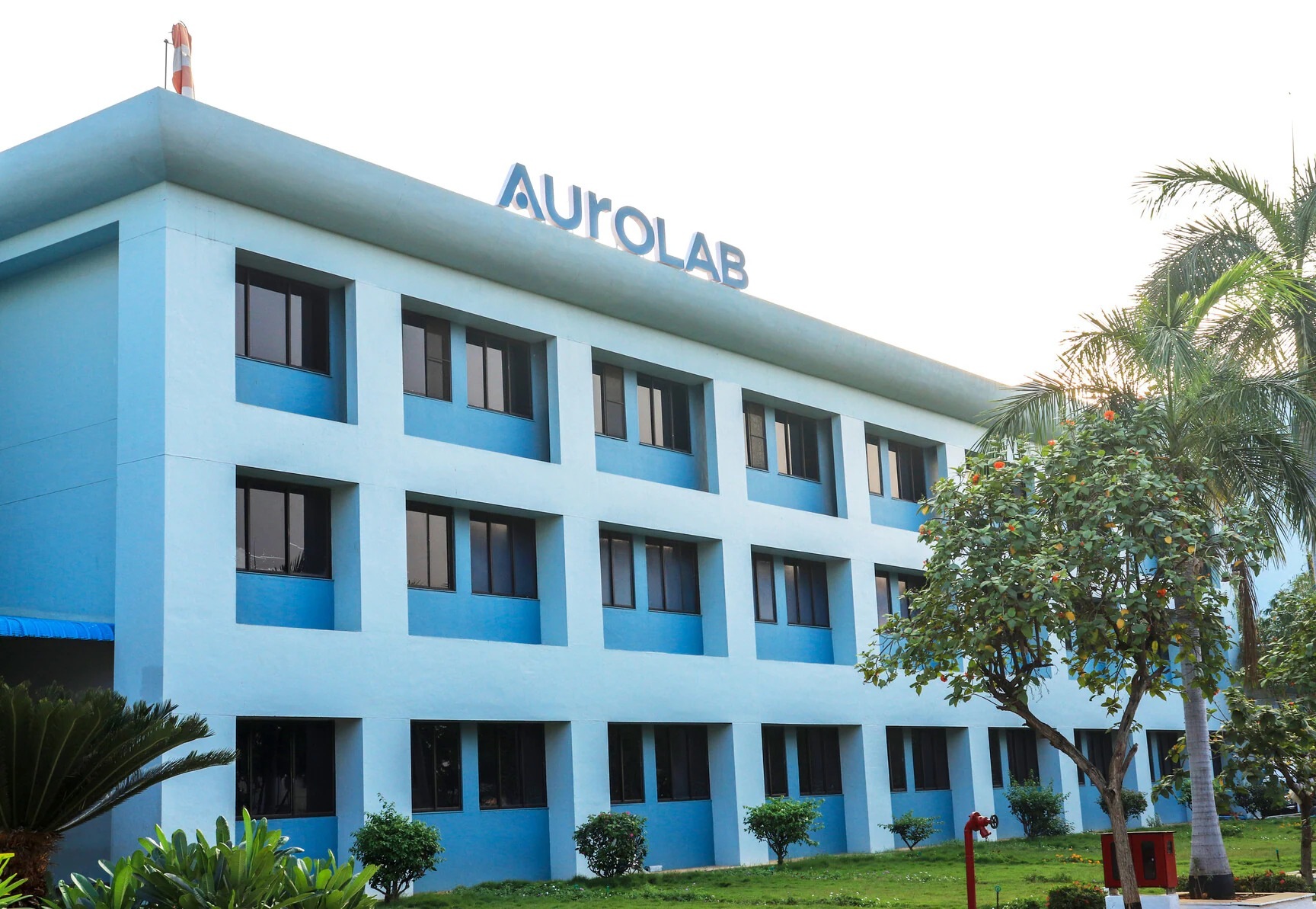
Auro Laboratories was incorporated in 1989 and makes generic Active Pharmaceutical Ingredients out of a single plant at Tarapur, Maharashtra. The flagship molecule is Metformin Hydrochloride, the first-line treatment for type 2 diabetes, alongside Chlorphenamine Maleate and Chlorzoxazone. Roughly 80% of revenue has historically come from Metformin, and the bulk of sales ships overseas — the credit assessment puts exports at about 85% of revenue, with Europe the main market.

The recent past has been dominated by one thing: a debt-funded brownfield expansion. The rating report notes a roughly nine-month disruption to operations while the new block was integrated, which is what turned FY25’s revenue into a crater. The new capacity was commissioned in August 2025, lifting installed capacity from 1,260 MT to 2,100 MT per year, and the company is separately building a forward-integration unit to make tablets from its own APIs.

Two more recent items sit on the record: a WHO GMP certificate for the Tarapur plant in November 2025, valid to September 2028, and — as ever with this company — a reshuffle in the finance function, covered later.

3 — Business Model: WTF Do They Even Do?

Auro buys chemical inputs, mostly from overseas vendors, and converts them into Metformin HCL powder that other companies turn into diabetes tablets. It is, functionally, a one-molecule export shop with two smaller molecules keeping it company on the product list.

This is a commodity API in a fragmented, ferociously competitive segment. The rating agency is blunt about the position: modest scale, limited pricing power against larger domestic and global players, and profitability that swings with raw-material prices and the rupee. Auro hedges some of the forex through natural hedging and forward contracts; the rest it simply lives with.

The concentration cuts both ways. Metformin is an essential medicine with year-round global demand, which is why a tiny Tarapur plant can ship to Europe at all. But one molecule doing ~80% of revenue means one molecule’s pricing cycle is roughly the whole business’s pricing cycle. There is no second leg to stand on when the first one wobbles — and in FY25, when the plant was down for its rebuild, there was no leg at all.

The forward-integration plan into tablets is the attempt to add that second leg: instead of selling powder to a formulator, sell the finished tablets, supported by a proposed arrangement with a European customer. The unit is designed for 750 million tablets a year. Whether that changes the economics or just adds a bigger loan is the open question the balance sheet keeps raising.

Does a WHO GMP stamp and a European tablet contract change what a single-molecule commodity shop fundamentally is — or just extend its reach?

4 — Financials Overview

Figures are standalone, in ₹ crore.

MetricLatest Q (Mar 2026)YoY (Mar 2025)QoQ (Dec 2025)
Revenue9.837.409.39
Operating Profit3.330.814.06
PAT0.970.391.95
EPS (₹)1.560.633.13

The March quarter did ₹9.83 crore, up 33% on the year-ago quarter and 5% on the prior one — the top line has clearly stabilised well above the FY25 low. Operating profit at ₹3.33 crore is nearly four times the year-ago figure.

Below that line, the story flips. Quarterly PAT of ₹0.97 crore is half the ₹1.95 crore booked in the December quarter, even though revenue was higher. Per the data sheet, the March quarter carried a 32.9% tax rate while the December quarter ran a tax credit, and finance costs sat at ₹1.49 crore against depreciation of ₹0.90 crore. The full-year results also flag an exceptional item of ₹14.42 lakh — an incremental gratuity provision arising from the new Labour Codes, per the filing. Operating strength, in short, met a heavier tax-and-interest bill on the way to the bottom line.

5 — Market Expectations & Historical Multiples

This section describes how the market is currently pricing the company and how that compares with its own history and peer group. It is descriptive, not predictive.

MetricCurrentHistorical AveragePeer Median
P/E~45x34.8x
EV/EBITDA18.3x
P/B3.42x
ROE8.15%9.86% (5-yr)
ROCE9.42%15.1%

The market currently pays roughly 45x earnings here, against a peer median of about 35x and an industry P/E of 34.8x. It pays 3.42 times book value on a company earning an 8.15% return on that equity — below the company’s own 9.86% five-year average ROE. Against the peer set, ROCE of 9.42% sits at roughly two-thirds of the 15.1% median.

What the multiple appears to be pricing in is the recovery, not the trailing record: FY26 sales rose 58% off the FY25 low, operating margin at the full-year level widened to 32.5%, and the ₹63 crore of borrowings has just been converted into commissioned capacity that only started contributing in August 2025. The market is paying for the plant that now runs, not the year it stood idle.

The factual observation to leave here: the pricing rests on a full year of expanded capacity performing, while the trailing five-year sales record compounds at −11%.

6 — What’s Cooking

The material events on the record, and only those:

The debt-funded expansion is the headline — the new block was commissioned in August 2025, and on the balance sheet CWIP fell from ₹56.48 crore to ₹14.48 crore while net block jumped from ₹21.06 crore to ₹75.19 crore. Capacity moved from 1,260 MT to 2,100 MT per year, per the rating report. A second capex, a forward-integration tablet unit sized at 750 million tablets a year, is underway.

In November 2025 the Tarapur plant received a WHO GMP certificate valid to September 2028. In April 2026 a fresh credit rating was assigned: long-term ACUITE BB+/Stable and short-term A4+ on ₹79.80 crore of bank facilities. And the AGM is scheduled for August 11, 2026, with the board having reappointed a Whole Time Director for a fresh three-year term.

7 — Balance Sheet

ItemMar 2024Mar 2025Mar 2026
Total Assets85.7399.09121.08
Net Worth41.9642.9746.35
Borrowings26.2542.7263.30
Other Liabilities17.5213.4011.43
Total Liabilities85.7399.09121.08

Assets equal liabilities in every column, as they should.

  • Borrowings have gone from ₹26.25 crore to ₹63.30 crore in two years — the debt has more than doubled while net worth crept up ₹4.4 crore.
  • Inventory closed FY26 at ₹13.54 crore against ₹3.67 crore a year earlier, roughly a 3.7x jump; the data sheet’s inventory-days figure sits at 815 for the year.
  • Cash and bank stood at ₹1.67 crore against ₹63.30 crore of borrowings — this is a business financed almost entirely on someone else’s balance sheet.

A balance sheet that triples its asset base in two years is either building the future or borrowing to survive the present; here the CWIP-to-net-block swing says it did the building.

8 — Cash Flow: Sab Number Game Hai

YearOperatingInvestingFinancing
FY2418.81-38.6719.09
FY255.75-24.4517.69
FY262.11-14.7814.04

The pattern is consistent across all three years: operating cash comes in modestly, investing cash pours out into the plant, and financing cash — borrowings — plugs the gap. Over FY24–FY26 the company invested roughly ₹78 crore and funded almost all of it by raising debt. Operating cash flow of ₹2.11 crore in FY26 covered barely a fraction of the ₹14.78 crore that went into investing.

When financing inflows exceed operating inflows three years running, the expansion isn’t self-funding — the lender is a partner, not a spectator.

9 — Ratios: Sexy or Stressy?

RatioValue
ROE8.15%
ROCE9.42%
P/E~45x
PAT Margin11.5%
D/E1.37

ROE at 8.15% means the equity is working part-time. ROCE at 9.42% barely clears what the company pays on its borrowings — interest coverage sits at 2.16, so the capital and the lenders are splitting the returns fairly evenly. PAT margin of 11.5% is the healthiest the bottom line has looked in a while, helped by the widened operating margin. Debt-to-equity of 1.37 is the number that frames all the others: this is a leveraged small-cap, and the ratios read like one.

10 — P&L Breakdown: Show Me the Money

YearRevenueOperating ProfitOther IncomePATEPS (₹)
FY2453.6410.681.507.7912.50
FY2519.403.400.661.842.95
FY2630.7410.001.873.535.66

The trajectory is a V with an asterisk. Revenue fell 64% in FY25 as the plant was rebuilt, then rebounded 58% in FY26 — still ₹23 crore short of the FY24 peak. Operating profit round-tripped from ₹10.68 crore to ₹3.40 crore and back to ₹10.00 crore, so FY26’s operating engine is roughly back to FY24 form on lower revenue, which is where the 32.5% operating margin comes from.

Worth watching in that last column: other income of ₹1.87 crore sits next to PAT of ₹3.53 crore — over half of net profit is non-operating. The real-business profit is the operating line, and it recovered; the headline PAT leans harder on other income than the operating strength alone would suggest.

11 — Peer Comparison

CompanySales Qtr (₹ Cr)PAT Qtr (₹ Cr)P/E
Sun Pharma14,611.792,709.6635.98
Divi’s Lab2,831.00751.0067.66
Torrent Pharma4,197.00364.0071.97
Cipla6,541.20542.5130.90
Auro Labs9.830.9743.52

The scale gap is the whole picture: Auro’s quarterly revenue of ₹9.83 crore is less than a rounding error against Sun Pharma’s ₹14,612 crore. Yet at ~45x, Auro carries a higher multiple than Sun, Cipla, and Dr Reddy’s, and sits above the 157-company median of 34.8x. It is a micro-cap trading at large-cap-innovator multiples while posting the peer group’s lowest ROCE, at 9.42% against a 15.1% median.

12 — Miscellaneous: Shareholding & Promoters

Holder%
Promoters52.17
Institutions (DII)0.01
Public47.82

The promoter block is the Deorah family plus Auro Impex Private Ltd (18.75%), with Sharat Deorah (18.71%) and Siddhartha Deorah (7.09%) the largest individuals; the holding has barely moved in three years. Sharat Deorah is Managing Director and Siddhartha a Whole Time Director. Institutional ownership is effectively zero at 0.01%, so nearly half the company sits with public shareholders — the shareholder count has drifted down from over 10,500 in mid-2023 to about 8,400 by March 2026.

13 — Corporate Governance: Angels or Devils?

The finance chair has been a revolving door. Amit Shah resigned as CFO effective October 2023; his replacement Shaan Jain resigned effective December 2024; Nitesh Bohra was appointed CFO in May 2026; and a separate filing records Kuntal Pancholi resigning as CFO effective May 28, 2026 — three-plus turns in the top finance seat inside three years, a fact the record states plainly.

Beyond that: the FY26 secretarial compliance report notes prior delays in appointing a Company Secretary/Compliance Officer and CFO, with a BSE fine partly pending, per the filing. The statutory auditors changed — the prior firm resigned in July 2023 and B.L. Dasharda & Associates now signs off, delivering an unmodified opinion on the FY26 results. An insider-trading violation by a relative was reported in April 2024. Pledged shares stand at zero. The audit opinion is clean; the compliance housekeeping around it has been visibly untidy.

14 — Industry Roast & Macro Context

The generic API business is a grinder. It is fragmented, price-competitive, and structurally unkind to anyone without scale — the rating agency spells out that a single-plant maker has limited bargaining power against larger domestic and global players. Inputs are often imported, so margins ride the twin waves of global commodity prices and the rupee, and a plant that stands still for a rebuild simply stops earning while its fixed costs keep clocking in.

Metformin itself is a low-margin, high-volume workhorse: essential, universally demanded, and precisely the kind of molecule where dozens of makers compete on cents. Export dependence adds a geopolitical layer — the rating report attributes softer-than-expected 9MFY2026 revenue partly to the situation in the Middle East. It is a sector where being small and single-product is the default difficulty setting, not a temporary one.

15 — EduInvesting Verdict

StrengthsWeaknesses
Operating margin recovered to 32.5%; capacity now commissionedROCE 9.42%, ROE 8.15% — single-digit returns
WHO GMP certified, ~85% export base, three-decade track recordD/E 1.37; borrowings doubled to ₹63.3 Cr in two years
OpportunitiesThreats
Forward integration into tablets; 2,100 MT capacity to fillSingle-molecule concentration; forex and raw-material swings
Utilisation ramp could lift revenue toward FY24 levelsInventory days at 815; finance costs quadrupled to ₹4.25 Cr

Auro Laboratories enters FY26 as a company that just rebuilt itself on borrowed money and is only now switching the new machinery on. The operating line has recovered, the plant is bigger, and the export franchise is intact — but the returns on all that capital are still single-digit, the debt has doubled, and the working-capital cycle has ballooned. A freshly expanded plant carrying a 45x multiple, and a nine-percent return on capital that has yet to prove it can fill it.