1. At a Glance – The Electric Underdog is Bites Back
If you thought the electric two-wheeler (E2W) race was just a two-horse race between legacy giants and aggressive newcomers, Ather Energy just crashed the party with a high-voltage entrance. The FY26 scorecard isn’t just a set of numbers; it’s a middle finger to the skeptics who thought premium performance couldn’t scale. We are looking at a company that grew its volumes by a staggering 69% YoY, putting 262,942 units on the road while simultaneously performing a surgical strike on its cost structure.
The headline act? EBITDA margins. In Q4 FY25, the company was bleeding with an EBITDA margin of -23.3%. Fast forward twelve months to Q4 FY26, and that loss has narrowed to a mere -2.5%. That is a 2,080 basis point improvement in a single year. While the “other guys” are busy fighting price wars in the sub-1 lakh “fluff” segment, Ather has hunkered down in the Mass Premium space, proving that people are willing to pay for a scooter that doesn’t feel like a plastic toy.
But here’s the kicker: they did this while the supply chain was throwing tantrums. Between rare-earth magnet bans from China and “bonkers” commodity inflation, Ather didn’t just survive; they thrived. They’ve crossed the 5 lakh cumulative units milestone, with the Rizta—their family-man-hero—already accounting for over 2 lakh units.
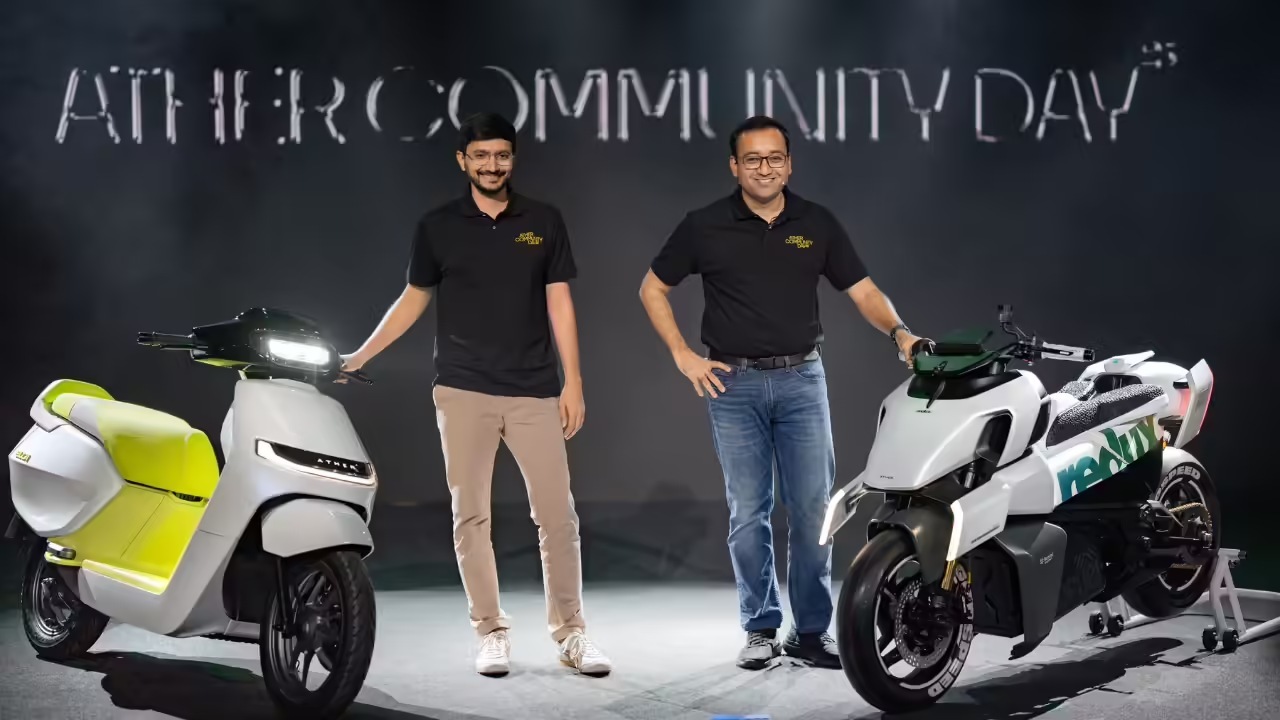
With Factory 3.0 in Maharashtra looming on the horizon with a 1 million unit capacity, and the new EL Platform set to disrupt the ₹1.0–1.25 lakh segment, Ather is no longer just a “Bangalore startup.” It is a national contender with an 18.6% market share and the title of the #1 Searched EV Brand in India. The burn is cooling, the engines (or rather, the motors) are humming, and the trajectory looks like a vertical takeoff.
2. Introduction – From Hosur with Love (and Efficiency)
Ather Energy isn’t just selling scooters; they are selling a “Stack.” Incorporated in 2013, this Bengaluru-born pioneer has spent over a decade perfecting the art of vertical integration. They don’t just assemble parts; they design the battery packs, write the software (AtherStack), and build the charging grid (Ather Grid) that keeps the whole ecosystem breathing.
The last fiscal year was the ultimate “walk the talk” moment. Management promised distribution expansion, and they delivered—doubling their Experience Centres to 700 across India. They promised cost reduction, and they slashed COGS per unit by 9% despite global headwinds.
What makes Ather different is their refusal to play in the “cheap and cheerful” bucket. They’ve carved a niche in the performance and family convenience segments. With the 450 Series catering to the enthusiasts and the Rizta capturing the family heartland, Ather has built a portfolio that feels mature.
They are currently the 4th largest E2W manufacturer in India by volume, but if you look at the value they capture per unit—roughly ₹1,40,817 in Q4 FY26—they are playing a much more profitable game than the volume-chasers. As they transition to their new EL architecture, the goal is clear: lower the entry price without nuking the margins. It’s a delicate dance, but for a company that just pulled off a 1,600+ bps EBITDA improvement in a year, they seem to have the rhythm down.
3. Business Model – WTF Do They Even Do?
At its core, Ather is a software company that happened to build a kick-ass hardware shell. They operate on a vertically integrated model, which is fancy corporate speak for “we do everything ourselves because we don’t trust anyone else to do it right.”
- The Hardware: They manufacture their own battery packs and assemble scooters in Hosur. They aren’t just buying off-the-shelf motors; they are engineering “Light Rare Earth” magnet tech to bypass geopolitical drama.
- The Software (The Secret Sauce): The AtherStack is where the real money is hidden. With a 93% attach rate for their ProPack, users are essentially paying for a subscription to features like Google Maps navigation, AutoHold, and “Ride