Aspinwall & Company FY26: Revenue Sprints 24% to ₹417 Cr While Profit Quietly Slips to ₹13 Cr
Spotted a factual error — a wrong number, date, or fact? Tell us and we will check the source.
General information and entertainment, not investment advice. The author is not a SEBI-registered adviser or research analyst. No recommendation, no promised returns. Markets carry risk including loss of capital. Figures may not be current. Consult a registered adviser before acting.
1 — At a Glance
Aspinwall & Company closed FY26 with revenue of ₹417 crore, a 24% jump over the prior year’s ₹336 crore — the kind of top-line move that usually gets a company noticed. Except the profit went the other way. Net profit landed at ₹13 crore, down from ₹14.5 crore, and operating profit barely held at ₹18 crore on a 4.2% margin.
So the pattern here is a business selling a lot more while keeping less. Coffee procurement costs ran hot through the first half, and the two loss-making opening quarters had to be dug out of by a strong finish. The market values the whole enterprise at ₹198 crore — below its own ₹201 crore net worth, a 106-year-old royal-family concern priced at less than the sum written in its own books.
The tension for this record: a company that has survived five generations of Travancore royalty, spanning coffee, logistics, rubber and coir, yet earns a return on equity of 4.6%. Growth without profit, heritage without a multiple. The chapters below trace where the money went.
2 — Introduction
Aspinwall was incorporated in 1920 and has sat under the control of the erstwhile Royal Family of Travancore since the early 1970s. Mr. Rama Varma has been Managing Director since 2007; on 27 May 2026 the board recommended his re-appointment for a further three-year term from 1 August 2026, subject to shareholder approval at the 106th AGM scheduled for 23 July 2026.
The company runs five distinct businesses: integrated logistics, speciality coffee processing and export, natural rubber plantation, coir and natural-fibre products, and the leasing of Aspinwall House, its commercial property. Crisil, which reaffirmed the group’s rating at BBB/Stable/A3+ on 16 March 2026, notes that logistics and coffee together contribute around 80% of revenue.
FY26 also carried some non-operating events. The company recorded a net gain on the sale of freehold land, booked ₹4.81 crore of exceptional gains on a consolidated basis, and absorbed a ₹70 lakh incremental gratuity charge tied to India’s new Labour Codes. A 106-year-old firm still selling off pieces of land while running a coffee curing plant — the diversification cuts in several directions at once.
3 — Business Model: WTF Do They Even Do?
Imagine a business that agrees on absolutely nothing about what it should be. That is Aspinwall.
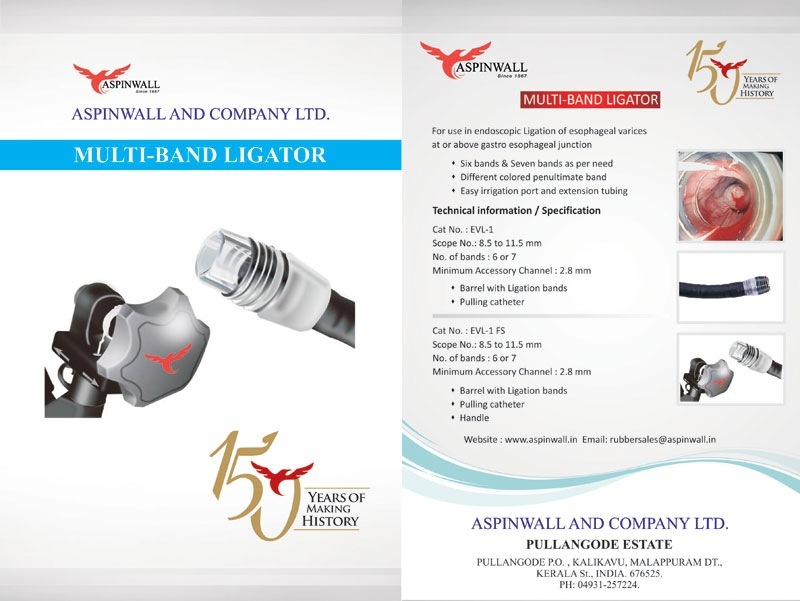
By FY26 segment revenue, Coffee is the largest at ~43%, Logistics ~38%, Plantation ~15%, and Others ~4%. The coffee arm cures up to 6,000 tonnes a year at Mangalore and ships speciality names — Monsooned Malabar AA, Mysore Nuggets Extra Bold. The logistics arm does customs clearance, ship agency, bulk cargo and freight forwarding across India’s ports. The plantation arm works a 2,200-acre rubber estate in Kerala and — in a genuinely unexpected pivot — manufactures medical Esophageal Varices Ligation bands. There is a coir business making mats and geotextiles, and there is a building leasing out four of its six floors.
Coffee brings the most revenue but earned a segment result of ₹12.7 crore; logistics, on smaller revenue, earned ₹12.4 crore. So the biggest line by sales isn’t the biggest earner — coffee’s margin is thin because, as Crisil flags, the segment is closely linked to international coffee prices and procurement costs ran high in the previous crop cycle.
The honest description of this model is a holding company wearing five hats, three of which are commodity businesses at the mercy of weather and global prices. Does a five-segment sprawl smooth out the cycles, or just guarantee at least one segment is always underwater?
4 — Financials Overview
Figures are consolidated, in ₹ crore.
Metric
FY26
FY25
YoY
Revenue
417
336
+24%
Operating Profit
18
19
−5%
PAT
13
15
−9%
EPS (₹)
16.83
18.58
−9%
The revenue line and the profit line pulled in opposite directions. Sales rose nearly a quarter; operating profit slipped. The Q4 (March 2026) quarter did the heavy lifting: quarterly sales of ₹130 crore ran 46% above the year-ago quarter, and quarterly PAT of ₹6.01 crore sat 166% above the ₹2.26 crore of March 2025.
That rebound was necessary because the year opened badly. The June 2025 quarter posted an operating loss of ₹1.78 crore and September managed just ₹0.09 crore of operating