Search for Stocks /

Ashima Ltd FY2026: ₹10 Crore in Revenue. ₹290 Crore in Market Cap. Someone Is Doing Math Differently.

Spotted a factual error — a wrong number, date, or fact? Tell us and we will check the source.

General information and entertainment, not investment advice. The author is not a SEBI-registered adviser or research analyst. No recommendation, no promised returns. Markets carry risk including loss of capital. Figures may not be current. Consult a registered adviser before acting.


1 — At a Glance

Ashima Ltd closed FY2026 with standalone revenue of ₹10.42 crore — a number that, placed against a market capitalisation of ₹291 crore, produces a Price-to-Sales multiple of roughly 28x. The company posted a PAT of negative ₹21.64 crore for the year, deepening the loss from the ₹18.88 crore posted in FY2025. Revenue across the last two full fiscal years has collapsed from ₹208 crore in FY2022 to approximately ₹10 crore — a 95% decline in four years.

The balance sheet carries ₹164 crore in borrowings against ₹275 crore in net worth. Investments stood at ₹142.95 crore, a figure that has risen sharply from ₹15 crore in FY2023 — the treasury division, it appears, is doing more work than the factory. Cash and bank balances fell from ₹89 crore in FY2025 to ₹21 crore in FY2026.

ROCE stands at 0.23%, ROE at -2.10% on a trailing basis. The interest coverage ratio is 0.11 — meaning operating income covers interest charges at a rate that rounds to “almost not at all.”

The attention signal: a company that has exited its primary manufacturing operations, pivoted toward real estate and treasury, appointed a new CEO in March 2026, and is now raising up to ₹130 crore in NCDs to fund its next chapter.

The worry signal: that next chapter is being funded with debt, while the current operations produce essentially no revenue.

There is a business here — just not the one that was listed in 1982.


2 — Introduction

Ashima Ltd was incorporated in 1982 and built its reputation in the Ahmedabad textile belt as a manufacturer of denim fabrics, piece-dyed fabrics, and readymade garments — shirts, jeans, the full wardrobe from yarn to finished product. At its peak around FY2019, standalone revenue touched ₹336 crore.

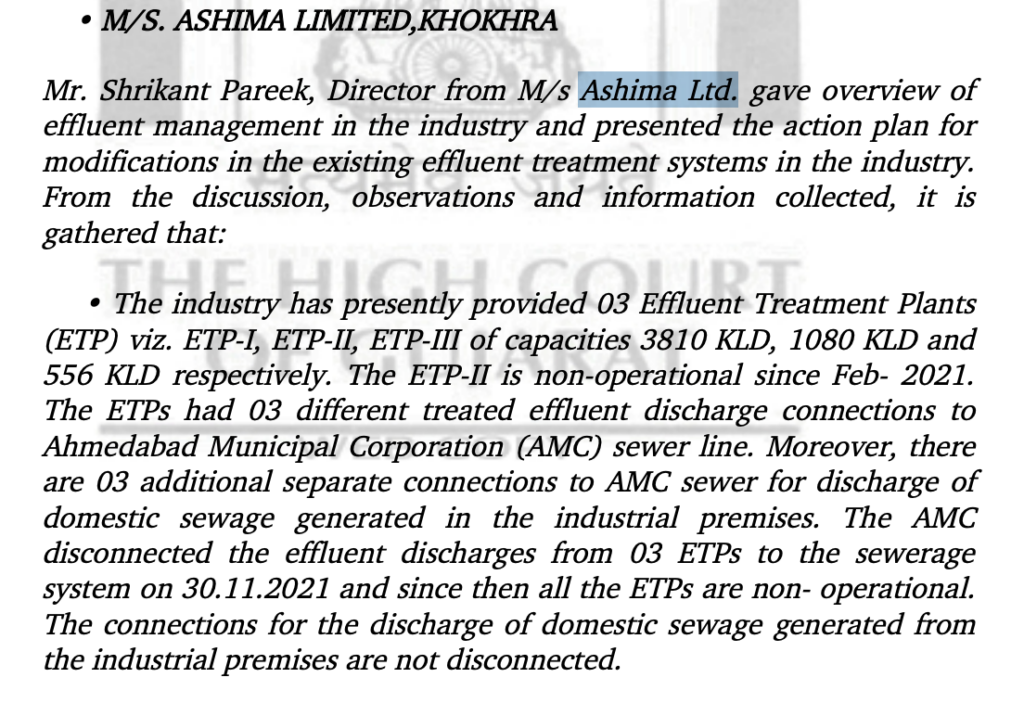
The unravelling began in FY2021, when a series of events eroded operations. In November 2021, production activities across various divisions were stopped following disconnection of the effluent discharge facility by the Ahmedabad Municipal Corporation pursuant to a Gujarat High Court order. Wet manufacturing operations remained suspended for most of FY2023, the company reported a loss of ₹6.65 crore that year, and management pursued outsourcing arrangements to keep some activity alive. A Zero Liquid Discharge facility and an Effluent Treatment Plant were subsequently installed.

Read the order here – https://www.greentribunal.gov.in/sites/default/files/news_updates/Affidavit%20in%20Reply%20by%20R-1%20in%20OA%20No.91-2023%20(page%20nos.319-461).pdf

The more consequential turn came in September 2024, when the board approved closure of cotton textile operations entirely — the core business that had run for four decades. By FY2025 and FY2026, textile revenue had effectively ceased. The company’s three reportable segments are now Real Estate, Investment, and Others — the “Others” category, in a quiet irony, is where the remnants of the textile business sit.

In May 2024, Ashima incorporated a wholly-owned subsidiary, Ashima Capital Management Limited, signalling an institutional push into the investment management space. In June 2025, the board approved a private placement of secured NCDs up to ₹130 crore with a 9-year tenure at 7.5% interest. In February 2026, Mrs. Vanita Mathur — an MBA in Finance with over 30 years of association with the Group, most recently heading a real estate entity of the Group — was appointed CEO effective 1 March 2026.

The company also has an ongoing legal matter: HDFC Bank filed recovery proceedings for a decretal amount of ₹21 crore, with the Recovery Officer directing attachment of certain immovable properties. A review petition is pending before the relevant authorities.


3 — Business Model: WTF Do They Even Do?

Ashima’s historical business was vertically integrated textiles — it owned the entire value chain from yarn to fabric to garment. On the fabric side: denim, piece-dyed fabrics, and fusible interlining. On the garment side: a catalogue that reads like a menswear mood board — Dress Shirts, Casual Shirts, Camp Shirts, Western Shirts, Engineered Shirts, Grandad Shirts, High Fashion Denim Shirts, Organic Cotton Shirts (GOTS Certified), 5 Pocket Jeans, Distressed Jeans, Coated Jeans, Super Stretch Jeans, and Organic Cotton Jeans (GOTS Certified). It also ran a design studio for high-end customers and offered the ICON brand — the first brand, management claims, to offer Ready-to-Switch (RTS) formal and casual shirt and trouser fabric packs.

That business is now closed.

The current Ashima is best understood as three parallel bets:

Real Estate. The company has entered residential and commercial property development. Swan Lake, a weekend homes project on the western outskirts of Ahmedabad, covers approximately 4.25 lakh sq yards, with 22.75 lakh sq ft of plots booked and revenue of ₹69.83 crore already recognised from the project. The total estimated revenue from Swan Lake is ₹350 crore. The Sovereign is a 37-storey residential tower — 4 and 5 BHK apartments, 6.46 lakh sq ft of built-up area — with total estimated revenue potential of approximately ₹500 crore. The company has already invested ₹92 crore in The Sovereign.

Investment / Treasury. The company makes long-term equity investments through its treasury division. The subsidiary Ashima Capital Management Limited extends this into investment management and advisory services. The investments line on the balance sheet has grown from ₹15 crore in FY2023 to ₹143 crore in FY2026.

Others (residual textiles). A diminishing stub of the former core business — interlining fabrics, some outsourced garment activity — generating minimal revenue.

The model, stripped to its essence: sell real estate plots and apartments in Ahmedabad, run an investment portfolio, and let the textile legacy depreciate quietly off the books. Whether those real estate project estimates (₹350 crore + ₹500 crore) translate to recognised revenue — and at what pace — is the central question the FY2026 numbers do not yet answer.


4 — Financials Overview

Figures are standalone, in ₹ crore.

Annual P&L — Key Metrics

MetricFY2026FY2025FY2024
Revenue10.4210.4089.61
EBITDA-14.36-11.42100.84
PAT-21.64-18.8896.41
EPS (₹)-1.13-0.995.03

Revenue held essentially flat year-on-year — ₹10.42 crore versus ₹10.40 crore — but that flatness conceals a third consecutive year of near-zero operating business. FY2024’s PAT of ₹96.41 crore was driven by other income of ₹28.80 crore, not operations. EBITDA has been negative in each of the last two years.

Q4 FY2026 (latest quarter)

MetricQ4 FY2026Q4 FY2025
Revenue6.330.74
Operating Profit-3.23-1.09
PAT-7.403.25

The Q4 revenue figure of ₹6.33 crore appears large relative to the full-year ₹10.42 crore only because the first three quarters generated ₹4.09 crore combined. Q4 FY2025 PAT was positive at ₹3.25 crore due to a positive other-income line that quarter.
On the filing: The board at its 23 May 2026 meeting approved the audited results, and statutory auditors Mukesh M. Shah & Co. issued an unmodified opinion on both standalone and consolidated financial results. The consolidated results incorporate the subsidiary Ashima Capital Management Limited, which reported total income of ₹2.27 crore and PAT of ₹1.34 crore for FY2026, per the audit report.


5 — Market Expectations & Historical Multiples

This section describes how the market is currently pricing the company and how that compares with its own history and peer group. It is descriptive, not predictive.

MetricCurrentHistorical AveragePeer Median
P/EN/A (negative EPS)24.6x (industry)
P/B1.06x
ROCE0.23%9.01% (peer median)
ROE-2.10%

P/E is not computable for FY2026 given the negative EPS of -₹1.13. The market currently prices the company at 1.06x book value — approximately book — against an enterprise value of ₹433 crore on revenue of ₹10 crore.

The EV/EBITDA multiple sits at 344x per the data, a figure that exists in a mathematical sense but describes a business generating deeply negative operating profit rather than a conventional valuation metric.

The market appears to be pricing Ashima on the forward potential of its two real estate projects (combined estimated revenue of ₹850 crore, per management’s published estimates) and its growing investment portfolio (₹143 crore), rather than on current-period earnings. The peer median ROCE of 9.01% compares to Ashima’s current 0.23%.

Does ₹143 crore in investments and ₹850 crore in estimated real estate pipeline justify a ₹291 crore market cap when operating earnings are deeply negative? The market’s answer, at this price, appears to be yes — the arithmetic behind that answer belongs to whoever is doing it.


6 — What’s Cooking

Several material events occurred during and just after FY2026:

NCD issuance — ₹130 crore: In June 2025, the board approved a private placement of secured NCDs up to ₹130 crore, 9-year tenure, at 7.5% interest per annum. This is the primary source of the borrowing increase from ₹122 crore to ₹164 crore on the FY2026 balance sheet.

CEO appointment: Mrs. Vanita Mathur was appointed CEO effective 1 March 2026. She holds an MBA in Finance and has over 30 years of association with the Group. Her most recent role before rejoining was heading a real estate entity of the Group, where she provided strategic leadership across engineering, legal, finance, and HR, management’s disclosure stated.

Cotton textile closure: In September 2024, the board formally approved closure of cotton textile operations. In September 2024, the board also approved disposal of cotton textile operational assets. These assets have been classified as held for sale on the balance sheet.

HDFC Bank recovery matter (ongoing): A recovery officer directed attachment of certain immovable properties in connection with HDFC Bank’s recovery proceedings for a decretal amount of ₹21 crore. The company has filed a review petition, which remains pending.

Secretarial compliance FY2026: The annual secretarial compliance report filed in May 2026 disclosed no SEBI or stock exchange regulatory actions.


7 — Balance Sheet

Standalone, ₹ crore

ItemFY2022FY2024FY2026
Total Assets318.65532.69555.85
Net Worth227.24316.86275.69
Borrowings18.15123.90164.21
Other Liabilities73.2691.93115.95
Total Liabilities318.65532.69555.85

The balance sheet balances — assets equal liabilities in each period, as they should.

Three observations on the numbers:

  • Borrowings have multiplied from ₹18 crore in FY2022 to ₹164 crore in FY2026 — a 9x increase in four years — while net worth has contracted by ₹41 crore over the same span. The two are moving in opposite directions with some conviction.
  • Other assets rose from ₹181 crore (FY2022) to ₹371 crore (FY2026), a category that includes real estate project inventory, receivables from Swan Lake, and other items. ₹290 crore of the ₹371 crore in Other Assets sits in inventory — an interesting line for a company that has closed its textile manufacturing.
  • The company’s investments line (₹143 crore in FY2026, up from ₹31 crore in FY2024) now exceeds its fixed assets (₹42 crore). The factory has been replaced, at least on paper, by a portfolio.

The company carried a net debt position of approximately ₹143 crore (borrowings of ₹164 crore less cash and bank of ₹21 crore) as of March 2026.

A vertically integrated textile company that owned its value chain from yarn to garment now has more in investments than in property, plant, and equipment. The looms have left. The portfolio has arrived.


8 — Cash Flow: Sab Number Game Hai

Standalone, ₹ crore

YearOperatingInvestingFinancing
FY2024-38.51-3.4786.45
FY2025-19.3423.27-9.72
FY2026-40.94-41.7633.62

Operating cash flow has been negative in each of the last three years — the business consumed ₹40.94 crore in cash from operations in FY2026. Investing activities consumed another ₹41.76 crore, reflecting the large purchase of investments (₹100.36 crore outflow) partially offset by proceeds from investments and asset sales. Financing activities contributed ₹33.62 crore, primarily from new long-term borrowings of ₹120 crore netted against repayments of ₹78.26 crore.

Net cash flow for FY2026 was negative ₹49.08 crore, which explains the fall in cash from ₹89 crore to ₹21 crore.

The pattern is consistent: operations consume cash, the investment portfolio and asset sales partially offset it, and borrowings fill the gap. A company burning cash from operations at ₹40 crore per year while investing heavily in a portfolio and real estate projects requires either cash generation from those projects or continued access to debt markets.

The cash flow statement for the last three years reads as a financing exercise, not a business one.


9 — Ratios: Sexy or Stressy?

RatioValue
ROE-2.10% (trailing)
ROCE0.23%
P/EN/A
PAT Margin-207.7%
D/E0.60x

ROE at -2.10%: The equity is generating a negative return — every ₹100 of equity is producing a loss.

ROCE at 0.23%: Capital employed of approximately ₹440 crore is producing operating returns that round to zero. A business justifying a ₹291 crore market cap on 0.23% ROCE is implicitly a bet on where that ROCE goes, not where it stands.

PAT Margin at -207.7%: Revenue of ₹10.42 crore accompanied by a loss of ₹21.64 crore means that for every rupee of revenue, the company loses two. The margin figure is arithmetically accurate and operationally brutal.

D/E at 0.60x: Borrowings of ₹164 crore against net worth of ₹276 crore. Not yet alarming in isolation, but trending in one direction: the D/E was 0.08x in FY2022.

Interest coverage at 0.11x: Operating profit of ₹0.97 crore (approximating from operating cash flow context) versus interest expense of ₹8.96 crore. The company is not covering its interest from operations — management’s capital deployment into real estate and investments is the intended path to changing this equation.


10 — P&L Breakdown: Show Me the Money

Standalone, ₹ crore

YearRevenueEBITDAPAT
FY202489.61100.8496.41
FY202510.40-11.42-18.88
FY202610.42-14.36-21.64

FY2024’s PAT of ₹96 crore was exceptional in the precise sense: it was driven by other income of ₹28.80 crore and the reversal of various items as the textile operations were wound down, not by a turn in operating performance. Removing that year, the picture is a company that generated consistent operating losses.

FY2026 repeats the FY2025 structure — thin revenue, heavy operating losses, other income turning negative (loss on fair valuation of investment activity was disclosed as a separate line in the financials). Raw material cost of ₹93.59 crore against revenue of ₹10.42 crore is the kind of ratio that requires context: real estate land development costs booked in that line, not textile inputs, management’s segment reporting confirms.

The long view: revenue was ₹336 crore in FY2019, ₹208 crore in FY2022, ₹90 crore in FY2024, ₹10 crore in FY2026. The 5-year compounded sales decline is -37%.


11 — Peer Comparison

Standalone figures, latest available

CompanyRevenue (₹ Cr)PAT (₹ Cr)P/E
K P R Mill1,784.65227.1746.97x
Vardhman Textile2,497.98189.2624.65x
Welspun Living2,435.43106.1673.80x
Trident1,632.53101.9835.69x
Indo Count1,057.6824.2066.63x
Alok Industries982.97-192.54N/A
Ashima6.33-7.40N/A
Sector Median130.515.0824.64x

Ashima’s quarterly revenue of ₹6.33 crore places it below the sector median of ₹130.51 crore by a significant margin. Its peers — K P R Mill, Vardhman, Welspun, Trident — are active manufacturers generating hundreds of crores in quarterly revenue.

The comparison requires a caveat: Ashima is no longer a textiles operating company in any meaningful sense. Placing it against textiles manufacturers is accurate by classification but somewhat like comparing a building that used to be a factory to the factories still running around it. The peer table’s value here is context on where the market prices active textile businesses — 24x median earnings — versus where it prices Ashima, which is a different animal entirely.


12 — Miscellaneous: Shareholding & Promoters

Holder%
Promoters73.49%
FIIs0.14%
DIIs0.00%
Public26.38%

Promoter holding has been perfectly static at 73.49% since at least June 2023, with zero change across twelve consecutive quarters. No pledge is disclosed.

The promoter entity is the Parikh family — Chintan Navnitlal Parikh and Shefali Chintan Parikh hold the controlling interest, structured across multiple entities including individual holdings, HUF, and family trusts. Krishnachintan C. Parikh serves as Executive Director (DIN: 07208067), signed the FY2026 results, and chairs the board that approved his own appointment-related matters in prior years.

The board he chairs approved his re-appointment as Managing Director for three years, per the May 2025 announcement. Mrs. Vanita Mathur was separately appointed as CEO in March 2026 — an external-facing professional manager to complement the family-led board structure.

The number of shareholders has grown from roughly 24,000 in September 2023 to approximately 40,600 in March 2026, suggesting retail participation increased materially through the period.


13 — Corporate Governance: Angels or Devils?

The auditors — Mukesh M. Shah & Co., Chartered Accountants — issued an unmodified opinion on both standalone and consolidated FY2026 results, per the 23 May 2026 board announcement. No qualification, emphasis of matter on going concern, or adverse finding is disclosed in the filing presented.

Internal auditors Dhirubhai Shah & Co LLP (established 1961, over 64 years in operation, Ahmedabad-based) were re-appointed for FY2026-27.

The annual secretarial compliance report filed May 2026 disclosed no SEBI or stock exchange regulatory actions.

Disclosed governance events:

  • Resignation of Mr. Shrikant Pareek as Whole Time Director (January 2025).
  • Resignation of the Company Secretary and Compliance Officer (May 2024).
  • HDFC Bank recovery proceedings (decretal amount ₹21 crore), with attachment of certain immovable properties directed; review petition pending.
  • Q3 results were refiled in February 2026 with a correction to consolidated segment assets (corrected to ₹52,526 lacs).

The pledged promoter percentage is nil, per the screener data. Related-party transactions are present in the financials given the group’s structure, but no extraordinary related-party concerns are flagged in the documents reviewed.

The governance record is clean on the audit side, mixed on management continuity — two senior-level departures in 12 months followed by a CEO hire is a pattern worth noting as a fact.


14 — Industry Roast & Macro Context

The Indian textiles sector is one of those industries that is perpetually “on the cusp of a revival” — a cusp that has existed since roughly the 1990s and shows no sign of resolving into either revival or cliff. Exports face competition from Bangladesh and Vietnam, which are cheaper. Domestic demand is seasonal, fashion-driven, and mercilessly fragmented. Denim specifically had a rough run post-COVID as global casualwear preferences shifted and inventory piled up across the supply chain.

The specific corner of textiles Ashima occupied — denim fabrics and readymade garments for the mid-market — is now populated by players with more modern capacity, better ESG compliance credentials for export customers, and the working capital to survive quarter-to-quarter volatility. The compliance requirements that shut Ashima’s effluent facility (Gujarat HC order, Ahmedabad Municipal Corporation) were not an aberration: environmental compliance in Indian wet processing is an increasing cost of doing business, and companies that had not invested in Zero Liquid Discharge infrastructure were always going to face this reckoning.

Real estate in Ahmedabad, Ashima’s pivot destination, is a different animal. Western Ahmedabad is a legitimate growth corridor with improving infrastructure, and the weekend-homes format Swan Lake is targeting has found buyers (₹69.83 crore booked). The Sovereign — a luxury high-rise — is a higher-risk, higher-duration bet. Both projects carry the hallmark of Ahmedabad’s new money moment: a city that spent decades being sensible is now building 37-storey towers.

Whether a textile company can successfully reinvent itself as a real estate developer and investment manager is an empirical question the sector answers rarely and the company is still in the process of answering.


15 — EduInvesting Verdict

SWOT

StrengthsWeaknesses
Significant real estate pipeline (est. ₹850 Cr) with bookings already underwayRevenue of ₹10 crore on a market cap of ₹291 crore
Zero promoter pledge; stable 73.49% promoter holdingOperating cash flow negative ₹41 crore; cash pile shrinking
Unmodified audit opinion; clean secretarial complianceInterest coverage at 0.11x; borrowings rising sharply
Growing investment portfolio (₹143 Cr); subsidiary in investment managementCore textile business closed; no operating revenue from the old model
OpportunitiesThreats
Swan Lake and The Sovereign revenue recognition as projects completeReal estate execution risk in a capital-intensive sector
Ahmedabad real estate market in an expansionary phaseHDFC Bank recovery matter; attached properties pending court outcome
NCD proceeds (up to ₹130 Cr) provide liquidity runwayContinued operating losses eroding net worth
New CEO with 30+ years Group experience and real estate backgroundDebt servicing at 7.5% on long-tenure NCDs adds to interest burden

A company that closed its factories, built a treasury portfolio larger than its fixed assets, started two real estate projects with combined estimated revenues approaching ₹850 crore, appointed a real estate-experienced CEO, and is raising ₹130 crore in NCDs — all while reporting ₹10 crore in revenue and ₹22 crore in losses — is either the prelude to a genuinely different business, or an extended intermission with a very expensive prop department. The balance sheet carries the evidence of both possibilities simultaneously, and the next two to three years of real estate project completion will determine which reading survives.

Leave a Reply