Artson Engineering Ltd Q3 FY26 – ₹32 Cr Quarterly Revenue, ₹12 Cr Loss, 75% Tata Control & a Balance Sheet That Looks Like It Survived a Welding Accident
1. At a Glance – Blink and You’ll Miss the Profit (But Not the Loss)
Artson Engineering Ltd currently trades around ₹146, quietly sitting on a market capitalisation of ~₹539 crore, while reporting quarterly sales of ₹32 crore and a quarterly loss of ₹12.2 crore for the latest reported quarter (Q3 FY26). Yes, you read that right. Revenue grew sharply on a quarter-on-quarter basis, but profits took a U-turn and drove straight into a ditch. Operating margins have turned negative again, interest coverage is below zero, and the stock price is still quoting at over 200× book value, which is impressive in the same way a leaking pressure vessel is impressive — technically fascinating, practically concerning.
The company is 75% owned by Tata Projects, carries ~₹49 crore of debt, and has a ROCE of ~25% on paper, which sounds heroic until you notice the ROE of 124% is mostly driven by a very thin (and occasionally negative) equity base. Over the last three months, the stock has fallen ~25%, reminding investors that pedigree alone does not weld profits together.
This is not a boring company. This is a company where steel structures, EPC drama, Tata support letters, shipbuilding orders, and accounting losses all coexist in uneasy harmony. Curious already? Good. Let’s put on the helmet and step inside the fabrication yard.
2. Introduction – Welcome to the Tata Subsidiary That Refuses to Behave
Artson Engineering is not some random microcap that popped up during a bull market with a PowerPoint and a prayer. It was incorporated in 1978, has lived through oil booms, oil busts, PSU delays, EPC nightmares, and multiple balance-sheet detox attempts. If companies had wrinkles, Artson would have laugh lines and stress lines.
It operates in oil, gas, hydrocarbon processing, heavy fabrication, and mechanical EPC works, which is fancy language for “we build very heavy, very expensive metal things and install them at sites where delays are guaranteed.” Historically, Artson bid independently for EPC projects. Then reality happened. Losses piled up, working capital stretched, and the company paused fresh EPC bidding, choosing instead to survive under the protective umbrella of its parent.
That parent is Tata Projects Ltd. And yes, that changes the game. Tata Projects provides corporate guarantees to lenders, letters of comfort, board oversight, and a steady pipeline of subcontracted work. Think of it as a strict but wealthy parent who keeps bailing you out but also monitors your homework.
Despite Tata support, Artson’s financials remain volatile. Revenues jump quarter to quarter, margins swing wildly, and profits appear and disappear like a subcontractor on payment day. The company is now pivoting towards manufacturing, shipbuilding, and fabrication-heavy orders, while legacy EPC projects are nearing completion.
The big question investors keep asking: Is this a turnaround story or a forever-restructuring story? Let’s dig deeper before the welding sparks blind us.
3. Business Model – WTF Do They Even Do?
Artson Engineering is best understood as a heavy engineering execution arm, not a pure-play EPC unicorn. Its core activities include:
Fabrication of steel structures
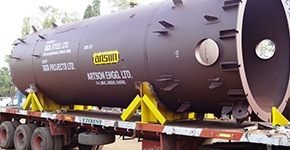
Manufacturing of pressure vessels and process equipment
Tankages, piping, and mechanical packages
On-site erection and mechanical services
Shipbuilding and propulsion-related fabrication works
Earlier, Artson chased full EPC contracts. That meant bidding aggressively, managing design, procurement, construction, cash flows, subcontractors, and client tantrums — all at once. Margins suffered. Cash got stuck. Debt ballooned.
So management did the sensible thing: stop bidding independently and start acting like a specialist subcontractor, mainly for Tata Projects. Today, most EPC exposure comes via Tata Projects, while manufacturing and fabrication orders are directly executed at Artson’s facilities.
The company operates manufacturing units in Nagpur and Nashik, with a new Raigad (Sudhagad Taluka) facility commencing production in March 2024. Nashik, in particular, handles complex jobs — including gas-to-gas heat exchangers weighing over 260 MT, exotic metal fabrication (Hastelloy, Inconel), and pressure vessels approved by IOCL.
Then there’s shipbuilding. Artson has secured ₹31+ crore of shipbuilding and propulsion system orders, mainly for the Indian Navy and Coast Guard, often structured as biennial or five-year rate contracts. This segment is lumpy but strategically important.
In simple terms: Artson builds fewer things now, but tries to build heavier, more specialised, and hopefully better-margin things. Does that strategy work financially? Let’s check the numbers.
4. Financials Overview – Quarterly Numbers That Need Adult Supervision
📌 Result Type Lock
The latest reported numbers fall under “Quarterly Results”. EPS annualisation rule applied: Quarterly EPS × 4.
📊 Quarterly Performance Table (Figures in ₹ Crore)
Metric
Latest Qtr (Dec 2025)
Same Qtr Last Year
Previous Qtr
YoY %
QoQ %
Revenue
32.0
18.0
48.0
77.8%
-33.3%
EBITDA
-14.0
-7.0
-0.0
NA
NA
PAT
-12.2
6.0
-2.0
-303%
-510%
EPS (₹)
-3.31
1.73
-0.61
NA
NA
Commentary: Revenue is volatile, margins are allergic to stability, and profits seem to require very specific planetary alignment. A single quarter of provisioning or cost overrun can wipe out months of operating effort. Does this look like a textbook manufacturing business? Or does it look like a company still shaking off EPC hangovers?
Ask yourself: If revenues can swing this much, how predictable are future cash flows?
5. Valuation Discussion – When Traditional Multiples Start Laughing
Let’s be honest. Valuing Artson is not straightforward. Still, let’s try.
1️ P/E Method
Latest quarterly EPS: -₹3.31
Annualised EPS: -₹13.24
Negative EPS means P/E is meaningless, unless you enjoy dividing by pain.
2️ EV / EBITDA
Enterprise Value: ~₹588 crore
EBITDA (TTM): negative
Again, valuation model refuses to cooperate.
3️ DCF (Very Conservative Thought Experiment)
Assume revenue stabilisation near ₹200 crore annually