Aplab FY26: A ₹2.52 Cr Profit Where ₹3.34 Cr of Other Income Did the Heavy Lifting
Spotted a factual error — a wrong number, date, or fact? Tell us and we will check the source.
General information and entertainment, not investment advice. The author is not a SEBI-registered adviser or research analyst. No recommendation, no promised returns. Markets carry risk including loss of capital. Figures may not be current. Consult a registered adviser before acting.
1 — At a Glance
Aplab closed FY26 with sales of ₹58.44 crore and a net profit of ₹2.52 crore — the largest annual profit this 1962-vintage electronics maker has posted in a decade. On the surface, a turnaround. One layer down, the composition asks a harder question: other income for the year was ₹3.34 crore, larger than the ₹3.00 crore of operating profit the actual business produced. The March quarter itself lost ₹0.72 crore.
The balance sheet, meanwhile, did something it hadn’t managed in years — reserves crossed into positive territory at ₹4.30 crore, after sitting below zero as far back as the data runs. Borrowings fell to ₹18.81 crore from ₹29.93 crore. And promoter holding, which stood at 67.60% in mid-2025, sits at 43.83% by March 2026.
Against all this, the market pays roughly 96x earnings for a company whose five-year sales growth is 1.97%. A profit that leans on non-operating income, a board that turned over almost entirely in one month, and a credit file marked “issuer not cooperating.” The record for the period is unusually busy. Where the operating engine ends and the accounting begins is the thread worth pulling.
2 — Introduction
Aplab Ltd manufactures professional electronic equipment out of Thane, and has done so since incorporation in 1962. It sits in the industrial power electronics space and is, per the company’s own material, the only Indian manufacturer of rack-mount programmable AC and DC power sources — a genuinely narrow moat, if a narrow market.
The company’s recent history is a study in survival. It carried accumulated losses and negative reserves for years; promoters extended unsecured loans to keep operations funded, later converting them into equity to repair net worth. That repair is now visible in the FY26 books.
FY26 was also the year the org chart caught fire. Chairperson and Whole-time Director Amrita P. Deodhar resigned effective 31 May 2026. On the same day, CFO, Company Secretary and Compliance Officer Rajesh K. Deherkar resigned. The board simultaneously appointed Nishith Deodhar as Executive Director, Tanvi Paharia Jain as Non-Executive Director, and Ravish Modi as CFO, all effective 1 June 2026. Sanjay N. Mehta signs the results as Managing Director. Earlier, in January 2026, an independent director resigned as well.
Layered onto the operations was a 1:1 rights issue and a stack of credit-rating and monitoring-agency paperwork. Both feature below, because both matter to what the numbers mean.
3 — Business Model: WTF Do They Even Do?
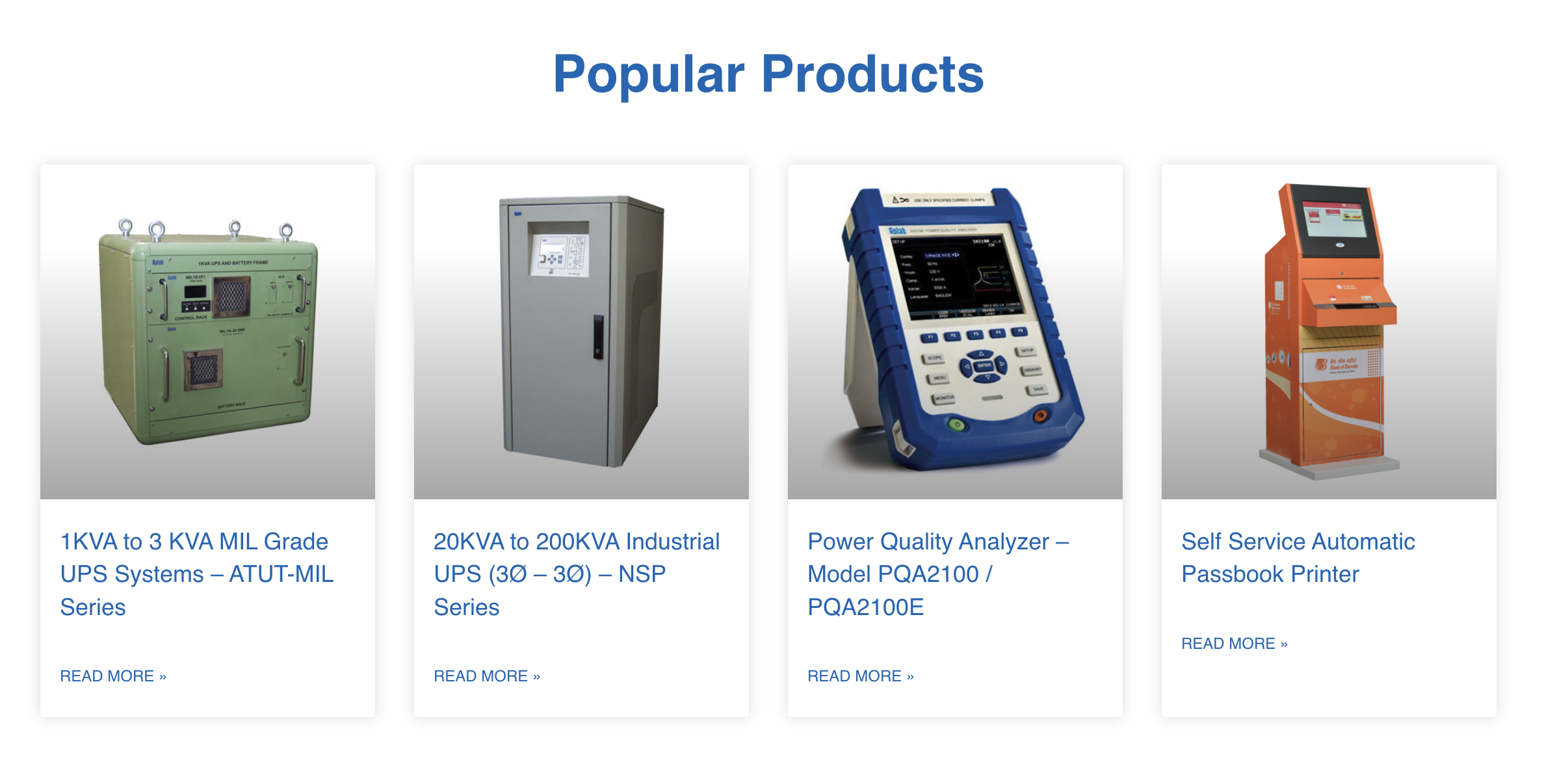
Aplab makes things that keep other things powered and measured. The FY24 product split — the most granular the record offers — puts uninterruptible power supply systems at 46.55% of sales, service income at 20.73%, regulated DC power supply at 11.80%, education products at 8.35%, test and measuring instruments at 6.80%, and passbook printers and machines at 5.77%.
That last line is worth a pause. In an economy racing toward UPI, Aplab still books revenue from passbook printers — the machine that stamps a paper booklet at a bank branch. The company has been deploying AI-software-based self-service passbook kiosks, which is a sentence that fits three different decades at once.
The stated strategy is to derive 50% of total revenue from spares, service, and support — deliberately leaning into lower-margin product segments where the after-sales service earns more than the box itself. Service income at 20.73% shows the plan is partway travelled, not arrived.
During the year the company exited its high-school electrical lab equipment line, most of whose sales came from the UK, where spending on such tools had been falling and margins were thin. Management said it expects to recover that revenue by raising output elsewhere. It also launched the rebranded ‘LONAR Series’ programmable AC sources, named after Maharashtra’s Lonar Lake.
So: a real engineering business with a defence-adjacent service footprint from Leh to the Andamans, wrapped around product lines at very different points of their lifespans. Does a genuine niche in programmable power sources outweigh a revenue base that grew 1.97% over five years, or just keep the lights on while the mix reshuffles?