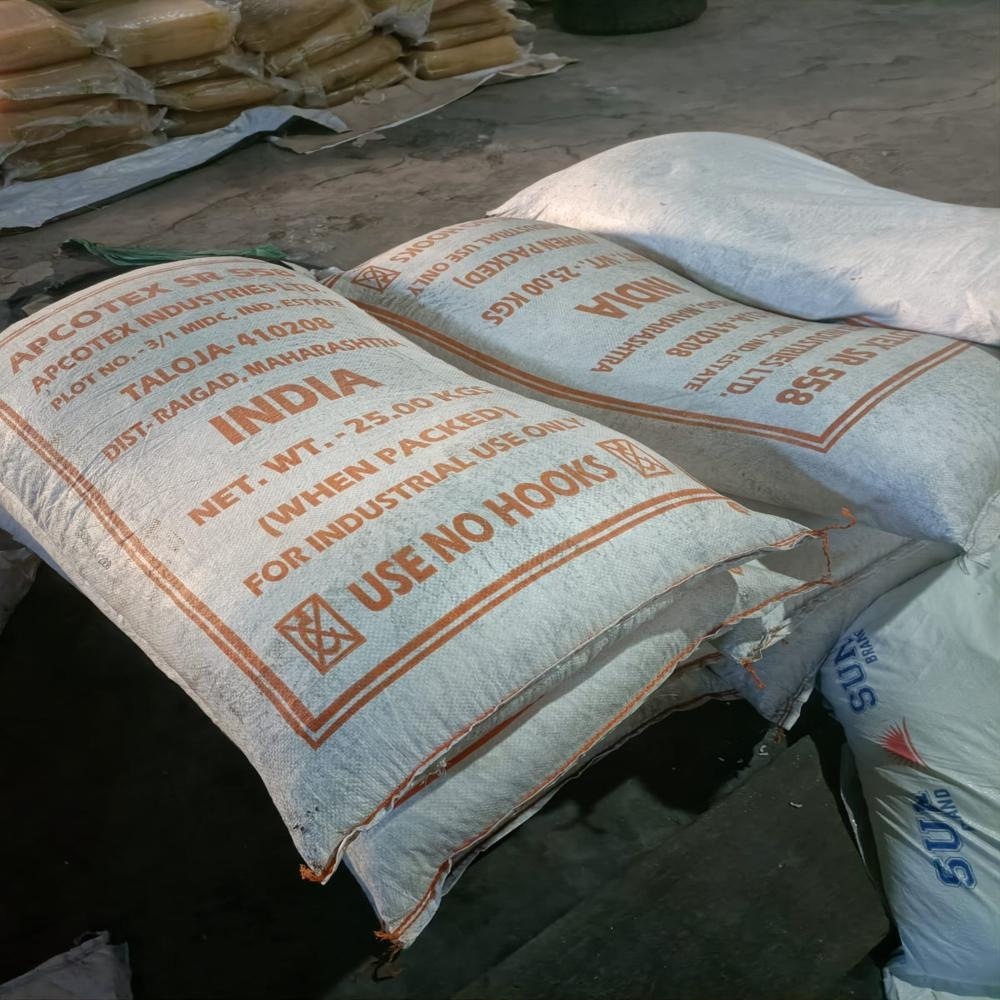
Apcotex Industries FY26: Margins Return, While Debt Vanishes in Rear-View
General information and entertainment, not investment advice. The author is not a SEBI-registered adviser or research analyst. No recommendation, no promised returns. Markets carry risk including loss of capital. Figures may not be current. Consult a registered adviser before acting.
1. At a Glance
Apcotex reported FY26 revenues of ₹1,442 Cr (+4% YoY) and net profit of ₹101 Cr (+88% YoY). The profit surge masks a gap: volumes grew 14%, but price realisations fell—raw material deflation ate the gain. The company carried ₹96 Cr in debt twelve months ago; it now holds ₹96 Cr in debt, having paid down ₹92 Cr in net debt over the year. OPM recovered to 12.3% from 9%, the sharpest rebound in three years. Capacity utilisation remains above 80% across most lines—but high-margin nitrile latex and NBR are now bumping into the ceiling.
The real tension: strong volume growth with compressed realisation, and now no more free capacity to absorb further demand without fresh CapEx.
2. Introduction
Apcotex Industries started in 1980 as a division of Asian Paints, then spun off in 1991 under Atul Choksey. Today it ranks among India’s few domestic synthetic rubber and synthetic latex producers. The company commands roughly 25–30% of India’s nitrile rubber market—the only domestic source for a segment where 70% of demand flows through imports. In 2024, management approved ₹210 Cr capex at Valia to add 37,000 MTPA synthetic latex and 14,600 MTPA NBR capacity by Q1 FY28.
The business runs on petrochemical inputs (styrene, butadiene, acrylonitrile). Raw materials are ~70% of revenue. When crude and derivatives fall, margins compress from lower price realisation even as volumes hold. That trade-off landed in FY26: volume growth didn’t flow to the bottom line until margins stabilised late in the year.
3. Business Model: WTF Do They Even Do?
Apcotex has two legs: Synthetic Latex (~70% of FY26 sales) and Synthetic Rubber (~30%). A third, ApcoBuild (construction chemicals), is nascent—double-digit growth, internal turbulence now past.
Synthetic Latex ships to paper mills, carpet makers, glove manufacturers, construction, and tyre cord plants. The product is downstream petrochemicals: cheaper than natural latex, consistent, scalable. FY26 saw nitrile latex utilisation at ~80% and general latex at ~80%. The subdivision sits at ~16% paper, ~12% carpet, ~15% nitrile latex, ~10% tyres.
Synthetic Rubber (NBR, HSR, nitrile polyblends) feeds footwear, automotive seals, rice roll moulds, and speciality goods. NBR ran at ~95% capacity all year. The company is India’s sole producer; ~65% of domestic demand still imports from Korea, Russia, China.
Exports: 33% of FY26 sales; management targets 42–45% by next cycle. Geography is diverse: 45+ countries, heavy on South/Southeast Asia. Middle East + nearby markets hit ~12% of topline.
The model is simple: buy commodities, polymerise them, ship. Margin depends on the crude cycle and customer stickiness. The company counts ITC, Asian Paints, Ultratech, MRF, SRF, Pidilite among major customers. Top 10 contribute 20–30% of revenue—concentrated, not fragile.
4. Financials Overview
Figures are consolidated, in ₹ crore.
Metric
Q4 FY26
YoY Change
Q3 FY26
Revenue
398
+14%
337
Operating Profit
55
+42%
41
Net Profit
35
+107%
25
EPS (annualised)
6.70
–
4.88
Q4 saw the strongest quarter of the year. Revenue grew 14% on volume (+10%) and “continued pricing discipline” per management—a polite way to say realisation held steady. Operating profit jumped 42%, margin reaching 13.76%. Net profit more than doubled, hitting 8.73% of sales.
Metric
FY26
YoY Change
FY25
Revenue
1,442
+4%
1,392
EBITDA
177
+42%
125
Net Profit
101
+88%
54
OPM
12.3%
–
9.0%
FY26 revenue grew only 4%, despite 14% volume growth. Management flagged this directly in the concall: “14% volume but only 4% revenue.” Raw material prices fell for 9–10 months of the year, collapsing realisations. Q4 and late Q3 saw stabilisation, lifting margins back. Full-year operating margin recovered 330 bps to 12.3%.
The profit story is cleaner: PAT jumped 88%, from ₹54 Cr (FY25) to ₹101 Cr (FY26). The jump came from two sources: (1) operating leverage as volumes grew and margins stabilised, and (2) one-off accounting cleanups in Q4. Management explicitly noted this quarter as a “year-end clean up” with provisions for employee benefits (~₹14 Cr), pending litigations (unquantified), and impairments on an underutilised co-gen turbine (~₹4 Cr, non-recurring per management).
5. Market Expectations & Historical Multiples
This section describes how the market is currently pricing the company and how that compares with its own history and peer group. It is descriptive, not predictive.
The market currently pays a P/E of 26.7 on FY26 earnings. Historical averages and peer context: