General information and education, not investment advice. The author is not a SEBI-registered adviser or research analyst. No recommendation, no promised returns. Markets carry risk including loss of capital. Figures may not be current. Always consult a SEBI-registered adviser.
1. At a Glance
Antony Waste Handling Cell collects, moves, sorts, buries and burns rubbish for Indian municipal bodies.
Revenue for the three months to June 2026 was ₹260.99 crore, against ₹247.34 crore a year earlier. That is a rise of 5.5% on the same quarter last year. Operating profit was ₹37.20 crore, against ₹55.06 crore in that earlier quarter. Profit after tax attributable to owners was ₹0.76 crore, against ₹17.78 crore. Earnings per share came to ₹0.27, against ₹6.26. The interest line for the quarter was ₹21.43 crore, against ₹15.88 crore.
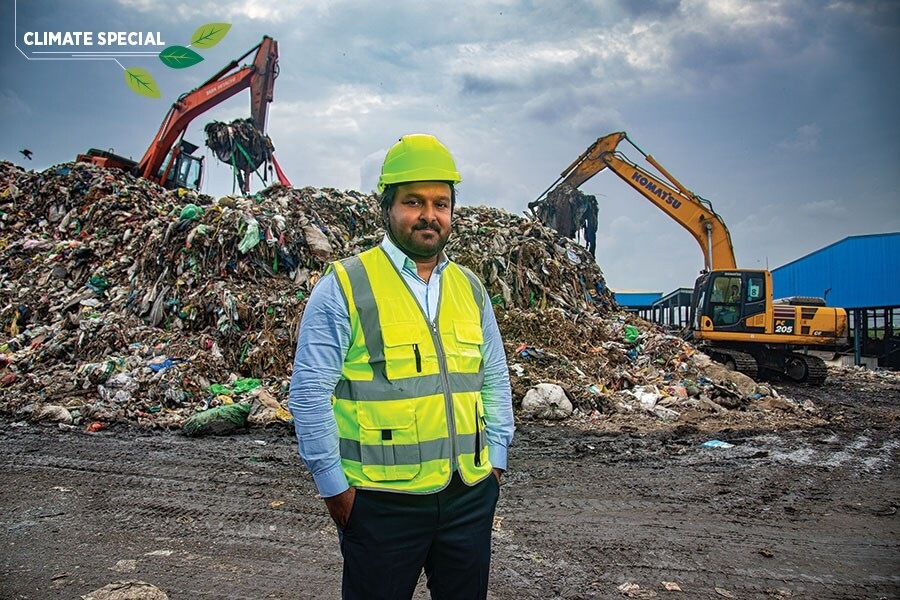
The quarter also carried an event that has nothing to do with accounting. On 8 July 2026, after roughly 650 mm of rainfall, a legacy waste mound collapsed onto an administrative building. The mound stood at a dumping site next to the company’s Pimpri-Chinchwad waste-to-energy facility. Twenty-three people were present at the time. Fourteen were rescued and nine died.
The company has stated it is paying medical expenses, legal expenses, funeral expenses and ₹40 lakh per affected family. It has also stated it is providing employment for immediate family members and education support for minor children.
Management stated that the mound was legacy waste lying outside the area allocated to the company. Management also stated that remediating it was not part of its contractual scope of work. The auditor treated it as a non-adjusting event under Ind AS 10, the rule covering events after a period closes. The financial impact will be recognised in the September 2026 quarter.
Separately, a road-sweeping contract worth ₹243.22 crore was awarded in August.
2. Introduction
Antony Waste Handling Cell Limited was incorporated in January 2001. It collects, transports, sorts, buries and burns India’s rubbish, and occasionally sells what is left. It belongs to the Antony Group, promoted by Jose Jacob and Shiju Jacob, which also builds automotive bodies. That is two decades spent on things that move and things nobody wants.
The route here reads like municipal India’s own biography. The first project, between 2000 and 2002, was manual sweeping for the Brihanmumbai Municipal Corporation. Mechanised sweeping followed. Then came collection contracts in R Central ward and Greater Noida, then Delhi, then Navi Mumbai. Private equity arrived, and in 2009-10 so did the Kanjurmarg landfill, the asset that now defines the company. Listing on the NSE and BSE came in 2021. The waste-to-energy plant at Pimpri-Chinchwad was inaugurated in August 2023 by the Prime Minister. That is a rare honour for a facility whose input material is what everyone else throws away.
Recent quarters have been busy in the way that generates paperwork. In December 2025, subsidiaries won two Brihanmumbai Municipal Corporation contracts worth roughly ₹1,330 crore over seven years. A ten-year Thane processing project of about ₹330 crore came alongside, carrying ₹67 crore of capital spending.
The NCLT, the tribunal that approves company mergers, cleared the merger of AG Enviro Infra Projects into the parent. AG Enviro was a wholly owned subsidiary, and the order is dated 18 December 2025. The appointed date is 1 April 2025, so the June 2025 comparatives were restated backwards. The standalone quarter grew from ₹8.75 crore of revenue to ₹146.75 crore. Same company, different arithmetic, entirely legitimate.
In April 2026, JFE Engineering invested about 750 million yen for 25% of two Andhra Pradesh waste-to-energy vehicles. These are special purpose vehicles, companies set up for one project each, at Kadapa and Kurnool. In July 2026, the company acquired 26% of Arts EV, for a Delhi electric bus project covering up to 800 buses. The year to March 2026 closed with revenue of ₹1,053.19 crore and a maiden dividend totalling ₹1.42 crore. The order book stood at ₹18,000 crore.
US
Now live
US Stocks terminal is live
13,000+ US tickers · EDGAR fundamentals · screener and filings feed — the same terminal, for American markets.
Explore →
3. Business Model: WTF Do They Even Do?
The company is paid to make rubbish disappear, and then paid again for what is left of it.
The first stream is collection and transportation. Crews pick up over 8,330 tonnes of municipal solid waste a day from households, shops, institutions and public places. It is hauled to a processing facility, a transfer station or a landfill. There are 19 such contracts running, with an average duration of 7.7 years. Billing runs on the number of trips, on a per tonne rate, or on a fixed daily rate. Escalation comes on the flat rate, on inflation, or on tender conditions. This was 60% of revenue in the year to March 2026.
Doing it takes a fleet of 2,639 vehicles. The two largest groups are small tippers and compactors, at 1,583 and 570. Then come drain silt machines and big tippers, at 143 and 127. There are 105 electric vehicles and 62 hook loaders. There are also 37 dumper placers and 12 power sweeping machines. Of the fleet, 2,484 carry GPS trackers, so a good stretch of road is watched by satellite on behalf of a compactor.
The second stream is processing, at 25% of revenue for the same year. It spans six waste processing contracts and one construction-and-demolition contract, averaging 23 years. Waste is sorted into organic, recyclable and inert, then composted, recycled, shredded or pressed into refuse derived fuel. That fuel is the dry combustible leftovers, meaning paper, textile, leather and rubber, plus non-recyclable plastic. Cement kilns buy it as a substitute for coal. The year to March 2026 saw over 1.77 lakh tonnes of it supplied, and over 15,500 tonnes of compost sold.
The centrepiece is Kanjurmarg, one of Asia’s largest single-location processing plants. It can handle 7,500 tonnes a day and currently manages about 6,000 tonnes. That is 90% of Mumbai’s waste. On site sit a 6,500 tonne-a-day bio-reactor landfill and a 250 tonne-a-day sanitary landfill. There