General information and entertainment, not investment advice. The author is not a SEBI-registered adviser or research analyst. No recommendation, no promised returns. Markets carry risk including loss of capital. Figures may not be current. Consult a registered adviser before acting.
1. At a Glance
The forging shop reported FY26 revenue of ₹141.78 Cr, up 17.8% year-on-year. The catch: net profit fell 20.5% to ₹28.27 Cr, the first decline after three years of consecutive growth.
The balance sheet holds ₹212.39 Cr of net worth against a ₹1,901 Cr market cap—a book value per share of ₹197, yet the stock trades at ₹1,646, a price-to-book multiple of 8.3x.
Operating margins widened to 30% from 28% the prior year. Working capital bloat—receivables now average 136 days, inventory at 71 days—absorbed cash that would have otherwise paid down debt or fund capex. The company sits nearly debt-free at ₹5.64 Cr borrowings.
An ₹150 Cr expansion project is underway (Phase 1 commissioned June 15, 2026). A question mark: Does heavy capex on profit inflation disappear once the new lines run full?
2. Introduction
Amic Forging Ltd (BSE-SME: 544037) was incorporated in 2007 and went public in December 2023 via a BSE-SME IPO. The stock has since tripled off its listing offer price.
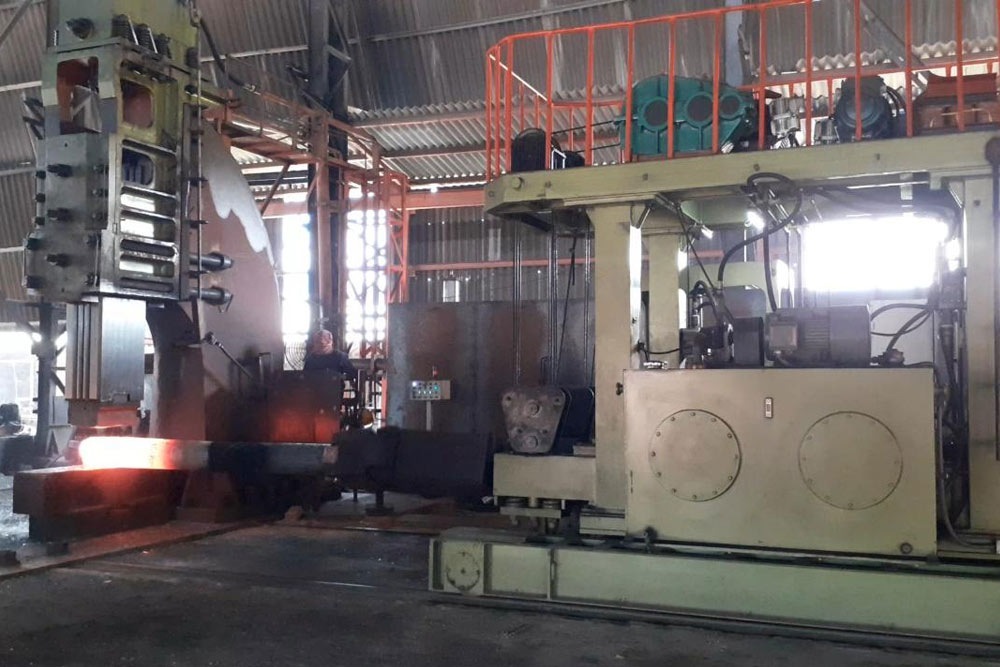
The company manufactures precision forged and machined components—shafts, blanks, flanges, coupling hubs, and bespoke engineering spares—mostly in carbon steel, alloy steel, and specialty alloys. Its customer base spans steel plants, railways, power generation, automotive suppliers, heavy engineering, and ports.
FY25 was anomalous: net profit jumped 268% to ₹35.56 Cr from ₹13.83 Cr in FY24, driven by a ₹20.71 Cr windfall in other income (likely a one-off investment gain). Strip that out, and FY25’s core profit was closer to ₹14.85 Cr—still growth, but not the headline-grabbing kind.
FY26 returned to reality. Revenue growth held steady at 18%, but operating profit gains did not fully translate to the bottom line. A higher tax rate (29% vs 22% in FY25) and rising finance costs (₹0.48 Cr, double FY25) compressed margins despite a better operating performance.
The company has filed to raise ₹220.99 Cr via preferential equity and warrants to fund a ₹150 Cr expansion into springs manufacturing for railway wagons. The fundraise and capex signal scale ambitions, not consolidation.
3. Business Model: WTF Do They Even Do?
The company operates a single segment: contract forging and precision machining.
Revenue is almost entirely from the sale of goods (97% in FY25), with a negligible contribution from services or licensing. A ₹2.5 Cr facility in Baidyabati, Hooghly (West Bengal), hosts the production lines. Installed capacity sits at ~18,000 MT per annum for forgings and ~8,400 MT for machining, though actual utilization hovers around 85%.
The customer list reads like a who’s-who of heavy industry: Indian Railways, NTPC, Vedanta steel plants, automotive OEMs, and material-handling firms. The company is vendor-qualified to AISI, BS, IS, and DIN standards—certification that locks customers in once qualified, but also means losing a customer can be slow if a new application is needed.
Geographical mix is 93% domestic, 7% export (FY25). There is room to grow exports—the company ships to customers globally but has not yet built a significant overseas footprint. Capex plans include a separate facility for springs, which suggests a vertical integration play or a new product line to reduce commodity-like pricing pressure on standard forgings.
The business model is asset-light by industrial standards—no mining, no smelting, no mining leases to manage. Raw materials (steel billets, scrap) are purchased freely, then transformed into finished goods via labour and equipment. Margins are therefore exposed to three levers: input cost inflation, labour efficiency, and pricing power. FY26 showed that input costs held (raw material as % of sales fell to 53% from 71%), but pricing power stayed muted.
4. Financials Overview
Figures are consolidated, in ₹ crore.
Metric
FY26
YoY Growth
FY25
Revenue
141.78
+17.8%
120.37
EBITDA
43.79
+13.8%
38.46
Net Profit
28.27
-20.5%
35.56
EPS
26.30
-22.5%
33.90
Revenue grew ₹21.4 Cr sequentially, the second consecutive year of double-digit top-line growth. EBITDA (profit before tax plus interest plus depreciation) rose 13.8%, a moderation from the prior year’s 22% jump. The moderation reflects the one-off nature of FY25’s income injection.
But net profit fell 20.5%, a full-stop decline after three straight years of 37%+ growth. The culprit: two items. First, other income shrank from ₹20.71 Cr to ₹1.03 Cr—a ₹19.7 Cr miss year-on-year. Second, the tax rate rose sharply to 28.8% (Effective Tax Rate was 29% on PBT of ₹39.72 Cr), a move from the 22% rate in FY25.
Depreciation nearly quintupled to ₹3.59 Cr from ₹2.87 Cr as the company capitalized new plant and machinery during the expansion phase. Finance costs doubled to ₹0.48 Cr as the company funded its capex partially via debt.
In half-year H1 FY27 (Oct-Mar 2026 ended): revenue was ₹75.2 Cr, net profit ₹15.9 Cr, EPS ₹14.76. Extrapolated, H1 trends suggest FY27 annualized profit in the ₹30-32 Cr range if growth steadies—a stabilization, not a recovery.
5. Market Expectations & Historical Multiples
This section describes how the market is currently pricing the company and how that compares with its own history and peer group. It is descriptive, not predictive.
Metric
Current
Historical Avg (3Y)
Peer Median
P/E
62.6x
51.2x
26.1x
EV/EBITDA
43.4x
38.7x
17.2x
P/B
8.3x
6.1x
3.8x
ROE
16.8%
19.4%
18.9%
ROCE
23.5%
25.6%
18.4%
The market currently pays 62.6x trailing earnings for Amic Forging, compared to a peer median of 26.1x for comparable forging and casting names (AIA Engineering, Happy Forgings, Balu Forge, Steelcast, Nelcast). The premium is pronounced.
On an EV/EBITDA basis, the gap is similar: 43.4x at Amic versus 17.2x at the peer median. Price-to-book stands at 8.3x, above the peer average of 3.8x.
Historical comparison: Amic’s own 3-year P/E average sits at 51.2x, so the current 62.6x is elevated even relative to its own recent framing. The stock has drifted upward post-IPO and warrant conversions.
What the market appears to be pricing in: (1) a belief that FY25’s profit jump was not entirely one-off; (2) the capex-driven scale-up will drive earnings in FY27-28; (3) the forging sector’s structural growth tailwinds (railways, power, heavy engineering). None of these are explicit management guidance—they are implied by the multiple.
Return on equity (ROE) sits at 16.8%, above the peer median of ~15%, and return on capital employed (ROCE) at 23.5% sits above the peer median of ~18%. Both metrics suggest efficient capital deployment, though ROCE