General information and education, not investment advice. The author is not a SEBI-registered adviser or research analyst. No recommendation, no promised returns. Markets carry risk including loss of capital. Figures may not be current. Always consult a SEBI-registered adviser.
1. At a Glance
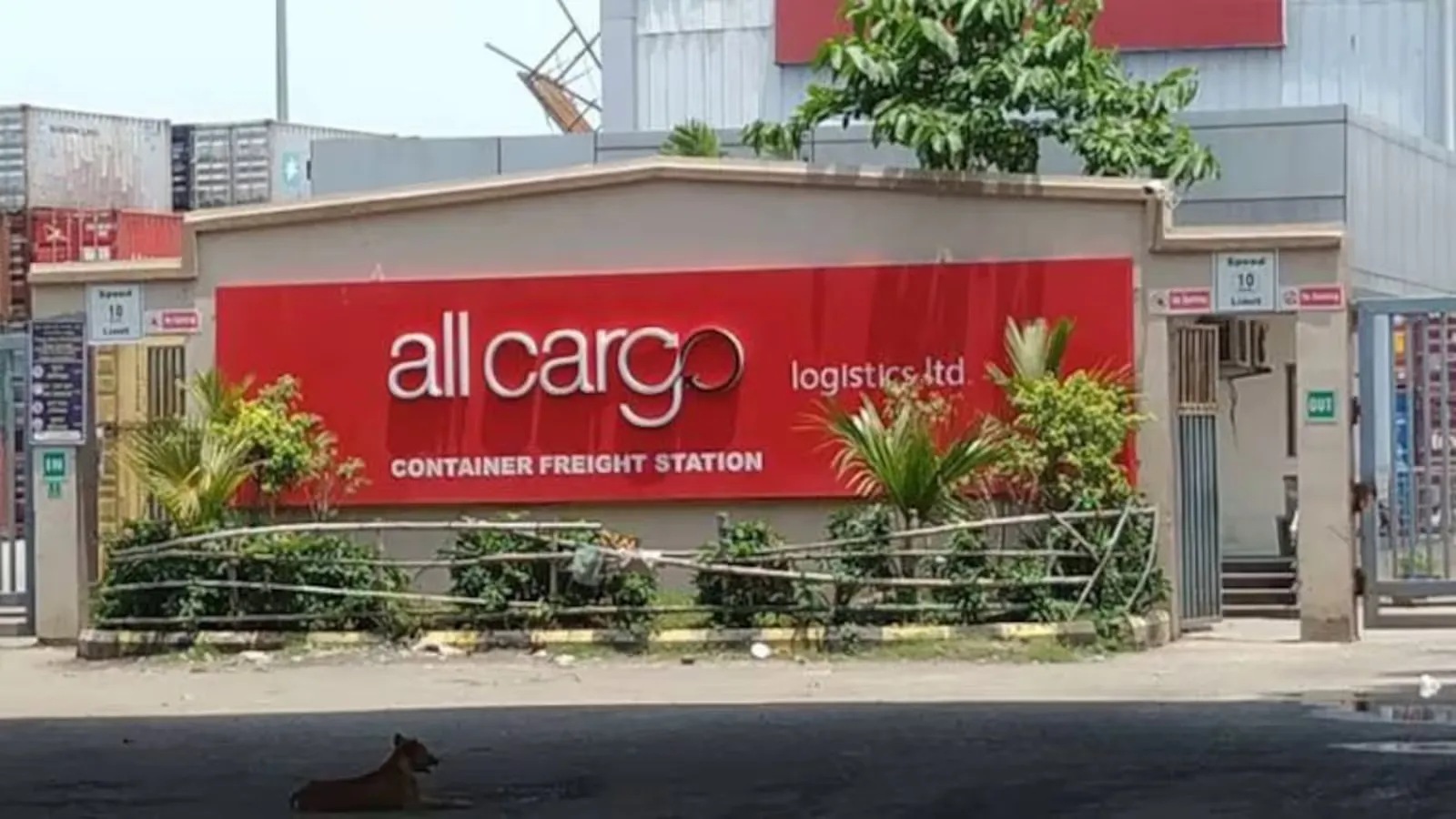
Allcargo Terminals runs container yards outside ports, where boxes are parked, unpacked, cleared by customs and handed on. Revenue in the three months to June 2026 was ₹214.41 crore, on 1,76,499 containers moved. A Managing Director has handed over the keys, and a ₹49.35 crore tax demand sits under appeal.
Revenue rose 14.5% from ₹187.25 crore in the same three months a year earlier. Operating profit, what sales leave behind after running costs, rose from ₹34.60 crore to ₹47.47 crore. That is an operating margin of 22.14%, the highest of the ten quarters on the sheet. Profit after tax came in at ₹6.37 crore, against ₹9.11 crore a year ago. Tax expense was ₹7.20 crore on a pre-tax profit of ₹13.57 crore. Management attributes that charge to tax on dividends from joint venture companies and a previous year’s tax impact.
Suresh Kumar Ramiah stepped down as Managing Director with effect from 31 August 2026. Pranav Choudhary was appointed from 1 September for a term of three years. The board also extended a ₹30 crore inter-corporate deposit taken from its own wholly owned subsidiary. An inter-corporate deposit is simply one company lending money to another. Borrowing from itself takes paperwork, which is what a group of this size reliably produces. Volumes grew 7.2%, and capacity grew about 20% in the year to March 2026.
2. Introduction
Allcargo Terminals was incorporated in 2019 and began standalone life only in the year to March 2023. It was carved out of Allcargo Logistics Ltd in a demerger, the splitting of one company into two. The National Company Law Tribunal approved that split by order dated 5 January 2023, effective 1 April 2023. Crisil, a credit-rating agency, says the business contributed roughly 3% of the old parent’s revenue. On Crisil’s figures it also contributed about 10% of that parent’s operating profit. This is the corporate equivalent of the quiet cousin who turns out to own property.
The physical business is much older than the listed company. The company’s own presentation traces the estate to 2003, when the first container freight station at JNPT opened. Mundra followed in 2007, Chennai in 2009, the Dadri inland depot in 2011 and Kolkata in 2019. Speedy JNPT was acquired in 2020. In the year to March 2022 the company bought 85% of Speedy Multimodes for ₹102 crore. Capacity went from 5,30,000 to 8,30,000 TEUs, the trade’s standard twenty-foot box. It picked up the remaining 15% in the year to March 2025, making Speedy wholly owned.
The recent stretch has been about pointing the business north and onto rails. In October 2024 the company approved buying a 7.6% stake in Haryana Orbital Rail Corporation Ltd. It bought that stake from Allcargo Logistics Ltd for ₹115 crore. The purchase was funded by a ₹140 crore term loan from Aseem Infrastructure Finance. Haryana Orbital is building an electrified double broad-gauge line from Palwal to Sonipat. The line is intended to connect to both the Dedicated Freight Corridor and Indian Railways. In the company’s plan it also connects to its proposed inland depot at Farukhnagar.
The share register has its own recent history. During the year to March 2026 the company allotted 3,97,98,999 partly paid shares at ₹20 each. That allotment aggregates ₹79.90 crore, of which ₹5 a share has been received. The rest is receivable on future calls, which are demands for the unpaid balance. Per the concall, ₹120 crore was raised in total, with close to ₹90 crore yet to be called. Very few businesses collect their own funding in instalments. Paid-up capital moved from ₹50.41 crore to ₹52.40 crore.
US
Now live
US Stocks terminal is live
13,000+ US tickers · EDGAR fundamentals · screener and filings feed — the same terminal, for American markets.
Explore →
3. Business Model: WTF Do They Even Do?
A container freight station is a car park that charges rent, employs customs brokers and occasionally opens the boxes.
More precisely: cargo reaches a port inside a sealed steel container, twenty or forty feet long. Somebody must take it off the port’s land, park it and unpack shared loads. Somebody must then obtain customs clearance, store the box while paperwork runs, and hand it to a truck. That somebody is Allcargo Terminals.
Per the company, operations cover import and export cargo stuffing and de-stuffing, customs clearance and ancillary services. Cargo handled includes containerised, hazardous and refrigerated loads. Break-bulk and specialised cargo are on the list too. The company also lists bonded warehousing, where goods sit before duty is paid, and non-bonded warehousing. First- and last-mile delivery and ISO tanks complete the offering. Revenue in the year to March 2024 was about 98% station services and about 2% other non-operating income, which is refreshingly free of the segment charts most companies use to look diversified.
The estate is seven stations at JNPT, Chennai, Mundra and Kolkata, plus one inland depot at Dadri held with CONCOR. The presentation lists each site like a real-estate brochure written by a logistics engineer. The two Mumbai yards cover 43 and 53 acres. Their throughput capacities are 3,60,000 and 1,80,000 containers a year. Mundra’s sites are listed at 80,000 and 1,40,000. Chennai carries 1,00,000 and Kolkata 75,000. Dadri is listed at 65,000. Distance from the port is given for every site, in kilometres, to one decimal place. Kolkata sits 2.5 km from the port. In this business, proximity is a business model. The company describes its subsidiary SML as the sole player in ‘Cluster 1’, the ring closest to the JNPA gate.
Total warehouse space stood at 1,15,378 sqm in the year to March 2026, unchanged from the year before. Throughput capacity was 10,50,000 containers a year, up from 8,80,000. Employees number more than 2,350, of whom 355 are on the payroll. More than 2,000 are contracted, which applies the asset-right approach to people.
The company leases its standalone stations at JNPA and Chennai from group company Transindia Real Estate Ltd. Per Crisil, Transindia also made the initial land acquisition investment for the Jhajjar inland depot project. Crisil calls this an asset-light model with capital allocation flexibility. Lease accounting then