All Time Plastics FY26: A 37-Multiple Masterclass in Squeezing Margins Out of Tupperware
Section 1 — At a Glance
The structural investment framework surrounding All Time Plastics Limited has entered a critical transition phase following its public listing in August 2025. Headline metrics reveal a widening divergence between revenue volume scaling and baseline profitability. Total consolidated revenue for FY26 closed at ₹610.50 crore, marking a 9.38% expansion year-on-year, driven primarily by volume execution across core international retail channels. However, consolidated profit after tax for the full year experienced a sharp compression of 25.14%, descending to ₹35.40 crore from the ₹47.29 crore recorded in the preceding fiscal cycle.
Investor attention is currently divided between an optimized capital structure and deteriorating operational return profiles. The injection of equity proceeds via the initial public offering has successfully deleveraged the balance sheet, liquidating legacy debt lines and reducing total borrowings from ₹218.60 crore to ₹80.30 crore. Conversely, this expanded capital base, combined with front-loaded capacity deployment costs, has triggered a severe dilution in structural efficiencies. Annualized return on equity deteriorated to 8.30% from a historical print of 21.00%, while corporate operating profit margins contracted by 340 basis points to finish at 14.73%.
This earnings degradation is closely tied to an aggressive asset-expansion roadmap. Total fixed property, plant, and equipment assets scaled to ₹402.80 crore as capital work-in-progress moved online at the Khatalwada export facility. While localized capacity additions aim to solidify long-term volume scalability, the near-term consequences manifest as unabsorbed fixed overheads, underutilized machinery configurations, and logistics-induced working capital extensions.
Deleveraging an industrial enterprise via equity expansion alters structural insolvency risk, but it simultaneously establishes a higher performance threshold for capital productivity metrics.
The forward-looking thesis now rests entirely on asset utilization velocity and the commercial validation of a newly conceptualized alternative material division.
Section 2 — Introduction
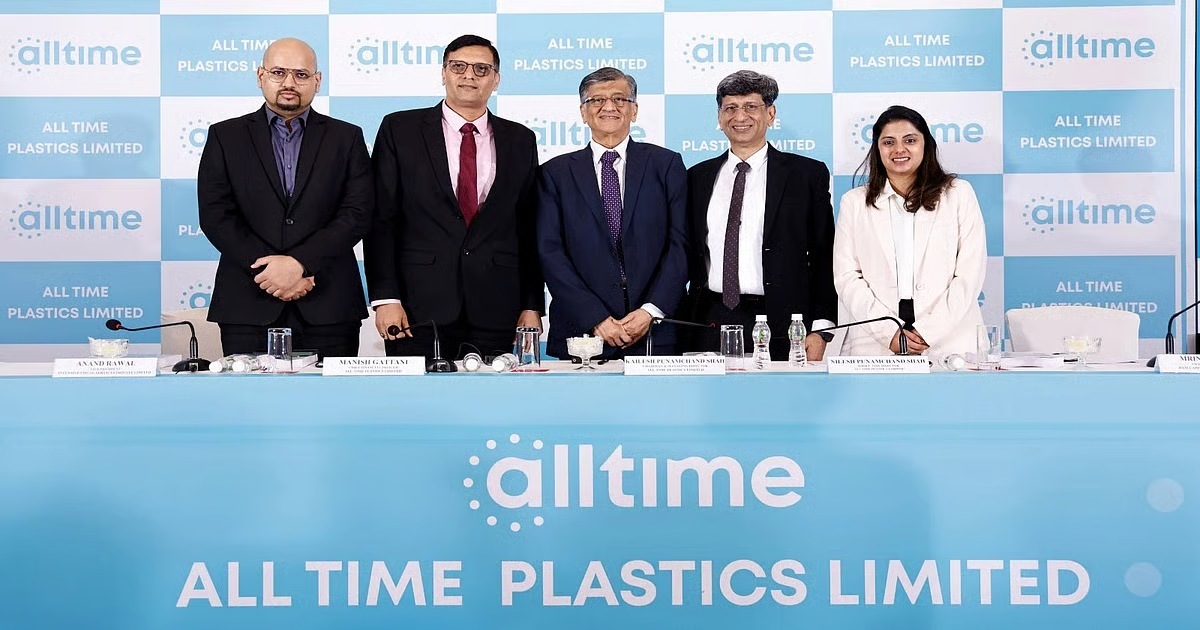
All Time Plastics Limited entered the corporate ecosystem over five decades ago, transitioning from a modest localized manufacturing footprint into an export-dependent, high-volume production platform for injection-molded plastic houseware. The structural narrative of the business took a definitive turn with its listing on the NSE and BSE platforms on August 14, 2025, an event that radically reshaped its balance sheet architecture while shifting the analytical spotlight onto its underlying operational mechanics.
The fiscal year 2026 was explicitly characterized by management as an investment and transition interval. The corporate framework spent the year deploying capital into extensive manufacturing expansions, notably at its primary export-oriented units in Khatalwada, Gujarat, and setting up a speculative infrastructure footprint in the northeastern bamboo production corridors. These strategic allocations occurred against a volatile macroeconomic backdrop, marked by severe maritime logistics friction along western trade routes, causing extended transit timelines and temporary inflation in foundational input costs. Management’s current focus remains centered on accelerating asset turnover across its newly established polymer lines while simultaneously initiating soft marketing launches for alternative consumerware categories to expand domestic penetration.
Section 3 — Business Model: WTF Do They Even Do?
All Time Plastics is, at its operational core, a massive, highly automated white-label kitchen and bathroom refinery disguised as a consumer products company. The business model functions almost entirely on a Business-to-Business (B2B) framework, dedicating 91.66% of its production architecture to manufacturing white-label consumerware. These goods are meticulously engineered, molded, and shipped directly to massive global retail conglomerates who stamp their own multi-billion-dollar brand logos onto the plastic hulls before placing them on shelves.
The product catalogue is a diversified spread of 1,848 stock-keeping units (SKUs) split across everyday domestic utilities. “Prep Time” kitchen tools and “Containers” hold a near-monopoly over corporate attention, consuming 35.77% and 34.91% of sales volume respectively, while hangers, organization modules, cleaning instruments, and baby cutlery pick up the structural crumbs.
The true vulnerability—or systemic dependency—of this operational layout is a staggering level of customer concentration. A single global home-furnishings behemoth, IKEA, commands 59.29% of All Time Plastics’ entire revenue pipeline. The broader international retail cohort—including Asda, Michaels, and Tesco—gobbles up the remainder, leaving the company’s export machinery responsible for 84.82% of total corporate sales. Geographically, this hitches the company’s fortune to European Union and UK consumption trends. If a single sourcing manager in Älmhult, Sweden, decides to alter their supply-chain allocation metrics by a fraction of a percentage point, the financial shockwaves inside All Time Plastics’ automated warehouses would be felt instantly.
Section 4 — Financials Overview
Figures are consolidated, in ₹ crore.
Headline Performance Metrics
Metric
Latest Quarter (Q4FY26)
YoY (%)
QoQ (%)
Revenue
145.75
-1.69%
-8.50%
EBITDA / Operating Profit
21.54
-11.36%
-8.34%
PAT
9.40
-2.89%
+2.61%
EPS (Reported)
1.43
-22.28%
+2.10%
The top-line momentum encountered a visible roadblock during the final three months of the fiscal year, with quarterly consolidated revenues dipping by 1.69% year-on-year to ₹145.75 crore. This compression trickled deep into the operational machinery, forcing quarterly EBITDA down by 11.36% to ₹21.54 crore as fixed overhead costs continued to bite into the lower-volume quarter.
What is Management Promising in the Coming Quarters?
During the corporate earnings calls, management presented an aggressive defensive posture regarding the structural compression seen across the transition period. The Chief Financial Officer explicitly indicated that the current margin degradation is a temporary phenomenon:
“EBITDA margin will definitely increase as the turnover increases because this fixed cost will be absorbed.”
The executive leadership team noted that while the broader civil and structural infrastructure layout at the core Khatalwada plant is entirely finalized, incremental costs over the next few horizons will be restricted to localized capex equipment deployment and basic operational labor additions as capacity utilisation scales upward from its exit rate of ~50% toward optimal design limits.
On the structural diversification front, management outlined a multi-quarter operational trajectory for its highly watched bamboo processing vertical. The corporate roadmap projects that the primary machinery deployments, which are currently in transit to the newly leased 75,000 square foot industrial site in Madanpur, Guwahati, will achieve full commissioning targets over the first half of the upcoming fiscal year. The financial guidance signals that while soft marketing initiatives and minor branded testing volumes will hit domestic touchpoints shortly, substantive commercial revenue recognition and visible P&L volume contribution will step up exclusively during the back half of FY27, with long-term strategic projections targeting a 20.00% revenue contribution mix within a three-year execution window.
Section 5 — Valuation Discussion: Fair Value Range Only
To evaluate the pricing boundaries of All Time Plastics Limited relative to its trailing market capitalization of ₹1,450.41 crore and a closing market price of ₹221.41, we evaluate three standard equity valuation methodologies based on full-year consolidated performance data.
The consolidated full-year reported basic EPS for FY26 settles exactly at ₹5.41 (derived from consolidated net profit of ₹35.40 crore divided by 6.55 crore outstanding equity shares). The immediate houseware and consumer durables peer group (comprising Cello World, Hawkins Cookers, and Borosil) exhibits a broad trading peer multiple band stretching from a conservative 24.0x to an aggressive 34.0x, establishing a normalized median peer multiple of roughly 30.0x. Applying this absolute operational peer band to the company’s verified EPS yields a primary baseline fair value range between ₹130 and ₹184 per share.
2. Enterprise Multiple Method (EV/EBITDA Band)
The corporate consolidated EBITDA for the full twelve-month period stands verified at ₹89.90 crore. Given the company’s post-IPO adjusted Enterprise Value of ₹1,436.00 crore,