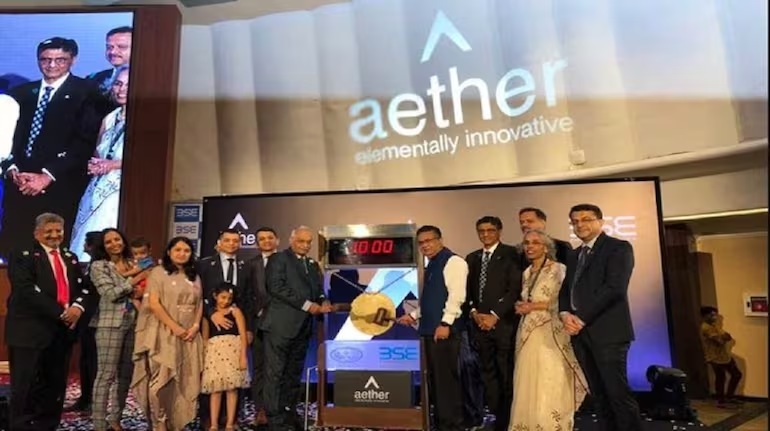
Aether Industries:
₹317 Cr Revenue. 64.2 Cr Profit.
Burning Cash Like It’s a New Energy Source?
Highest-ever quarterly revenue. Two new factories coming online soon. Management claims Baker Hughes and Milliken are about to hand them the keys to the kingdom. Meanwhile, the working capital cycle is longer than a Hindi cinema interval. Who’s the real winner here?
The Specialty Chemistry Startup That’s Actually Profitable (Plot Twist)
- 52-Week High / Low₹1,086 / ₹723
- TTM Revenue (12M)₹1,094 Cr
- TTM PAT (12M)₹224 Cr
- Latest EPS (TTM)₹16.3
- Q3 FY26 EPS₹4.86
- Book Value₹176
- Price to Book5.98x
- Dividend Yield0.00%
- Debt / Equity0.09x
- Interest Coverage18.4x
Aether: The Chemistry Nerd Who Decided to Become Rich
Aether Industries is what happens when you take a bunch of PhDs, lock them in a lab in Surat, and tell them: “Make chemicals nobody else in India can make.” Founded in 2013, the company now manufactures specialty chemicals like 4-MEP, MMBC, Bifenthrin Alcohol, and enough other unpronounceable compounds to make a NEET student weep. They’re the only large-scale manufacturer of several of these products in India. Globally, they’re the largest by volume for some. Congratulations, I guess.
The business model: Buy base oils and precursors from around the world. Hire scientists. Run them through complex multi-stage processes (some with 16 steps — yes, 16). Sell to pharma companies, agro-chemical firms, oil & gas majors, and whoever else needs really, really specific chemicals. Rinse. Repeat. Scale aggressively. Maybe go public. Maybe get a Stonepeak-like acquisition later. Maybe lose money. The point is, there’s profit here — but it’s drowning in working capital headaches.
Q3 FY26 just closed: ₹317 crore in quarterly revenue, highest ever. The company is ramping two new factories (Site 3++ and Site 5). They’ve signed contracts with Baker Hughes (oil & gas titan), Milliken (material science), Otsuka Chemicals, and are now courting European conglomerates. The stock is up, the mood is up, and everyone’s asking: Is this a ₹13,904 crore company or a ₹6,000 crore company with delusions of grandeur?
Making Molecules That Make Other People Rich
Aether’s business breaks down into three buckets: Large Scale Manufacturing (LSM, 59% of FY24 revenue), Contract Manufacturing / Exclusive Manufacturing (26%), and Contract Research & Manufacturing Services — CRAMS (14%). They export to 21 countries and sell domestically to over 220 customers. Pharma is 51% of revenue, agro is 27%, material science is 8%, coatings are 5%, and the rest are scattered like breadcrumbs.
The operational setup: Three manufacturing sites in Surat (Facility 1 for R&D and CRAMS, Facility 2 for large-scale production with 6,096 MTPA capacity, Site 3 with 3,500 MTPA, Site 4 now producing for Baker Hughes). Site 3++ is coming. Site 5 is coming. They’re adding capacity faster than customer demand is materializing. The company runs a 15.4% R&D spend (FY24), which is basically “throw everything at innovation and hope something sticks.” It worked. They’ve hired 276 scientists and engineers, including 148 PhD/Master’s degree holders.
The execution rigor is genuinely impressive. For one product like 4-MEP, the manufacturing involves 16 chemical stages. One fire in Q4 FY24 destroyed ₹14 crore of inventory and taught them a painful lesson in operations risk. But they’ve recovered. Capacity utilization at Site 2 is 76%, Site 3 is 70%, Site 4 is 49% (they admit it’s “progressing as per strategic planning,” which is HR-speak for “we’re waiting for Baker Hughes to ramp it up”).
Q3 FY26: The Numbers That Raise Questions
Result type: Quarterly Results | Q3 FY26 EPS (Consolidated): ₹4.86 | Annualised EPS: ₹19.44 | TTM EPS: ₹16.27
Source table
| Metric (₹ Million) | Q3 FY26 Dec 2025 |
Q3 FY25 Dec 2024 |
Q2 FY26 Sep 2025 |
YoY % | QoQ % |
|---|---|---|---|---|---|
| Revenue | 3,171 | 2,197 | 2,804 | +44.4% | +13.1% |
| Operating Profit | 1,083 | 620 | 849 | +74.7% | +27.6% |
| OPM % | 34% | 28% | 30% | +600 bps | +400 bps |
| PAT | 645 | 434 | 541 | +48.6% | +19.2% |
| EPS (₹) | 4.86 | 3.27 | 4.07 | +48.6% | +19.4% |
What’s This Chemistry Set Actually Worth?
Method 1: P/E Based
TTM EPS = ₹16.27. Industry P/E (chemicals peer group median) = 26.8x. Aether currently trades at 62.14x — a 2.3x premium. Specialty chemicals (higher ROIC, R&D-heavy) can justify 35x–50x multiples in growth phases. Fair P/E band: 35x–50x.
Range: ₹569 – ₹814
Method 2: EV/EBITDA Based
TTM EBITDA (estimated from 33% OPM conservatively on ₹1,094 Cr TTM revenue) = ₹361 Cr. Current EV = ₹14,063 Cr → EV/EBITDA = 38.9x. Specialty chemicals peers trade at 15x–25x EBITDA during normal cycles, 25x–40x during growth phases. Site 3++ and Site 5 coming online = growth phase justified.
EV range (25x–40x EBITDA): ₹9,025 Cr – ₹14,440 Cr → Per share:
Range: ₹678 – ₹1,085
Method 3: Sum-of-the-Parts (SOTP)
LSM Core (₹1,094 Cr × 59% = ₹645 Cr) at 25x EBITDA (mature, high capex) = ₹16,125 Cr. CEM/CRAMS Future (₹449 Cr) at 40x EBITDA (high-margin, recurring) = ₹17,960 Cr. Sites 3++/5 Optionality = +25% premium for new capacity utilization ramp.
→ Optimistic SOTP (25% ramp + exit multiple expansion): ₹1,050 per share
Range: ₹750 – ₹1,050
Baker Hughes, Milliken, and the Art of Betting Everything on Two Customers
🔥 The Factories Are Coming (We Think)
Site 3++ construction is complete. Site 5 Phase 1 (first 2 production blocks) construction is done. Water trials, solvent trials, equipment testing all done. Commercial production will begin “in the very near future” — which is corporate-speak for “soon-ish, maybe Q4, maybe Q1 FY27, who knows?” The company expects 45–50% utilization at Site 3++ and 35–40% at Site 5 (Block 1–2) in FY27 (first year ramp). Translation: they’re building factories with no guaranteed customer base. Welcome to venture capital thinking in a $600 Cr revenue company.
✅ Baker Hughes: Oil & Gas Jackpot?
- • Site 4 revenue: ₹60 cr in Q3 vs ₹50 cr in Q2 (+20% QoQ)
- • 8 products in production, 7–8 in pipeline
- • Management expects “run-rate to continue in FY26 and increase in FY27”
- • Goal: “Strategic partner across basket of products for next decades”
- • Reality: All eggs in one basket. One customer. Make or break.
⚠️ Milliken: 10-Year Contract, Zero Visibility
- • 10-year contract manufacturing deal signed June 2025
- • Site 3+ fully dedicated to one Milliken product
- • Commercialization on track for Q1 FY27
- • Revenue contribution: TBD (management silent on numbers)
- • Risk: Milliken owns 0% stake, 100% of leverage.
✅ New Adjacencies Emerging
- • Electronic chemicals (semiconductors): Validation batches in Japan, S. Korea, Taiwan
- • European material science CEM: Small now, “significant large contract within 1 year”
- • Otsuka Chemical: FY26 target of ₹35–40 cr on track
- • Converge Polyol (H.B. Fuller + Saudi Aramco): Still alive, early stage
⚠️ Lithium-Ion Additives: On The Shelf
- • Developed and scaled electrolyte additives (first time in India)
- • Now “on hold, on pause” due to China pricing crash (tanked to half)
- • “Not economically viable” right now, but ready to launch when pricing normalizes
- • Translation: Good R&D, bad timing. Story for maybe 2027–2028.
Is the Fort Still Standing? (Spoiler: It’s Expanding Faster Than It Can Afford)
Source table
| Item (₹ Cr) | Mar 2024 | Mar 2025 | Sep 2025 | Latest |
|---|---|---|---|---|
| Total Assets | 240 | 264 | 285 | 285 |
| Net Worth (Eq + Reserves) | 206 | 209 | 230 | 230 |
| Borrowings | 18 | 20 | 22 | 22 |
| CWIP (Capex in Progress) | 23 | 36 | 56 | 56 |
| Total Liabilities | 240 | 264 | 285 | 285 |
9M FY26 CWIP (Capital Work in Progress) = ₹500 cr. Expected full-year capex cash outflow: ₹450–500 cr. Site 3++ capitalization: ₹250–260 cr. Site 5: First 2 blocks ~₹200 cr, rest in CWIP. This is not prudent expansion — this is “we’re going to bet the farm.”
Debt = ₹22 cr (essentially debt-free). Debt/Equity = 0.09x. Interest coverage = 18.4x. But note: ₹500 cr CWIP will eventually become ₹500 cr debt if not funded through equity. The IPO money is being spent, not banked.
Inventory days: 356 days. Receivable days: 126 days. Payable days: 114 days. Net working capital cycle = 368 days. For every ₹100 of revenue, ₹100+ is stuck in working capital. This is the anti-Amazon model.
Operating Cash Flow vs. The Factory Budget
Source table
| Cash Flow (₹ Cr) | FY24 | FY25 | 9M FY26 |
|---|---|---|---|
| Operating CF | -1.6 | +10.0 | +122 |
| Investing CF | -42.4 | -41.8 | -283 |
| Financing CF | +89.4 | +2 | +157 |
| Net Cash Flow | +45.4 | -29.8 | -4 |
The Brutal Scorecard
Annual Trends — FY24 to TTM
Source table
| Metric (₹ Cr) | FY24 | FY25 | 9M FY26 | TTM |
|---|---|---|---|---|
| Revenue | 60 | 84 | 853 | 1,094 |
| Operating Profit | 13 | 24 | 272 | 359 |
| OPM % | 22% | 29% | 32% | 33% |
| PAT | 8 | 16 | 166 | 224 |
| EPS (₹) | 0.62 | 1.20 | 12.5 | 16.27 |
This is hypergrowth, undeniably. FY24 was a fire casualty year (₹60 cr revenue). FY25 and 9M FY26 show a company finding its footing. But here’s the thing: TTM revenue of ₹1,094 cr is still smaller than Castrol India’s quarterly run-rate (₹1,440 cr). And Aether trades at 5–6x the market cap of many peers in the specialty chemicals space. Margins are expanding because they’ve fixed the fire damage and are scaling existing contracts. Once capex ramps and new factories come online, margins will compress. This is the invisible third act.
Aether vs The Chemistry Nerds Next Door
Source table
| Company | TTM Revenue (₹ Cr) | TTM PAT (₹ Cr) | P/E | ROCE % | ROE % |
|---|---|---|---|---|---|
| Aether | 1,094 | 224 | 62.1x | 10.2% | 7.8% |
| Pidilite | 14,159 | 2,314 | 61.1x | 29.8% | 23.1% |
| Gujarat Fluoro | 4,852 | 667 | 52.4x | 9.9% | 8.3% |
| Deepak Nitrite | 7,946 | 542 | 37.3x | 16.3% | 13.4% |
Aether’s P/E is on par with Pidilite. But Pidilite earns 29.8% ROCE. Aether earns 10.2%. Pidilite doesn’t need ₹500 cr of capex. Aether does. Pidilite returns 23% on equity. Aether returns 7.8%. These are not comparable companies dressed in the same P/E — they’re in different universes.
Who Owns This Chemistry Lab?
- Promoters74.98%
- Public6.96%
- DIIs (SBI Funds)12.25%
- FIIs5.81%
Pledge: 0.00%. Shareholder count: ~67,806 (as of Dec 2025) — a growing base, but still concentrated. OFS (Offer For Sale) in FY26 brought down promoter from 81.79% to 74.98% to comply with listing norms.
Promoters: The Desai & Manjrekar Clans
Purnima Ashwin Desai (17.4%), Ashwin Jayantilal Desai (5.07%), and multiple family trusts. They’re engineers and chemists by training. Family trusts hold ~40% combined. No external investors on the board — it’s a founder-run family business with delusions of being a multinational.
SBI Funds: The Anchor Investor
SBI MultiCap Fund (8.63%), SBI Magnum Midcap Fund (partial stake). SBI being the largest institutional holder is both a blessing (credibility) and a curse (they’ll dump if growth stalls). When SBI exits, watch out.
Who’s Steering This Ship?
✅ Credibility Checkers
- ✓ ICRA rated [A+ (Positive)] in Sep 2025 — solid credentials
- ✓ Clean audit history — no material qualifications ever
- ✓ 276 scientists on payroll, 148 with advanced degrees
- ✓ R&D spending at 15.4% of standalone revenue (FY24) — top-tier commitment
- ✓ Quarterly concalls maintained, investor meetings attended (Singapore Emerging India, Abakkus, etc.)
- ✓ Pledge: 0.00% — promoters have skin in the game
⚠️ Red Flags
- ⚠ CTO James Ringer appointed March 2024 (new global tech hire, good sign, but why now?)
- ⚠ No dividend policy — zero return to shareholders while burning capex
- ⚠ Fire incident Q4 FY24 destroyed ₹14 cr, revealed operational fragility
- ⚠ Working capital cycle of 368 days is structural — no quick fix
- ⚠ Customer concentration risk (Baker Hughes, Milliken are single points of failure)
- ⚠ Factory announcements keep slipping (“in the very near future” has been the mantra for 6 months)
Specialty Chemicals: Where Margins Exist But Moats Don’t
The specialty chemicals industry is the wild west of Indian manufacturing. High margins (30–35%), niche products, recurring revenue from long-term contracts — all sounds great on paper. In reality, it’s capital-intensive, working capital-heavy, and entirely dependent on customer relationships and R&D firepower. Aether’s playing in a segment where product switching costs are high, but pricing power is zero (customers are massive multinationals who negotiate like sharks).
🌍 Global Outsourcing Tailwind: Real But Fragile
Management mentioned European chemical plants are “shutting down” and companies are showing “clear urgency” to finalize India partnerships. This is true — European manufacturing is expensive, and ESG regulations are punishing. India gets the overflow. But this creates a second problem: China also gets the overflow, and at ₹10/kg vs Aether’s ₹30–40/kg. For LSM (large-scale manufacturing) products, the price pressure from China is permanent.
🎯 CEM vs LSM: The Strategic Bet
Management’s targeting 70% CRAMS+CEM revenue and 30% LSM by medium term. CRAMS/CEM have recurring revenues (5–10 year contracts, auto-renewal), shorter payment cycles (45–60 days vs 180 days for LSM), and lower working capital. This is smart. The problem: conversion from CRAMS to commercial is taking 1–2 years on average (with some spanning 6 years). It’s a long game dressed as an urgent transformation.
⚡ Working Capital: The Kryptonite
LSM products (competing with China) require 180–250 day payment terms and LC (letters of credit). Receivable days of 126 and inventory days of 356 are killing cash conversion. Management acknowledged the issue but offered no concrete solution (“shift the mix toward CEM”). That’s not a solution — that’s a wish.
🔮 The Lithium Bet (On Hold)
Aether developed electrolyte additives for lithium-ion batteries — a ₹10,000+ crore global market. They scaled it. Then China crashed the price in half, making it uneconomical. It’s ready to launch when China pricing normalizes. The upside is real; the timeline is invisible.
Competitive landscape: Pidilite (consumer moat, 29% ROCE), Deepak Nitrite (integrated pyrites producer, pricing power), Aarti Industries (commodity chemicals with scale), and dozens of global majors (BASF, Eastman, etc.) are all swimming in the same pool. Aether’s unique because they’re the only large-scale Indian producer of certain molecules. But uniqueness ≠ profitability if the ROCE is 10%.
Macro backdrop: India’s capex cycle is strong (infra, vehicles, equipment). LSM demand is growing. Global supply-chain fragmentation is real. But inflation is also squeezing margins. Energy prices matter for chemistry. Crude oil at $80–90/bbl is manageable; at $120+, it’s brutal.
The Chemistry Is Solid. The Math Isn’t.
Aether is a company firing on all cylinders — 44% revenue growth, 49% profit growth, 276 PhDs on payroll, contracts with Baker Hughes and Milliken signed — but the stock is priced as if the company will deliver a 20-year CAGR of 40% from a 10% ROCE base. The delta between valuation and fundamentals isn’t just wide. It’s a canyon.
Q3 FY26 Execution: Highest-ever quarterly revenue (₹317 cr). Operating margins expanded to 34% (though management guides 29–30% forward). Baker Hughes revenue jumped from ₹50 cr to ₹60 cr QoQ. Five new marquee clients added. The concall spoke of “urgency” from European players and “strategic” multinationals lining up. On paper, this reads like a IPO-sized growth story still in the early innings.
The Hard Reality: Returns on capital are 10% (ROCE) and 7.8% (ROE) — lower than the cost of money. For every ₹100 of capex they deploy (and they’re deploying ₹500 cr), the company generates ₹10 in return. Meanwhile, ₹500 cr more of cash is tied up in working capital (inventory + receivables). The stock’s P/E of 62x prices in a 6–7 year doubling. That requires either (a) ROCE to shoot to 20%+ (possible), (b) margins to stay at 33% (unlikely), or (c) multiple expansion (the riskiest bet).
The Two Futures: Bull case — Sites 3++ and 5 come online, Baker Hughes and Milliken ramp, ROCE improves to 18–20%, stock re-rates to 40x P/E. 5-year CAGR: 25–30%. Bear case — Capex costs spiral, sites underutilize, Baker Hughes plateau, ROCE stays at 10%, multiple compresses to 35x. 5-year CAGR: 5–10%. The margin of safety is near zero. The stock is fairly valued for a perfect execution scenario. For a realistic one, it’s 20–25% overvalued.
✓ Strengths
- Only large-scale Indian manufacturer of several key molecules
- 44% revenue growth, 49% profit growth (Q3 FY26 YoY)
- R&D spending at 15.4% of revenue; 276 scientists
- Long-term contracts (5–10 years) with marquee clients
- Debt-free, zero pledges, ICRA A+ rating
- Margin profile at 30–33% OPM (industry-leading)
✗ Weaknesses
- ROCE 10.2%, ROE 7.8% — below cost of capital
- Working capital cycle 368 days (inventory-heavy, payment terms compressed)
- Free cash flow negative (capex ₹283 cr > operating CF ₹122 cr in 9M)
- No dividend, all earnings plowed into capex
- Customer concentration on Baker Hughes and Milliken
- China pricing pressure on LSM products (180–250 day payment terms required)
→ Opportunities
- Sites 3++, 5 coming online (₹500 cr capex) could unlock 1.5–2x capacity
- Electronic chemicals (semiconductors) emerging adjacency — global market ₹100,000+ cr
- European outsourcing tailwind — plants shutting, India capturing overflow
- Lithium-ion additives (ready to launch, ₹10,000+ cr market) waiting for China pricing normalization
- CRAMS/CEM mix shift (target 70% in 3–5 years) improves working capital and recurring revenue
- Converge polyol (H.B. Fuller + Saudi Aramco) early-stage commercialization
⚡ Threats
- China competition on LSM products (pricing, terms)
- Capex cost overruns (sites already 1–2 quarters behind original timeline)
- Baker Hughes or Milliken relationship deterioration = 50%+ revenue impact
- Working capital cycle remains structurally high (no easy fix)
- ROCE improvement requires significant operational efficiency gains (uncertain)
- Fire risk (Q4 FY24 incident) — operational and reputational
Aether is betting the farm on two new factories and two customer relationships coming through at scale.
The science is sound. The execution is plausible. The valuation is aggressive. A P/E of 62x is fine if you believe in 40% EPS CAGRs for the next 5 years. But most investors buying at ₹1,048 are betting on momentum, not fundamentals. Sites 3++ and 5 will launch. Baker Hughes will ramp. But the ROCE won’t improve overnight. Working capital will still be a drag. And when the reality of 12–15% growth (instead of 40%+) sets in, multiple compression will be brutal.
This is a high-conviction growth stock for conviction-level investors. Everyone else should wait for a 20–25% pullback or for the new factories to actually start generating cash. The market is paying for the dream. You need to decide if you’re buying the company or the narrative.