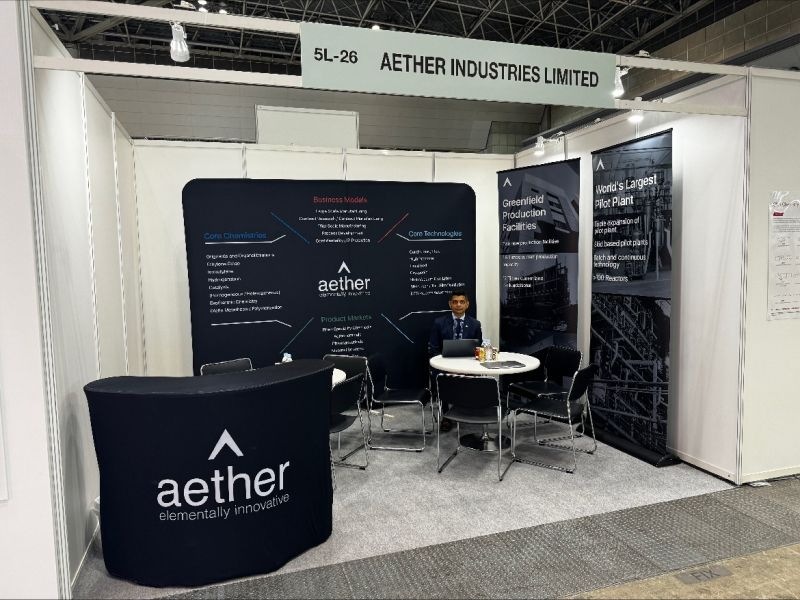
Aether Industries Limited Q4 FY26: The ₹11,601 Million Chemical Equation Where Operating Cash Slows and Multi-Stage Inventories Mount
1. At a Glance
Aether Industries Limited presents a complex case in the specialty chemicals sector. Total consolidated revenue from operations for the full financial year ended March 31, 2026, reached ₹11,601 million, showing a 38% growth compared to ₹8,405 million in the previous financial year. Concurrently, consolidated net profit after tax rose to ₹2,195 million from ₹1,584 million. These growth figures have drawn significant interest from market observers.
However, beneath these top-line and bottom-line expansions lie specific financial anomalies that warrant objective scrutiny. A principal area of focus is the structural difference between the company’s generated operating profits and its actual cash position. For the financial year 2026, the company reported a consolidated EBITDA of ₹3,547 million, yet the net cash generated from operating activities stood lower at ₹1,424 million. This indicates that a substantial portion of paper profits is tied up before converting to liquid capital.
The operational bottleneck is primarily located within current assets. Consolidated inventories expanded sharply from ₹3,969 million in FY25 to ₹5,375 million by March 31, 2026. Trade receivables also climbed from ₹2,886 million to ₹3,901 million over the same period. This building intensity in working capital has put pressure on asset efficiency.
Operational Disconnection Breakdown
Original reporting figures are presented in ₹ million.
Metric Type
Value (₹ Million)
Functional Status
Consolidated EBITDA
3,547
Total baseline operating profit recorded on paper
Inventory Outflow Absorption
-1,480
Capital trapped in raw materials and multi-stage steps
Receivables Outflow Absorption
-910
Capital locked in uncollected customer invoices
Net Cash from Operating Activities
1,424
Actual liquid cash flowing into bank accounts
Furthermore, the company’s expansion strategy has relied heavily on external capital. Net cash used in investing activities reached ₹6,194 million in FY26, outstripping the organic cash flows generated by operations. To fund this gap, short-term borrowings under current financial liabilities spiked from ₹1,825 million in FY25 to ₹4,417 million in FY26.
This balance sheet expansion has had a tangible impact on broader capital efficiency metrics, with the company’s return on capital employed remaining around 10% for the prior fiscal year, weighed down by high capital work-in-progress and prolonged conversion timelines.
2. Introduction
Aether Industries Limited functions within the highly specialized domain of advanced intermediates and specialty chemicals. Its manufacturing processes are characterized by complex chemistries that often involve numerous synthesis steps. While this positions the firm uniquely in the product landscape, it demands an intensive asset base and a prolonged manufacturing pipeline.
The financial performance of the fourth quarter of FY26 reveals shifting operational levers. Quarter-on-quarter dynamics indicate a sequential deceleration in profit metrics. Consolidated revenue from operations for Q4 FY26 was reported at ₹3,051 million, down from ₹3,188 million in Q3 FY26. Consolidated net profit for Q4 FY26 also cooled to ₹540 million from ₹645 million in the preceding quarter.
Management has attributed parts of this sequential volatility to logistics-driven shipment delays in late March and localized disturbances, including an external warehouse fire incident near Site 1 on March 11, 2026, which necessitated an inventory loss provision of ₹70 million.
From a structural standpoint, the company continues to execute an expansive capital expenditure program across its manufacturing facilities and research laboratories. While these expansions are intended to cater to a broader client portfolio across pharmaceuticals, agrochemicals, and material sciences, they alter the near-term risk-return profile of the balance sheet by elevating fixed charges and scaling up debt liabilities before production utilization optimizes.
3. Business Model – WTF Do They Even Do?
To understand how Aether operates, one must look at its three-pronged business segments. They do not just bulk-produce basic solvents; instead, they operate as a customized chemical laboratory running on an industrial scale.
Core Revenue Diversification
The operational structural mix for the business spans across three highly integrated distinct models:
Segment Model
Revenue Contribution (FY26 / Q4)
Operational Mandate & Core Focus
Large Scale Manufacturing (LSM)
43% of Sales
Advanced intermediates where Aether is the dominant or sole local supplier
Contract / Exclusive Manufacturing (CEM)
46% of Q4 Sales
Multi-year exclusive supply frameworks executed for multinational companies
Contract Research & Manufacturing (CRAMS)
10% of Q4 Sales
Low-volume, high-margin strategic research and scale-up services
The underlying irony of this business model is its multi-stage manufacturing complexity. For instance, creating specialized molecules like 4-(2-Methoxyethyl) Phenol (4MEP) requires up to 16 distinct chemical reaction stages.
While this creates high entry barriers for competitors, it forces the company to maintain mountains of Work-in-Progress (WIP) inventories. The materials sit inside expensive glass-lined reactors for extended periods, turning the manufacturing facilities into capital-devouring structures.
Have you ever wondered if a chemical process with 16 separate stages is a sustainable competitive advantage or just an operational nightmare waiting to trap your cash flow? Let us know your thoughts in the comments section below.
4. Financials Overview
The financial performance presents a distinct story depending on whether you examine the year-on-year expansion or the sequential quarter-on-quarter cool-off. Let us look directly at the verified consolidated disclosures.