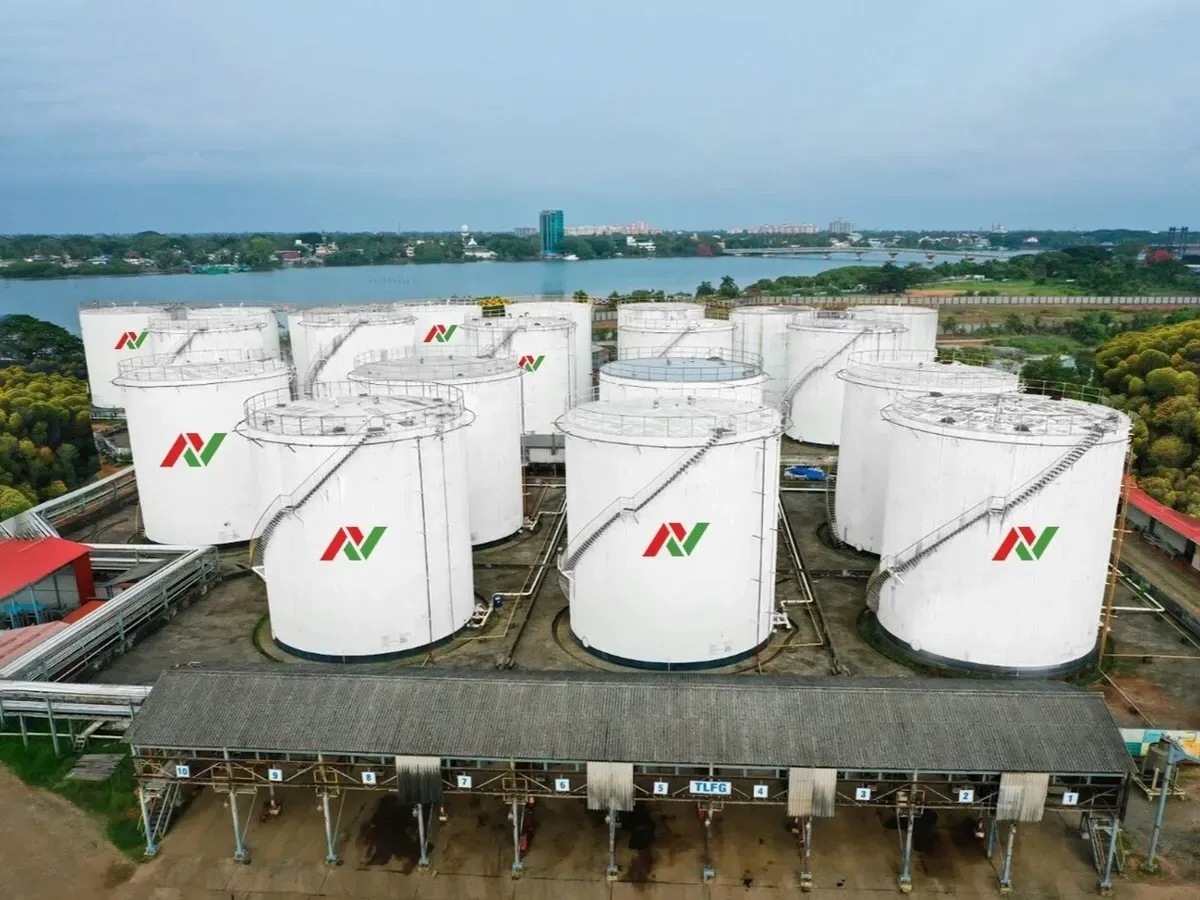
Aegis Vopak Terminals Q4 FY26: Margins at 74%, But ROCE Says “Still Waiting”
General information and entertainment, not investment advice. The author is not a SEBI-registered adviser or research analyst. No recommendation, no promised returns. Markets carry risk including loss of capital. Figures may not be current. Consult a registered adviser before acting.
1. At a Glance
Aegis Vopak Terminals posted FY26 revenue of ₹923 crore, up 49% year-on-year. That’s solid top-line thrust. But dig past the headline: net profit jumped 144% to ₹310 crore, yet return on equity sits at a lazy 10%.
The company owns India’s largest independent LPG and liquid storage network across six ports. Operating profit margin is a luscious 74.4%, which should be printing money. Instead, ROCE of 7.3% sits below the company’s cost of capital, suggesting assets aren’t yet sweating. The IPO in June 2025 raised ₹2,800 crore and triggered a ₹20.2 crore debt repayment—clean-up work that shifted the balance sheet but not yet the returns equation.
Capex is accelerating. Management speaks of ₹1.2 billion (₹12,000 crore) by end-next-year and ₹5 billion ($60+ billion INR) by 2030. That’s a bet on LPG demand, liquid logistics, and ammonia—India’s energy transition story written in storage tanks.
The tension: margins are world-class, but returns are landlocked. Can new capacity ramp-up fix that, or will ROCE stay stuck as a reminder that you can own 25% of India’s LPG imports and still not be rich?
2. Introduction
Aegis Vopak Terminals is a 50-50 joint venture between Aegis Logistics (an Indian conglomerate in oil, gas, and chemical logistics) and Royal Vopak (a Dutch giant with 400 years of terminal heritage and 77 facilities across 23 countries). The pairing is ancient expertise meeting emerging-market scale.
The company was spun into listed form in June 2025, giving public investors a direct bet on India’s LPG and chemical import infrastructure without the parent’s retail and distribution clamour.
Execution has been visible. Since the JV’s formation in late 2021, LPG capacity has grown 4.5-fold (from 67,000 MT to 226,800 MT post-acquisition of Hindustan Aegis LPG), and liquid storage has scaled 3.75-fold. The company operates 22 terminals across 6 ports: Kandla, Pipavav, Mangalore, Haldia (new, acquired in Jan 2026), Kochi, and JNPT (Mumbai).
In June 2025, FY26 quarter closed with Q4 revenue of ₹243 crore (+22% YoY) and net profit of ₹69 crore (+18% YoY). Full-year PAT hit ₹310 crore. The balance sheet was then reset: ₹3,731 crore in borrowings remain (down from ₹4,009 crore), and net debt sits near zero post-IPO proceeds.
3. Business Model: WTF Do They Even Do?
Aegis Vopak owns and operates storage and handling infrastructure for three product buckets.
Gas (Liquefied Petroleum Gas): The company stores and handles LPG at five terminals (Kandla, Pipavav, Mangalore, Haldia, and JNPT). Current static capacity is 225,800 MT, with another 77,236 MT under construction at JNPT. A cryogenic terminal at Mangalore (82,000 MT) and Pipavav (48,000 MT) came online in mid-2025. The company calls throughput “design turns”—how many times a year the storage empties and refills. At 84.75 turns, Aegis Vopak achieves some of the highest density in India. Gas revenue was ₹482 crore in FY26 (+8.6% YoY), about 52% of total sales.
Liquids (Chemicals, Oils, Petroleum Products): Six ports house liquid storage tanks across 2.1 million cubic meters of capacity. The company handles chemicals, lubricants, petroleum products, and vegetable oils. Liquid revenue jumped to ₹441 crore in FY26 (+27.8% YoY)—the fastest-growing segment. JNPT expansion is adding 318,100 cbm of new liquid capacity.
Ammonia (Energy Transition Bet): In March 2026, the company signed a 15-year take-or-pay contract with Hindustan Zinc (for its upcoming DAP plant at Pipavav) to store ammonia. A 36,000 MT ammonia terminal is being built for ~₹5.3 billion capex, commissioning Q1 FY27. Strategic partner Itochu bought 10% of the ammonia subsidiary for ₹80 crore in March 2026, with intent to raise to 25% over three years.
The business model is brutally simple: own terminals, sign take-or-pay or spot contracts, collect storage and throughput fees, repeat. Customers include state oil companies (IOCL, BPCL, HPCL), private traders, and global chemical majors. No inventory risk, no product risk—pure infrastructure toll.
Margins are thick because boats dock, hoses connect, tanks fill, boats leave. The company doesn’t buy or sell the molecules; it rents the real estate. That’s why OPM is 74.4% even as ROE is 10%—the denominator (equity) swelled with IPO capital, diluting the earnings.
The restatement for consolidation of Hindustan Aegis LPG (75% acquired Jan 2026) lifted FY25 comparables, but even on like-for-like terms, growth was real.
Q4 FY26 narrowed the picture: revenue ₹243 crore, EBITDA ₹179 crore (73.6% margin), PAT ₹69 crore (28.4% margin). The OPM dipped slightly in Q4 vs full-year (73.6% vs 74.4%), a signal that mix or utilisation tightened slightly, but immaterial.
From the Jun 9, 2026 Concall:
Management framed Q4 as “the year came together.” LPG throughput hit 3.9 MMT for FY26, steady vs prior-year path. Liquid segment was called “the fastest growing,” driven by Kandla and Mangalore ramp-up. Management guided no formal numbers but