Advani Hotels & Resorts (India) Ltd — FY26: One Resort, One Revaluation, One Very Large Number
Spotted a factual error — a wrong number, date, or fact? Tell us and we will check the source.
General information and entertainment, not investment advice. The author is not a SEBI-registered adviser or research analyst. No recommendation, no promised returns. Markets carry risk including loss of capital. Figures may not be current. Consult a registered adviser before acting.
1 — At a Glance
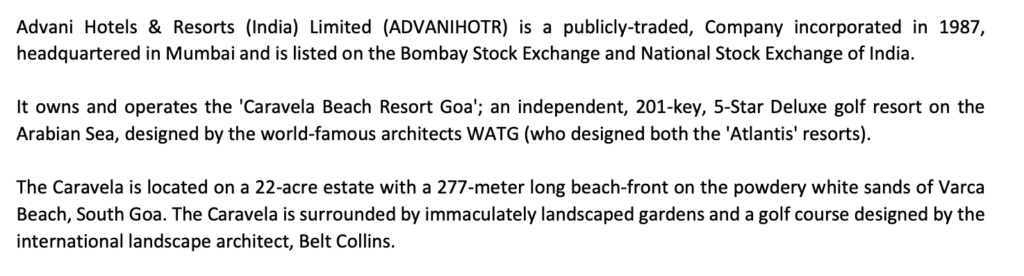
Advani Hotels & Resorts (India) Limited is a ₹491 crore company that owns exactly one asset: the Caravela Beach Resort, a 201-key, 5-Star Deluxe property on a 22-acre beachfront estate at Varca, South Goa. In FY26, that single asset generated ₹107 crore in revenue and ₹24.6 crore in net profit — modest figures on a standalone basis.
Then the board did something that changed the shape of every number on the balance sheet. Land carried since 1987 at a historical cost of ₹2.56 crore was revalued to ₹429.82 crore, per a registered valuer’s report. The ₹427.26 crore incremental surplus flowed into Other Equity via OCI, and total assets vaulted from ₹108 crore to ₹544 crore overnight — without a single additional rupee of revenue.
The operational picture is quieter. Annual occupancy fell from 82.0% to 73.4%, management attributed to geopolitical uncertainty and subdued foreign tourist inflows per the press release. Revenue from operations was flat at ₹107 crore. PAT dipped from ₹26 crore to ₹24.6 crore. The company remains debt-free, sits on ₹57.18 crore in liquid fund reserves including fixed deposits, and declared a total 70% dividend for FY26.
The tension entering FY27 is structural: operating earnings are steady but not expanding, occupancy has slipped a meaningful notch, and a new banquet facility is under construction — funded from internal accruals, per management. Whether the banquet hall restores occupancy momentum or merely adds capacity to an already-seasonal business is the open question.
2 — Introduction
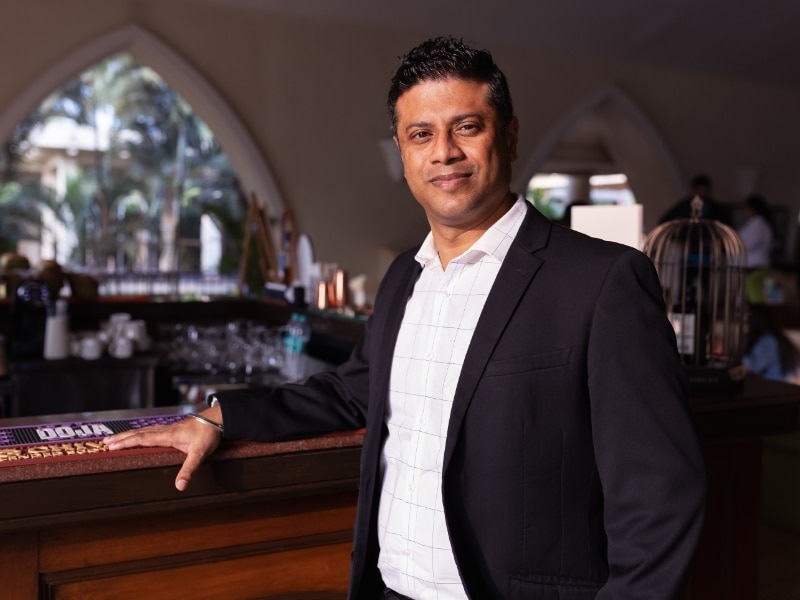
Advani Hotels & Resorts (India) Limited was incorporated in 1987 and has operated the Caravela Beach Resort Goa as its sole business ever since. The company is listed on both BSE (523269) and NSE (ADVANIHOTR), with its registered office in Nariman Point, Mumbai. It is run by the founding Advani family: Sunder G. Advani as Chairman and Managing Director, Prahlad S. Advani as CEO and Whole-Time Director, and Haresh G. Advani as Executive Director.
FY26 was operationally unremarkable by design — the resort does what it does, season in and season out. What made the year structurally notable was the land revaluation exercise completed in May 2026, which moved the freehold land from historical cost to revaluation model under Ind AS 16. Two registered valuers — Whitestone and ANVI — were engaged; the board adopted the lower (Whitestone) valuation of ₹429.82 crore for the resort land, against a historical book value of ₹2.56 crore.
The company also commissioned going-concern valuations of the operating business as a whole. Whitestone placed the as-is enterprise value at ₹828.50 crore; ANVI at ₹838.90 crore. The board disclosed the lower figure. A separate brand valuation of the ‘Caravela’ trademark was conducted; ANVI placed it at ₹81.88 crore and Whitestone at ₹93.72 crore — the board adopted the lower ANVI figure.
On the operational side, the company initiated construction of a new banquet facility, with plinth-level work already completed. Four pickleball courts were added to the property. The company also transitioned from LPG cooking systems to electric stoves during Q4, a change management attributed in the press release to volatile LPG prices that enabled cost optimisation.
A second interim dividend of ₹0.80 per share (40%) was declared in May 2026, bringing total FY26 dividend outgo to ₹1,664 lakhs — a 70% payout of PAT.
3 — Business Model: WTF Do They Even Do?
Advani Hotels & Resorts is, in the most literal sense of the phrase, a one-trick pony — except the trick is a 277-metre beachfront on the Arabian Sea, and the pony has been running it for nearly four decades without stumbling.
The Caravela Beach Resort Goa is the entire company. There are no subsidiaries, no other properties, no brand-management agreements, no real estate developments, no fee-based management contracts. The filings confirm: hoteliering is the sole business segment and segment disclosure is therefore not applicable. Everything from the P&L to the cash flow statement to the annual report tells the story of one address in Varca, South Goa, and nothing else.
The resort operates 201 keys as a 5-Star Deluxe property. It was designed by WATG — the architects behind both Atlantis resorts — and sits on a 22-acre estate. The golf course was designed by Belt Collins. The beach frontage runs 277 metres on the white sands of Varca Beach. This is not a budget property dressed up in marketing language; the physical asset is genuinely large and the positioning is genuinely luxury.
Revenue in FY23 (the most recent detailed breakup available in the filings) came approximately 63% from room sales, 24% from food, 5% from beverages, and the remainder from services including spa, transport, and health club. The model is classic integrated resort economics: get the guest onto the property, then extract value from every hour they stay. Room sale is the anchor; food and beverage is the margin extender.
Seasonality is structural and severe. The Goa resort calendar runs peak through the winter months (October–March) and goes quiet in monsoon. The quarterly results make this legible: Q4 (Jan-Mar 2026) posted revenue of ₹36 crore; Q3 (Jul-Sep 2025) posted ₹15 crore. The company generates nearly all its operating profit in two quarters and fights through two others.
The brand has accumulated a set of awards in FY26 — ‘Best Shack in Goa’ for the Beach Hut at Food Connoisseurs India Awards, ‘Best MICE Resort of Goa’ at India MICE Awards 2025, ‘Best Luxury Beachfront Wedding Resort in Goa 2025’, and the Booking.com Traveller Review Award 2026 with an 8.7/10 rating, per the press release, marking the eighth consecutive year of that recognition.
The business model’s central proposition has not changed: own irreplaceable beachfront real estate, operate it with a consistent luxury standard, and let Goa’s perennial demand for sun-and-sand luxury do most of the work. The strategic additions this year — a banquet hall and pickleball courts — are bolt-ons to the core, not a pivot.
Does a single-asset company with a beachfront it cannot replicate and earnings it cannot easily scale represent concentration risk, or geographic moat? The number that answers that question is TRevPOR, and it has risen from ₹9,933 in FY23 to ₹21,086 in FY26 — a 112% move in three years.
4 — Financials Overview
Figures are standalone, in ₹ crore. The filing confirms the company has no subsidiaries; standalone is the only basis available.
Annual P&L — FY26 (Full Year)
Metric
FY26
FY25
FY24
YoY Change
Revenue from Ops
107
107
105
Flat (-0.6%)
EBITDA (excl. other income)
32
35
34
-8.6%
PAT
24.6
26.0
24.8
-5.5%
EPS (₹)
2.58
2.86
2.70
-9.8%
Note: FY26 PAT of ₹24.6 crore (₹2,386 lakhs per press release) and EPS of ₹2.58 are full-year figures. This is the result type — Annual — so no annualisation is applied.
Q4 FY26 (Jan–Mar 2026)
Metric
Q4 FY26
Q4 FY25
YoY
QoQ (vs Q3 FY26)
Revenue from Ops
35.5
33.5
+5.97%
+140%
Operating Profit
16
15
+6.7%
—
PAT
11.9
11.5
+3.4%
—
EPS (₹)
1.27
1.24
+2.4%
—
Management Commentary (per the press release and board filing, May 27, 2026):
Management attributed the full-year occupancy decline from 82.0% to 73.4% to geopolitical uncertainty and subdued foreign tourist inflows. Despite this, TRevPOR rose 6.9% from ₹19,725 in FY25 to ₹21,086 in FY26, management said. The company also noted a transition from LPG cooking to electric stoves during Q4, which management attributed to volatile LPG prices and described as resulting in meaningful cost optimisation. The