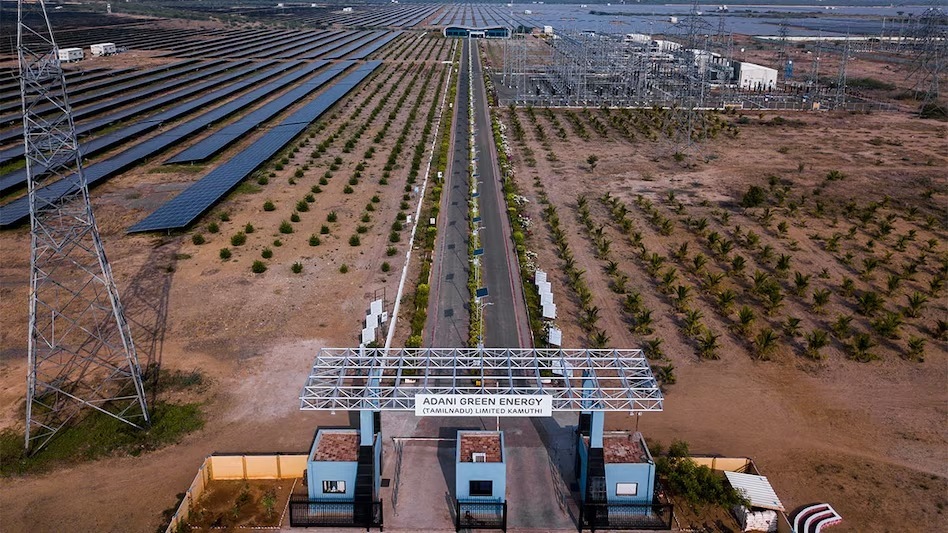
Adani Green Energy FY26: Solar Capacity at 19.3 GW, Debt at ₹1,03,545 Crore
General information and entertainment, not investment advice. The author is not a SEBI-registered adviser or research analyst. No recommendation, no promised returns. Markets carry risk including loss of capital. Figures may not be current. Consult a registered adviser before acting.
1. At a Glance
Adani Green added 5.1 GW of capacity in FY26, reaching a total of 19.3 GW by March 2026—a 35% year-on-year increase in installation pace. Energy sales jumped to 37.6 billion units, up 34% from FY25. Revenue grew 15% to ₹12,928 crore, while net profit inched up 14% to ₹1,652 crore.
Yet the company now carries ₹1,03,545 crore in debt, a 29% jump from FY25’s ₹80,040 crore. Total equity stands at ₹19,965 crore (capital plus reserves). The balance sheet has swollen to ₹1,42,988 crore in total assets, with capital work-in-progress (CWIP) at ₹19,031 crore—unfinished megaprojects waiting for grid connection.
The market paid ₹1,481 per share on the data reference date, valuing the enterprise at ₹2,43,947 crore. That implies a P/E of 133x on FY26 full-year earnings of ₹10.03 per share (calculated at 164.72 crore shares). Does a balance sheet piled with debt and unproductive assets earn that multiple? Or is the market pricing in a five-year vision where Khavda and 50 GW justify it?
Why this matters. Scale without earnings leverage is just capex. And capex without debt capacity is a cliff.
2. Introduction
Adani Green Energy is India’s largest renewable power generator and part of the Adani Group, which owns about 62% of the equity (as of FY26 shareholding data). The company was incorporated in 2015 and has grown from a footnote in renewable energy to a builder of the world’s largest single-location renewable complex—Khavda in Gujarat.
The renewable power sector in India is seeing policy tailwinds: record non-fossil capacity additions (55 GW in FY26 alone), India’s stated 500 GW renewables target by 2030, and an acute need to replace coal-fired baseload capacity. Adani Green sits at the center of this energy transition story and has the execution muscle to absorb capital at scale.
But the capital is coming via debt. FY26 borrowings crossed ₹1 lakh crore for the first time. The company is also building storage—battery and pumped hydro—to address intermittency, a shift from pure power generation. By March 2026, Khavda held 1.4 GWh of operational battery capacity, with plans to add 10 GWh by end-FY27.
The April 2026 concall revealed that transmission evacuation (grid connection capacity) is now the binding constraint on additions, not construction speed. Management stated they’ve scaled to add 5+ GW per year but will throttle to 4.5–5 GW in FY27 pending grid expansion.
Context. The market is pricing a story where infrastructure gating gives way to earnings, and where debt repayment begins. This article reports the numbers. The story—whether it holds—belongs to you.
3. Business Model: WTF Do They Even Do?
Adani Green’s core business is brutally simple: sign 25-year fixed-tariff power contracts (Power Purchase Agreements or PPAs) with state and central utilities, build solar and wind plants to fulfill them, and collect ₹X per kWh for life.
That’s not a competitive business. It’s a concession business. Pricing is set by tender. Suppliers compete on execution speed and cost. The winner builds and collects. Risk is political (will the counterparty pay?), not commercial (will customers buy?).
FY26 contract mix: 86% of energy came from fixed-tariff PPAs, mostly with SECI, NTPC, NHPC, and state DISCOMs. The other 14% was merchant sales—uncontracted power sold in the day-ahead market at spot prices. Fixed tariffs lock in predictability; merchant exposure drives upside volatility.
Adani Green’s portfolio by technology:
Solar: 71% of capacity in FY26. The bulk of the business. Solar is capital-intensive upfront (build cost ~₹4 crore per MW), then operationally cheap (minimal fuel cost, predictable output). Capacity factor (utilization) averages 24.8% in FY26, meaning each MW runs ~6 hours of equivalent full output per day.
Wind: 13% of capacity. Windier assets in coastal India. Capacity factor of 27.2% in FY26. Wind is lumpier—some sites excel, others don’t—so diversification matters.
Hybrid: 14% of capacity at year-end (down from 16% in FY25). Solar + wind on the same land, offsetting seasonal variation.
Pumped Hydro Storage: Pilot stage. One 500 MW project under construction in Andhra Pradesh (Chitravathi), targeted for FY27 commissioning. This is strategic: it shifts Adani from a “power generator” to a “dispatchable power provider.” Storage commands premium pricing; it also absorbs capex and debt.
Revenue model is straightforward: energy sold (in MWh or billion units) × average realization (Rs/kWh). In FY26, energy sales were 37.6 billion units (up from 27.9 billion in FY25), and average realization was ₹3.43/kWh (a mix of tariffs across the portfolio). Result: ₹12,928 crore in revenue.
Operating expenses are minimal—the OPM (operating profit margin) was 83% in FY26. That means ₹100 of revenue leaves ₹83 as operating profit after paying for operations, maintenance, salaries, and admin. Why so fat? Because the tariff covers capex repayment, fuel, and profit upfront. Adani Green doesn’t compete on margin; it competes on execution (building on time, under budget) and on debt cost (borrowing cheap).
The hard part is deployment. Adani Green must add 5 GW+ per year through 2030 to hit its 50 GW target. Each GW needs ~₹4,500–5,000 crore of capex and ~₹8,000–10,000 crore of debt/equity finance. Land acquisition, EPC (engineering, procurement, construction) contracts, environmental clearances, transmission links—any delay compounds.
Khavda alone is 30 GW by 2029, making it a single point of execution risk. If Khavda stumbles, the entire trajectory stumbles.
4. Financials Overview
Figures are consolidated, in ₹ crore.
Metric
FY24
FY25
FY26
YoY Change (FY26 vs FY25)
Revenue
9,220
11,212
12,928
+15%
Operating Profit (EBITDA est.)
7,339
8,889
10,785
+21%
Depreciation
1,903
2,498
3,372
+35%
Interest
5,088
5,492
6,484
+18%
Profit Before Tax
1,671
2,215
2,001
-10%
Tax
411
214
14
-93%
Net Profit
1,100
1,444
1,652
+14%
EPS (Full Year)
₹6.94
₹9.12
₹10.03
+10%
Quarterly trajectory (FY26):
The year was uneven. Q1 (Apr–Jun 2025) saw ₹3,073 crore in sales and ₹230 crore net profit. Q2 (Jul–Sep 2025) surged: ₹3,800 crore sales, ₹713 crore profit—the strongest quarter due to heavy energy output (monsoon winds). Q3 (Oct–Dec 2025) cooled: ₹3,008 crore sales, but ₹583 crore profit, a miss on the expected follow-up. Q4 (Jan–Mar 2026) dipped further: ₹3,502 crore sales, only ₹397 crore profit, pulled down by a ₹135 crore tax loss carryforward that turned into a one-time tax benefit.
Full-year tax rate: 0.7%. That’s not a typo. Tax was ₹14 crore on ₹2,001 crore of PBT because the company carried forward losses (from earlier years when it was pre-profitability) and applied them as credits. This is real and legal, but it masks underlying effective tax rate. Once loss carryforwards are exhausted, expect the tax rate to normalize toward 20–25%.
Concall flavor (April 2026):
Management reported FY26 energy sales of 37.6 billion units (+34% YoY). Revenue from power supply was ₹11,602 crore (+22% YoY). EBITDA was ₹10,865 crore (+23% YoY), with an EBITDA margin of 91.2%. This margin is unusually high because most contracts are fixed-tariff PPAs; Adani’s job is to collect, not to negotiate prices. Capacity additions of 5.1 GW were described as the “highest greenfield annual capacity extension globally by any company outside China.” Khavda now hosts ~9.4 GW of operating capacity (solar, wind, hybrid, and battery storage across the group). The Chitravathi pumped-storage project is “slated to complete in this fiscal year” (FY27). Battery storage at Khavda is being ramped aggressively toward 10 GWh by end-FY27.
The tone was confident but gated: management acknowledged that transmission evacuation capacity is the “primary near-term limiter” and that they are aligning FY27 additions (4.5–5.0 GW) to match grid availability, not to their installation capability.
5. Market Expectations & Historical Multiples
This section describes how the market is currently pricing the company and how that compares with its own history