01 — At a Glance
The Pharma Intermediate Company That’s Becoming Something Else Entirely
- 52-Week High / Low₹2,297 / ₹930
- Q3 FY26 Revenue₹393 Cr
- Q3 FY26 PAT₹106 Cr
- Q3 EPS (₹)₹13.19
- Annualised EPS (Q3×4)₹52.76
- Book Value₹173
- Price to Book12.8x
- Dividend Yield0.07%
- Debt / Equity0.01x
- 3-Month Return+34.2%
Breaking Down the Madness: Acutaas just posted ₹393 crore quarterly revenue (+43% YoY), ₹106 crore PAT (+134% YoY), and a 27% PAT margin. Gross margin exploded to 57% — an increase of 1,073 basis points. EBITDA margin hit 38.3%. The stock returned +35% in 3 months and +97% in 1 year. Management calls this “phase 1” of a three-vertical pivot. They’re upgrading FY26 guidance to ~30% revenue growth and 32–35% EBITDA margin. This is not normal. This is not sustainable. This is what happens when a company stops being a contract manufacturer and starts building its own businesses.
02 — Introduction
A Contract Chemist Becomes a Strategic Beast (Or Dies Trying)
Acutaas Chemicals (formerly Ami Organics) was founded in 2004 as a contract manufacturer of pharmaceutical intermediates. Decent margins. Boring story. Global footprint across 55 countries. 130 Ph.D.-level R&D staff. Client list reads like a pharma directory: Sun, Cipla, Lupin, Zydus. The business worked. It still works. Pharma APIs for NCEs and generics. Specialty chemicals for cosmetics and paints. Straightforward.
Then management had an idea: What if we stopped being someone else’s contract factory and built our own verticals?
2024–2025 was the inflection. CDMO (Contract Development and Manufacturing Organization) business ramped. Battery chemicals (electrolyte additives) plant started commissioning. Semiconductor chemicals joint venture with Korean partner launched. The Ankleshwar facility reached GMP certification from Japan’s PMDA. Multiple facilities now validated globally.
Q3 FY26 is the first quarter where all three engines fired in parallel. Revenue at ₹393 crore. PAT at ₹106 crore. EPS of ₹13.19. Annualised EPS (Q3×4) = ₹52.76, which makes the P/E look “only” 42x instead of 63x (if full-year earnings distribute evenly). They’re not distributing evenly. This is a quarter of peak margins driven by product mix, not a normalized run-rate.
Let’s understand what’s actually happening and whether the magic is real or fairy dust.
Concall Noise (Feb 2026): “We are evolving into a diversified chemicals company with multiple business verticals… by FY28, we will operate as independent self-sustaining growth engines.” Translation: We’re getting tired of being a glorified vendor. Also, FY26 guidance raised to 30% revenue growth and 32–35% EBITDA margin.
03 — Business Model: WTF Do They Even Do? (Now, Really)
Pharma + Batteries + Semiconductors = Three Bets on the Future (But Which One Pays?)
Acutaas operates three segments, all aligned toward the India + Emerging Markets megatrend:
Vertical 1: Advanced Pharmaceutical Intermediates (85% of revenue). The core business. They buy or synthesize key starting materials, convert them into advanced pharmaceutical intermediates, and sell to global pharma companies who use them in their drugs. Low-volume, high-complexity. Two sub-verticals: (a) APIs for off-patent generics (bulk commodity stuff, lower margins), and (b) CDMO (contract development manufacturing for patented molecules and NCEs—higher value, higher risk). 4–5 year payoff horizons. Management targets CDMO to reach ₹1,000 crore by FY28 (from ~₹90 crore FY24). Ambitious. Possibly delusional. Possibly not.
Vertical 2: Battery Chemicals (Electrolyte Additives) — Just Commissioned. New in FY26. Jhagadia facility inaugurated Jan 19, 2026. Makes VC (vinylene carbonate) and FEC (fluoroethylene carbonate)—the additives that go into lithium-ion battery electrolytes. Global battery market growing 20%+ annually. Acutaas’ capacity is 4,000 MT (2,000 VC + 2,000 FEC). Management called this “a very humble capacity vs market.” Translation: they’re just getting started. Margins > pharma. Contract-based pricing (not spot). Ramp-up expected from Q1 FY27.
Vertical 3: Semiconductor Chemicals (Baba Fine Chem + Indichem JV). Baba Fine Chem (BFC) is the in-house semiconductor chemical unit—early stage, high-value specialty products for chip manufacturing. Indichem Inc. is a South Korea joint venture (75% Acutaas, 25% local partner J and Materials Co.) focused on semiconductor chemicals manufacturing for Korean/Japanese/Taiwanese markets. Capex: ₹200 crore over FY26–FY27. Revenue expected from CY27 onwards. Unit economics: “1 to 1 asset turn with high EBITDA margins.”
Three verticals. Three geographies. Three margin profiles. By FY28, management wants each to be “self-sustaining.” Translation: each hits ₹300–500 crore revenue run-rate independently.
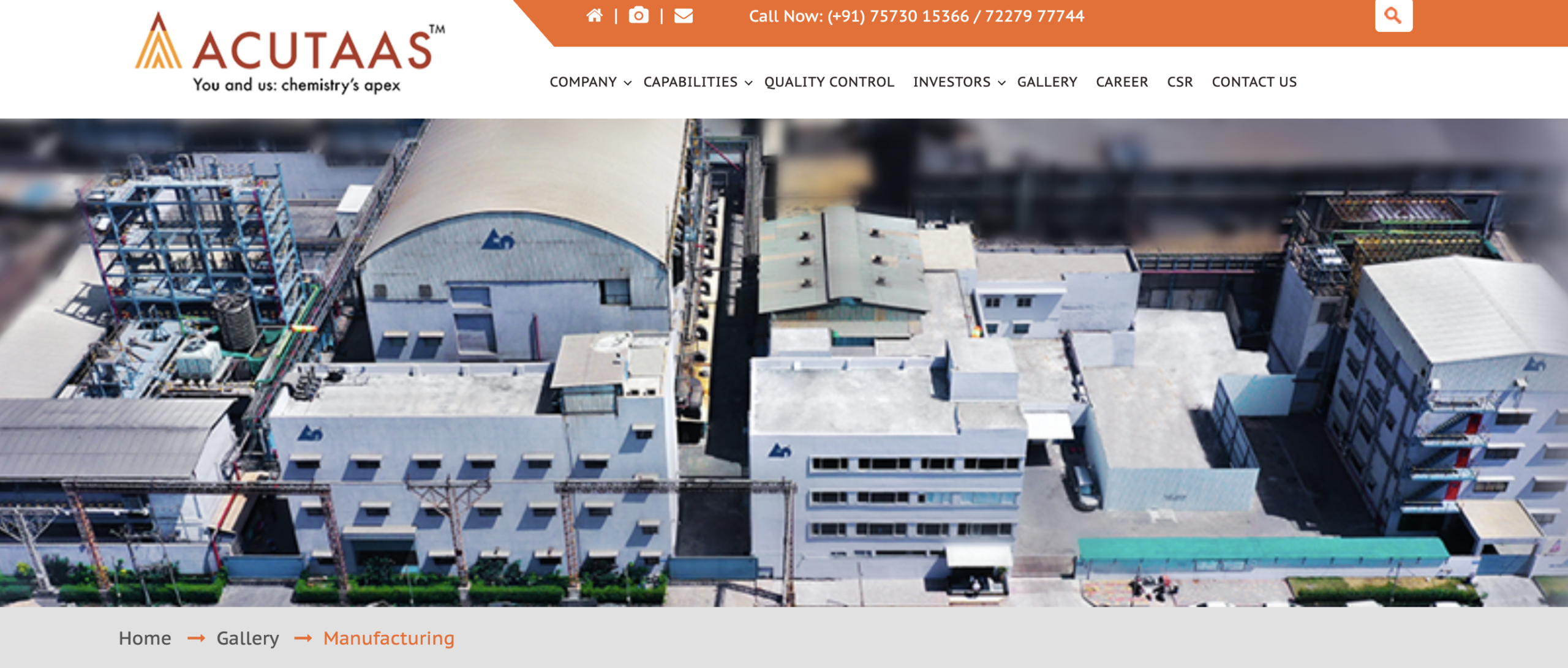
Manufacturing Footprint: Four facilities across Gujarat and Uttar Pradesh. Total area 76,891 sq m. Total installed capacity 1,100 KL. All validated globally. Ankleshwar (442 KL) is the growth driver—CDMO + battery chemicals + semiconductor chemicals all happening here.
04 — Financials Overview
Q3 FY26: Record Profitability (Or Is It?)
Result type: Quarterly Results | Q3 FY26 EPS: ₹13.19 | Annualised EPS (Q3×4): ₹52.76 | FY25 Full-Year EPS: ₹19.38
| Metric (₹ Cr) |
Q3 FY26
Dec 2025 |
Q3 FY25
Dec 2024 |
Q2 FY26
Sep 2025 |
YoY % |
QoQ % |
| Revenue | 393.2 | 275 | 306 | +43.0% | +28.6% |
| EBITDA | 150.7 | 69 | 95 | +118.5% | +58.6% |
| EBITDA Margin % | 38.3% | 25% | 31% | +1,335 bps | +735 bps |
| PAT | 106.2 | 45 | 72 | +133.7% | +47.5% |
| EPS (₹) | 13.19 | 5.49 | 8.82 | +140.3% | +49.4% |
What Just Happened: Revenue jumped ₹118 crore QoQ. EBITDA jumped ₹56 crore. PAT jumped ₹34 crore. This is not normal sequential growth—this is two months of trial production followed by one month of actual sales (battery chemicals block commissioned Jan 19). Yet somehow, gross margin went from ~50% to 57%, and operating margin from 31% to 38%. Management explicitly said: “More of a margin improvement for this quarter is again… because of the product mix.” Translation: they’re selling the right products in the right geographies right now. But this doesn’t run-rate.
P/E Math: FY25 full-year EPS = ₹19.38. CMP ₹2,210. P/E = 114x (yikes!). But Q3 EPS annualised (Q3×4) = ₹52.76. P/E = 42x (still expensive, but less insane). Full-year FY26 guidance implies ~30% growth, so let’s assume FY26 EPS ~₹25–28 (conservative). CMP ₹2,210. P/E = 79–88x (expensive). The key phrase: “IF the company executes on FY28 capex and FY27 ramp-ups, valuations compress. If they don’t, this looks like a 60x bet on faith.”
05 — Valuation: Fair Value Range
What’s This Company Worth (Seriously)?
Join 10,000+ investors who read this every week.