Action Construction Equipment Q4 FY26: Heavy Metal Slowdown Meets the ¥500,000 Japanese Handshake
Section 1 — At a Glance
Action Construction Equipment ended FY26 on a flattish note, signaling a temporary exhaustion of the domestic capital goods growth cycle. Revenue for the full year stood at ₹3,280.44 crore, down marginally by 1.40% from the previous fiscal. Net profit managed a tiny expansion to ₹415.09 crore compared to ₹409.22 crore in FY25, highlighting a shift from rapid volume expansion to absolute pricing execution. While trailing multiples remain high, market participants are processing a massive deceleration in core volumes following structural transitions.
Investor attention remains intensely focused on the newly operationalized joint venture with Kato Works Company, Japan. This partnership is designed to establish a premium domestic platform for heavy slew cranes and international exports. However, deep cyclicality worries are mounting. Core cranes and construction material handling equipment volumes dropped sharply to 10,853 units in FY26 from 13,360 units in FY25, revealing the severe hangover of pre-buying ahead of strict environmental regulation shifts.
When structural demand runs into sudden compliance-driven price hikes, capital returns inevitably face brief dilution. Return on Capital Employed (ROCE) moderated significantly from 40.59% to 32.71% due to a expanding cash pile sitting on the balance sheet. Net cash and investments now eclipse ₹700 crore, creating a capital allocation drag that requires efficient project deployment. The short-term trend depends entirely on navigating severe steel raw material inflation and the market absorption of sequential price increases.
Section 2 — Introduction
Action Construction Equipment (ACE) operates as a prominent capital goods play integrated into India’s infrastructure expansion. Established in 1995, the company has transformed from a regional hydraulic crane manufacturer into a heavy equipment giant spanning logistics, construction, agriculture, and defense. It commands the domestic industrial landscape by supplying heavy lifting capacity across real estate developments, manufacturing complexes, and transport networks.
The operational focus of FY26 has been marked by defensive pricing strategies and corporate reorganization. To insulate its long-term market share from external macro constraints, management finalized a 50:50 corporate split of its heavy cranes division into a joint venture with Kato Works. Concurrently, severe input costs and macro disruptions forced the company to transition away from structural volume growth toward protective pricing calibrations.
Section 3 — Business Model: WTF Do They Even Do?
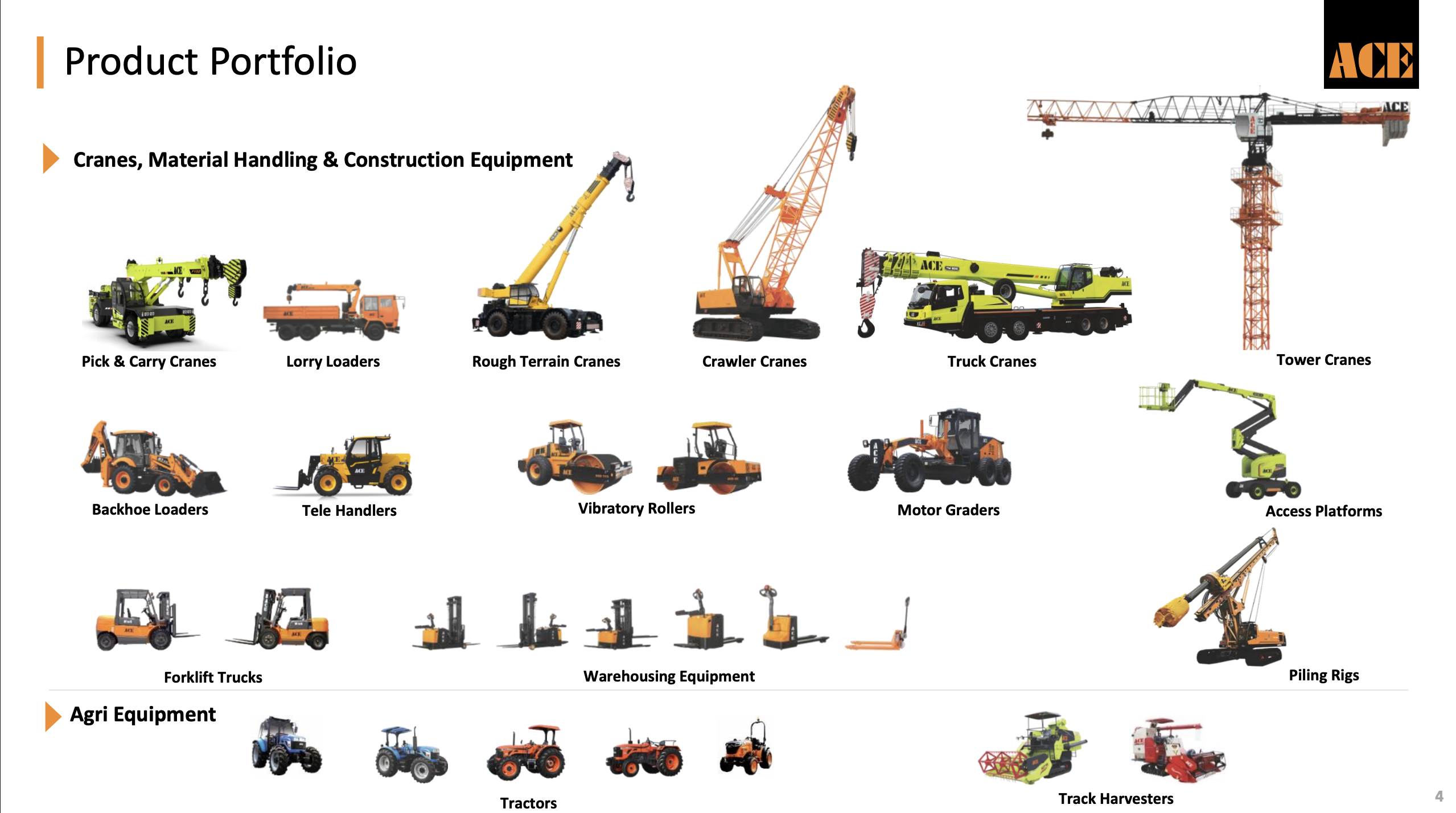
ACE manufactures mechanical beasts designed to lift, move, and dig heavy things. If a project requires shifting thousands of tons of concrete across an infrastructure site, ACE provides the machinery.
The enterprise thrives on structural dominance in two core domestic categories: Pick & Carry mobile cranes, where they enjoy a 63%+ market share, and fixed tower cranes, capturing 60%+ of the market. The business is heavily tilted toward infrastructure, manufacturing, and logistics, which collectively soak up 80% of total product output. The remaining business line involves building tractors and harvesters for the agricultural sector. Unfortunately, the agricultural arm behaves like a low-margin side hobby, generating only 8% of segment revenue while running on a thin 1% operating margin framework.
Section 4 — Financials Overview
Figures are consolidated, in ₹ crore.
Quarterly Consolidated Performance
Metric
Latest Quarter (Mar 2026)
YoY (%)
QoQ (%)
Revenue
₹1,029.49
23.17%
20.46%
EBITDA
₹172.40
32.94%
32.88%
PAT
₹110.91
12.67%
-4.72%
EPS (Reported)
₹9.31
12.58%
-4.81%
The final three months of the fiscal year provided a significant revenue surge, pushing quarterly sales above ₹1,000 crore for the first time. Profitability metrics improved on a sequential basis, with operating margins expanding by 145 basis points. However, absolute net profit suffered a sequential drop of 4.72%. This divergence occurred because other income turned into a negative ₹6.12 crore due to mark-to-market valuations on listed bond portfolios. Volatile investment valuations often obscure underlying manufacturing gains during periods of sharp treasury market fluctuations.
Did Management Walk the Talk?
During previous periods, management confidently pointed toward structural volume growth and