Search for Stocks /

Abate As Industries FY2026: A ₹14 Cr Company Became a ₹159 Cr One Without Selling Much More Eyewear

Spotted a factual error — a wrong number, date, or fact? Tell us and we will check the source.

General information and entertainment, not investment advice. The author is not a SEBI-registered adviser or research analyst. No recommendation, no promised returns. Markets carry risk including loss of capital. Figures may not be current. Consult a registered adviser before acting.

1 — At a Glance

Consolidated revenue at Abate As Industries went from ₹14.09 crore in FY2025 to ₹159.41 crore in FY2026. Net profit moved from ₹1.1 crore to ₹12.3 crore over the same stretch. On the face of it, this is an eleven-fold year. Look one layer down and the picture rearranges: in February 2025 the company issued 7.37 crore equity shares on a preferential basis “for a consideration other than cash,” and its FY2026 consolidated statements now fold in three subsidiaries, one of them in Bahrain. The auditor’s own note records that ₹160.65 crore of the ₹161-odd crore group revenue and ₹10.44 crore of group profit came from subsidiaries reviewed by other auditors, not the parent.

So the headline growth and the corporate housekeeping arrived in the same twelve months. The parent standalone entity earned its keep on other income; the consolidated entity earned its scale on additions. Both numbers are audited, both are real, and they describe two different companies wearing one name.

The market currently pays 12.7x earnings for the whole thing — against a hospital-peer median near 48x. A company that grew revenue 1,031% trades at a quarter of its sector’s multiple. That gap is the entry’s central tension.

Does a company become eleven times bigger, or does it simply consolidate eleven times more of itself onto one page?

2 — Introduction

Abate As Industries was incorporated in 1991 and, until recently, went by the name Trijal Industries Limited. The rename tracks a change in purpose: the company today describes itself as an eye-healthcare operator running super-specialty hospitals and optical outlets, and simultaneously as a “multi-sector enterprise” spanning healthcare, education, retail, technology, real estate and consultancy.

The FY2026 record is dominated by capital-structure events. In February 2025 the board allotted 7.37 crore shares on a preferential basis, lifting paid-up capital from about ₹5 crore to ₹78.8 crore. On 31 July 2025 it issued 1:1 bonus shares, doubling the count again to 15.76 crore shares. In December 2025 authorized capital was raised to ₹200 crore, and a February 2026 board note took it further still. Alongside, an independent director resigned in November 2025 citing personal reasons, and an internal auditor was appointed in May 2026.

Management, on its June 2026 earnings call, framed the year as a move “from platform building phase to platform scaling phase,” with healthcare intended to become the primary long-term driver. The filings, meanwhile, record segment reporting as “not applicable” — so the group runs six stated business lines and reports them as one.

3 — Business Model: WTF Do They Even Do?

Start with the part that has a building attached to it. Abate runs four operational eye hospitals — Perinthalmanna, Calicut, Kannur and Chennai — and states a target network of 44 across “South India and the Gulf.” Around that sits a chain of optical outlets selling eyewear. This is the coherent business: ophthalmology and the spectacles that logically follow.

Then the portfolio widens considerably. The company also lists wholesale mobile-accessory retail, departmental stores, an electronics range “from different brands under one roof,” educational institutions offering courses in healthcare, architecture and business, a private-university ambition across five cities, business and financial consultancy (including “public listing support such as BSE acquisition”), architecture consultancy, marketing consultancy, and value-driven real estate. Six sectors, one micro-cap, no segment disclosure.

The consolidated group makes this concrete. Its FY2026 subsidiaries are Salamath Import & Exports, Prudential Management Services, and Sky International Trading WLL in Bahrain, plus an associate, SAIA Educational Support Services, also in Bahrain. Per the concall, healthcare contributed roughly 22% of consolidated revenue in FY2026; management stated a directional aim of pushing that toward 70–80% “over time” without giving a year.

Which means the eye-care company is, for now, mostly a trading-and-services company that also does eye care. The FY2025 revenue split the company itself disclosed puts sale of services near 90% and sale of products near 3%. The hospitals are the story management tells; the trade is where the revenue currently sits.

4 — Financials Overview

Figures are consolidated, in ₹ crore.

MetricMar 2026 (Q)YoY (Mar 2025)QoQ (Dec 2025)
Revenue33.9414.0942.69
Operating Profit3.100.813.93
PAT2.931.193.06
EPS (₹)0.190.080.19

The March quarter shows revenue more than double its year-ago level, while stepping down from the December quarter’s ₹42.69 crore. Operating margin for the quarter sits at 9.1%, up from 5.75% a year earlier — the figures are on the data sheet. Note the earlier quarters of FY2025: through June, September and December 2024 the entity recorded revenue of zero and small operating losses, then ₹14.09 crore lands in the March 2025 quarter alone. The revenue base, in other words, switches on rather than builds.

On the earnings call, management attributed FY2026 momentum to “patient volume, procedure growth, clinical capabilities, and operating efficiencies,” and pointed to positive operating cash flow as a quality-of-earnings milestone — the CFO’s framing, quoted, not adopted here as forecast.

5 — Market Expectations & Historical Multiples

This section describes how the market is currently pricing the company and how that compares with its own history and peer group. It is descriptive, not predictive.

MetricCurrentHistorical AveragePeer Median
P/E12.7x48.2x
P/B0.90x
EV/EBITDA10.4x
ROE7.3%
ROCE6.7%14.8%

The market currently pays 12.7x earnings here versus a peer median near 48x. On operating returns, the company’s 6.7% ROCE sits below the peer median of about 14.8%. The peer set, however, is Apollo, Max, Fortis, Narayana and similar large listed hospital chains — single-business operators at thousands of crore in revenue — while this is a ₹156 crore multi-sector entity carrying a 22% healthcare mix. The multiple gap and the return gap describe the market pricing a small, diversified, recently-consolidated company differently from established single-line hospitals.

What the market appears to be pricing in, on the facts in this entry, is caution: a business whose reported scale arrived through consolidation and capital events within one year, whose returns trail the sector, and whose largest revenue lines are trade and services rather than the healthcare it leads with. The book multiple below 1x reflects that the market values the equity near its stated net worth of ₹173 crore rather than above it.

The one factual observation on market expectations: the peer set’s multiple prices continuity of operations; this company’s multiple prices a track record still one year old.

6 — What’s Cooking

The material events sit in the filings, and there are several. A 1:1 bonus issue landed on 31 July 2025. Authorized capital was raised to ₹200 crore in December 2025. In March 2026, an entity named ASYA acquired 70,92,291 shares — about 45% of a holding — off-market from a public shareholder named Fazil. In April 2026, NPMED Healthcare LLP sold in the open market, its stake falling to 10.09%. An internal auditor, Sasi Vijayan & Rajan, was appointed in May 2026, and an independent director was appointed the same February the capital plans advanced.

On the forward side, management disclosed on its June 2026 call a capex envelope of roughly ₹50 crore “to support future expansions,” with acquisitions considered “only… financially attractive and aligned,” and no funding mix specified. That ₹50 crore figure is the largest hard forward number in the record — set against a company that generated ₹6.13 crore of operating cash this year.

7 — Balance Sheet

ItemMar 2025Mar 2026
Total Assets205.65222.93
Net Worth163.79173.39
Borrowings10.579.55
Other Liabilities31.2939.99
Total Liabilities205.65222.93

Assets equal liabilities in both columns; the books close.

  • Reserves fell from ₹84.99 crore to ₹15.78 crore while equity capital rose from ₹78.8 crore to ₹157.61 crore — the 1:1 bonus capitalising reserves into share capital, moving money from one line to the next without leaving the building.
  • Borrowings of ₹9.55 crore against ₹173 crore of net worth give a debt-to-equity of 0.06; leverage is not where this company’s questions live.
  • Cash and bank stood at ₹3.54 crore at year-end — a modest till for an entity floating a ₹50 crore capex ambition.

A balance sheet can be clean and still be young. This one is both.

With ₹3.54 crore cash against ₹9.55 crore borrowings, the company sits in a small net-debt position rather than net cash, notwithstanding the “almost debt-free” label the ratios earn it.

8 — Cash Flow: Sab Number Game Hai

YearOperatingInvestingFinancing
Mar 2025-0.71-162.42164.66
Mar 20266.13-3.02-2.43

FY2025 tells its own story in three numbers: ₹164.66 crore flowed in from financing, ₹162.42 crore flowed out into investing, and operations leaked ₹0.71 crore. That is the shape of a year spent acquiring and capitalising rather than trading. FY2026 is calmer — ₹6.13 crore generated from operations, small outflows elsewhere. The swing from negative to positive operating cash is the one line management leaned on hardest, and it is the line that most cleanly reflects a business now running rather than assembling.

Cash flow is the ledger that doesn’t care how you got here — only whether the doors stayed open once you arrived.

9 — Ratios: Sexy or Stressy?

RatioValue
ROE7.3%
ROCE6.7%
P/E12.7x
PAT Margin7.7%
D/E0.06

ROE at 7.3% means the equity is putting in a part-time shift — the net worth is large relative to the profit it currently produces. ROCE of 6.7% sits below the sector and below what a capital-heavy healthcare build typically aims for. The 7.7% PAT margin is respectable for a trading-weighted mix, and reflects that other income of ₹2.64 crore did real work inside a ₹13 crore pre-tax profit. D/E of 0.06 confirms the company funds itself with equity, not debt — which, given the year’s capital-raising, is less a virtue than a description.

10 — P&L Breakdown: Show Me the Money

YearRevenueOperating ProfitOther IncomePATEPS (₹)
Mar 202514.090.810.971.100.07
Mar 2026159.4113.002.6412.300.78

The Other Income column earns its place here. In FY2025, other income of ₹0.97 crore sat beside operating profit of ₹0.81 crore — meaning the non-operating line was larger than the business’s own operating result. In FY2026 the operating profit of ₹13 crore finally outweighs the ₹2.64 crore of other income, so the profit is now predominantly operational rather than incidental. That shift — operating profit overtaking other income — is a cleaner sign of a working business than the revenue headline is.

On EPS: profit rose roughly eleven-fold and EPS rose from ₹0.07 to ₹0.78 in step. Because the share count is stated on a consistent adjusted basis (15.76 crore shares), the bonus doubling doesn’t distort the comparison — EPS and PAT move together, and neither hides the other.

11 — Peer Comparison

CompanyRevenue (Qtr)PAT (Qtr)P/E
Apollo Hospitals6,605.50551.3064.4
Max Healthcare2,142.89342.2271.1
Fortis Health.2,364.67271.1967.3
Narayana Hrudaya2,593.81223.9947.5
Global Health1,159.05141.6563.0
Abate As Indust33.942.9312.7

The comparison is a scale mismatch as much as a valuation one. Abate’s quarterly revenue of ₹33.94 crore is smaller than Apollo’s quarterly profit. It carries the lowest multiple in the table by a wide margin — roughly a quarter of Narayana’s, the cheapest of the large chains — on a ROCE of 6.7% against a peer set clustered between 11% and 18%. The table pairs the lowest multiple with the lowest returns and the smallest base; each fact describes the same thing from a different angle.

12 — Miscellaneous: Shareholding & Promoters

Holder% (Mar 2026)
Promoters32.42
Public67.58

Promoter holding rose to 32.42% in March 2026 from 27.56% a year earlier, a change of about 4.86 points. It remains low for a company of this size — the public float holds two-thirds. The shareholder count itself tells a story: from 1,064 holders in March 2025 to 3,030 by March 2026, nearly tripling. The register is filling with new names as fast as the revenue line filled with subsidiaries.

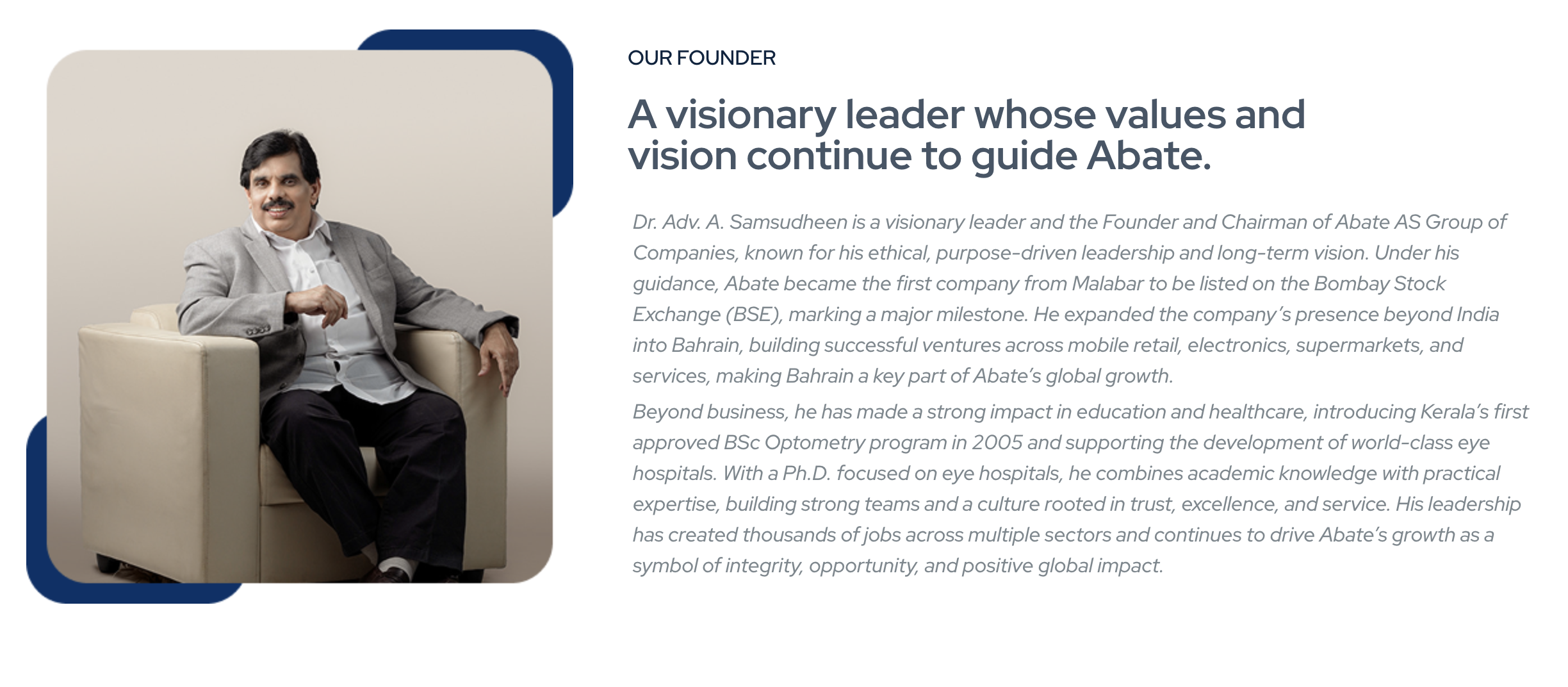
The chairman, Dr. Adv. Arikuzhiyan Samsudeen, signs the results as “Chairman cum Non-Executive Director” — the promoter figurehead sits in a non-executive seat while the CFO, George C Chacko, signs the confirmations. Among the larger public holders, single individuals hold double-digit stakes, and off-market transfers of 45% blocks moved between them within the year.

13 — Corporate Governance: Angels or Devils?

The statutory auditor, Mahesh C. Solanki & Co., issued an unmodified opinion on both standalone and consolidated FY2026 results — clean, on the record. Two items are worth setting down as facts. First, the 7.37 crore preferential shares in February 2025 were issued “for a consideration other than cash” — a share allotment against assets rather than money, which is how the group grew. Second, the consolidated review report notes the corresponding prior-period figures “have not been subjected to review,” and that three subsidiaries carrying the bulk of group revenue were reviewed by other auditors, not the primary firm.

The company also flags a low tax rate and carries a deferred tax asset it expects future profits to absorb. An independent director resigned in November 2025 for stated personal reasons. None of these is a red flag on its own; laid in a row, they describe a group whose consolidated numbers depend on entities and events the primary auditor examined only through others’ reports.

14 — Industry Roast & Macro Context

Indian eye care is a genuinely large, genuinely fragmented opportunity — management’s own framing cites rising life expectancy, diabetes prevalence and age-related vision disorders, all real demand drivers for ophthalmology. The sector rewards density: one surgeon, one machine, many procedures. The organized chains in the peer table earn their 15%-plus ROCEs by running that playbook at scale across dozens of centres.

The trouble with a fragmented sector is that everyone can see the opportunity, which is precisely why it stays fragmented — trusted local brands don’t consolidate on a spreadsheet. A four-hospital operator declaring a 44-hospital target is describing the size of the pond, not the fish it has caught. The eyewear-and-electronics-and-real-estate spread, meanwhile, competes in markets where margins are thin and moats are thinner. The sector is large; being small inside a large sector is the default state, not an achievement.

15 — EduInvesting Verdict

StrengthsWeaknesses
Positive operating cash flow (₹6.13 Cr) after a negative FY2025Revenue scale arrived via consolidation, not organic growth
Near debt-free; D/E 0.06ROCE 6.7% and ROE 7.3% trail the hospital peer set
Trades below book value (0.90x) and well below peer P/EHealthcare only ~22% of a six-sector, no-segment-disclosure mix
OpportunitiesThreats
Stated healthcare mix-shift toward dominance over time₹50 Cr capex plan vs ₹3.54 Cr cash and ₹6 Cr operating cash
Large, fragmented eye-care market with real demand driversPrior-period figures unreviewed; subsidiaries audited by others

The tension is clean once the eleven-fold headline is set aside. Abate As Industries spent FY2026 becoming larger on paper through consolidation, bonus and preferential issuance, and simultaneously becoming better in substance through positive operating cash and operating profit finally clearing other income. Which of those two changes the ₹156 crore market cap is paying for is the question the 12.7x multiple leaves open — a company that grew 1,031% priced as though the market has read the auditor’s footnotes.

A revenue line that arrived overnight, and a business that will take years to prove it belongs there.

Leave a Reply