General information and entertainment, not investment advice. The author is not a SEBI-registered adviser or research analyst. No recommendation, no promised returns. Markets carry risk including loss of capital. Figures may not be current. Consult a registered adviser before acting.
1 — At a Glance
Abans Enterprises closed FY26 with revenue of ₹13,813 crore — a 259% jump on the prior year’s ₹3,850 crore. Against that ocean of turnover, the company kept ₹3.96 crore as net profit. The operating line went negative: a loss of roughly ₹5 crore, an operating margin of -0.03%. The entire pre-tax profit of ₹8.41 crore is smaller than the ₹28.4 crore of other income sitting beside it, which means the trading engine itself ran below break-even for the full year.
The March quarter is where the tension sharpens. Consolidated sales of ₹6,510 crore came in at more than triple the year-ago quarter, yet the company reported a net loss of ₹7.95 crore against a ₹4.28 crore profit a year earlier. A business tripled its top line and moved from profit to loss in the same breath.
For a company that turns over sixty-six times its own market capitalisation of ₹208 crore, the whole story lives in the third decimal place of the margin. Revenue this large earning profit this small tells you where the value is captured — and it isn’t here.
Does ₹13,813 crore of turnover mean anything when the operating line is red?
2 — Introduction
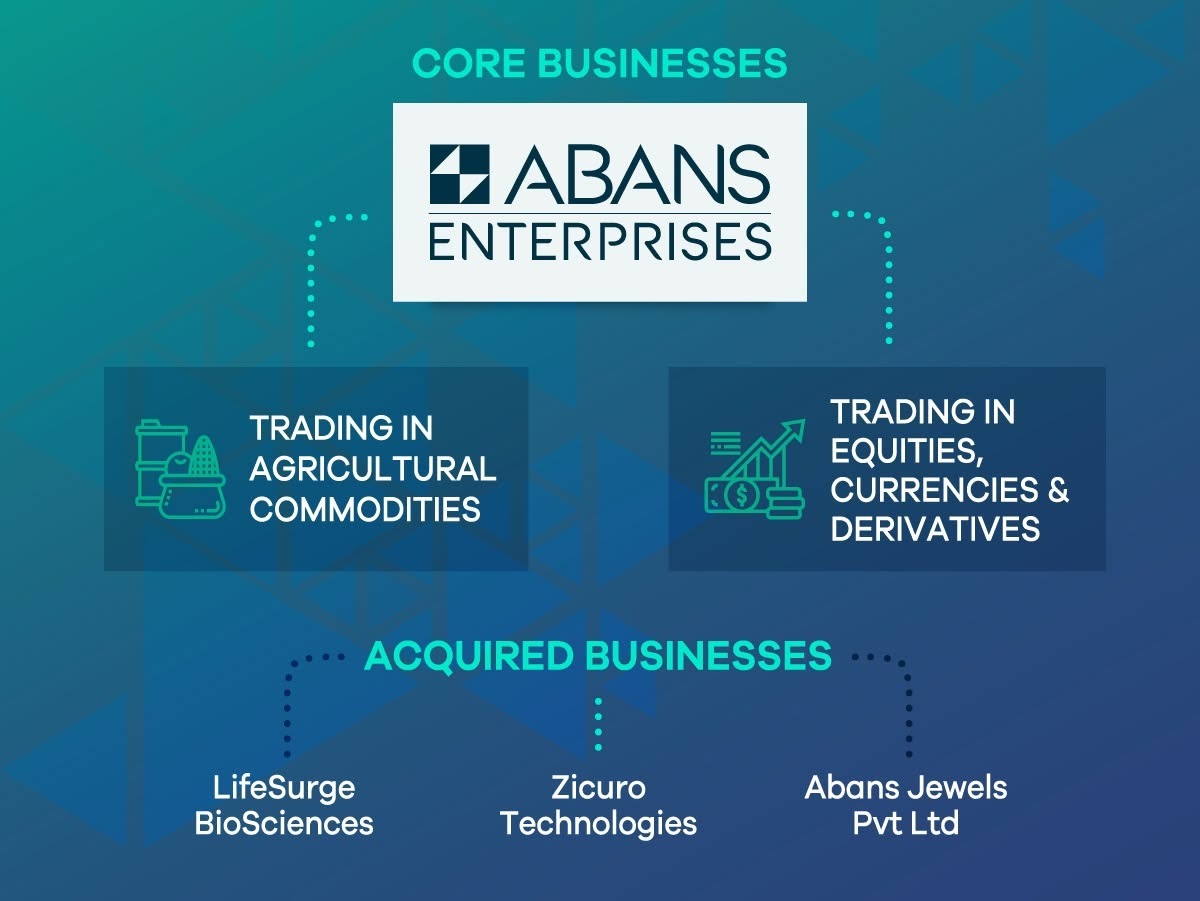
Abans Enterprises Ltd was incorporated in 1985 and operates out of Nariman Point, Mumbai. Its business is general trading — agri-commodities, precious metals, securities, currencies, and derivative contracts across exchanges and the spot market. It is, in essence, a very large conveyor belt: goods and contracts move through, and a sliver of margin is meant to stick on the way.
FY26 was busy in the corner offices even when it was quiet on the income statement. The finance chair changed hands more than once — Anurag Kanwatia resigned as CFO effective February 28, 2026; Deepak Zope was appointed a whole-time director around the same window; and by May 12, 2026 the board appointed Ankit Joshi as an Additional Whole-Time Director alongside his role as Chief Financial Officer. Sahil Gurav came in as Company Secretary from March 28, 2026.
The other structural event was a reversal: the board withdrew the proposed amalgamation of wholly owned subsidiary Abans Jewels Limited, citing evolving business and market dynamics, and the NCLT disposed of the application as withdrawn on March 12, 2026. A merger the board had approved in November 2024 was unwound before it completed.
3 — Business Model: WTF Do They Even Do?
Abans buys and sells things it does not make. The trading book spans agricultural commodities — castor seed, chana, guar gum, guar seed, cotton oil seed, coriander, jeera — plus non-agri metals like aluminium and lead, and precious metals including gold, silver and platinum. Alongside the physical trade sits a financial-markets desk dealing in equity, derivatives, futures and options, currency and bonds.
Per the FY23 revenue breakup, sale of goods made up around 99% of revenue and net gains on financial instruments about 1%. This is the defining feature of the whole enterprise: it is a high-volume, near-zero-margin trading house. When you route ₹13,813 crore of goods to keep ₹4 crore, you are not running a brand — you are running a toll booth on other people’s transactions, and the toll is thin.
The consolidated group carries three subsidiaries: Abans Jewels Limited (India, 100%), Abans Gems & Jewels Trading FZC (UAE), and Splendid International Limited (Mauritius). The jewels and overseas arms matter more than their size suggests, because they are where FY26’s fourth quarter came apart — a point Section 6 returns to.
A trading model lives or dies on turnover velocity and spread. Abans has the velocity. The spread is the part still looking for itself.
4 — Financials Overview
Figures are consolidated, in ₹ crore.
| Metric | Latest Q (Mar 2026) | YoY (Mar 2025) | QoQ (Dec 2025) |
|---|---|---|---|
| Revenue | 6,510.40 | 1,973.88 | 3,456.52 |
| Operating Profit | -1.90 | -8.82 | -20.30 |
| PAT | -7.95 | 4.28 | 2.36 |
| EPS (₹) | -1.14 | 0.61 | 0.34 |
Revenue nearly quadrupled year-on-year and almost doubled sequentially, while profit went from black to red on both comparisons. Operating profit was negative across the last three quarters shown, so the March loss isn’t a one-quarter accident — it’s a continuation.
The statutory auditors, CLASS & CO LLP, issued an unmodified opinion on both the standalone and consolidated results for the year ended March 31, 2026, and the accounts were prepared on a going-concern basis. One item drew an Emphasis of Matter: the withdrawal of the Abans Jewels merger scheme, which management stated has no effect on the company’s financial position or results for the period.

5 — Market Expectations & Historical Multiples
This section describes how the market is currently pricing the company and how that compares with its own history and peer group. It is descriptive, not predictive.
| Metric | Current | Historical Average | Peer Median |
|---|---|---|---|
| P/E | ~52x | — | 49.3x |
| P/B | 0.96x | — | — |
| ROE | 1.87% | 7.82% (5-yr) | 11.65% |
| ROCE | 4.98% | — | 11.65% |
The market pays about 52x earnings here, close to the peer median of 49.3x and the industry figure of 49.2x. On book value the company is priced below its equity at 0.96x, meaning the market values the whole enterprise at slightly less than its stated net worth of ₹216 crore. On returns, the current ROE of 1.87% sits well under its own five-year average of 7.82% and under the peer median of 11.65%.
What the market appears to be pricing is the revenue trajectory rather than current profitability — a company scaling turnover from ₹3,850 crore to ₹13,813 crore in a year, priced at less than book while earnings stay minimal. The multiple leans on volume growth; the sub-book value reflects the thin returns those volumes have produced so far.
One factual observation on market expectations: a P/E near the peer median paired with a P/B under one describes a company the market credits for scale but not, yet, for the profitability of that scale.
6 — What’s Cooking
The material events of FY26, drawn from the company’s own filings:
The consolidated March-quarter loss traces largely to the subsidiaries. Per the audit report, the two subsidiaries covered contributed a net loss after tax of ₹6,803.71 lakh — roughly ₹68 crore — for the quarter, even as the standalone parent posted a small quarterly profit. The overseas and jewels arms, in other words, are what pulled the group into the red in Q4.
The Abans Jewels amalgamation was withdrawn, with the NCLT disposing of the application on March 12, 2026 and a further update filed April 16, 2026.
The finance function saw sustained churn: CFO Anurag Kanwatia’s resignation effective February 28, 2026, and Ankit Joshi’s appointment as CFO and Additional Whole-Time Director on May 12, 2026. The board also re-appointed internal auditors PSSV & Associates LLP for FY27 and shifted the registered office within Nariman Point.
None of these are the kind of “spicy” order-book news a factory reports. For a trading house, the movement is in who signs the numbers and which subsidiary is bleeding — and both moved.
7 — Balance Sheet
| Item | Mar 2022 | Mar 2024 | Mar 2026 |
|---|---|---|---|
| Total Assets | 324 | 445 | 392 |
| Net Worth | 205 | 186 | 216 |
| Borrowings | 81 | 155 | 157 |
| Other Liabilities | 39 | 105 | 19 |
| Total Liabilities | 324 | 445 | 392 |
Assets equal liabilities in each column, as they must.
- Borrowings nearly doubled from ₹81 crore in FY22 to ₹157 crore in FY26 — debt grew while the operating line went negative.
- Other liabilities collapsed from ₹105 crore in FY24 to ₹19 crore in FY26, shrinking the balance sheet even as revenue exploded — a trading book that turns over fast leaves little parked on the sheet.
- Net worth of ₹216 crore against a ₹208 crore market cap is why the stock is priced under book.
With cash of ₹23 crore against borrowings of ₹157 crore, the company sits in a net-debt position, not net cash. A balance sheet that turns over ₹13,813 crore through ₹392 crore of assets is running remarkably light — the entire year’s revenue passes through in a matter of days.
8 — Cash Flow: Sab Number Game Hai
| Year | Operating | Investing | Financing |
|---|---|---|---|
| FY24 | 59 | -111 | 53 |
| FY25 | -193 | 84 | 53 |
| FY26 | 161 | -37 | -120 |
Operating cash flow whipsawed: positive ₹59 crore, then a ₹193 crore outflow, then a ₹161 crore inflow. For a trading business, this is working capital sloshing — inventory and receivables expanding and contracting far faster than profit moves. In FY26 the ₹161 crore generated from operations was largely used to repay borrowings, with financing showing a ₹120 crore outflow. A year where the cash came in and went straight back out the door to lenders.
9 — Ratios: Sexy or Stressy?
| Ratio | Value |
|---|---|
| ROE | 1.87% |
| ROCE | 4.98% |
| P/E | ~52x |
| PAT Margin | 0.03% |
| D/E | 0.72 |
- ROE of 1.87% — the equity is barely showing up for work this year.
- ROCE of 4.98% sits below what the capital could earn parked in a fixed deposit, and below the 11.65% peer median.
- A PAT margin of 0.03% is the number that defines the model: three paise of profit per hundred rupees of revenue, so any wobble in cost or a loss-making subsidiary swamps the whole result.
- D/E of 0.72 with negative operating profit means interest of ₹12 crore is being serviced by a business that lost money at the operating line.
10 — P&L Breakdown: Show Me the Money
| Year | Revenue | Operating Profit | Other Income | PAT | EPS (₹) |
|---|---|---|---|---|---|
| FY24 | 1,771 | 30 | 5 | 9 | 1.33 |
| FY25 | 3,850 | 23 | 28 | 19 | 2.70 |
| FY26 | 13,813 | -5 | 28 | 4 | 0.57 |
The Other Income column is the tell. In FY26, operating profit was negative ₹5 crore while other income was ₹28 crore — meaning every rupee of the ₹8.41 crore pre-tax profit, and then some, came from non-operating sources rather than the trading business. The same pattern shows in FY25, where ₹28 crore of other income sat against ₹23 crore of operating profit. Two straight years where the reported profit leans on income from outside the core trade.
On EPS: the count of shares is comparable across these years despite a face-value change from ₹10 to ₹2 (a split), so on an adjusted basis of about 6.97 crore shares, EPS falling from ₹2.70 to ₹0.57 tracks the drop in PAT rather than any dilution artefact. Revenue went up 3.6x; profit went down. That is the sentence the whole entry orbits.
11 — Peer Comparison
| Company | Sales (Qtr, ₹ Cr) | PAT (Qtr, ₹ Cr) | P/E |
|---|---|---|---|
| ABans Enterprise | 6,510.40 | -7.95 | 52.6 |
| SG Mart | 1,822.84 | 41.47 | 76.8 |
| BMW Ventures | 728.63 | 10.85 | 13.7 |
| Lloyds Enterpris | 719.64 | 68.52 | 1015.7 |
| Mangalam World. | 264.95 | 15.37 | 22.4 |
| Emergent Indust. | 180.97 | 1.33 | 150.3 |
Abans posted by far the largest quarterly revenue in the set — roughly 3.5x the next-biggest peer — while being the only name reporting a quarterly loss. SG Mart earned ₹41 crore of quarterly profit on under a third of Abans’s revenue; Lloyds earned ₹69 crore on roughly a ninth. The comparison lays out the trading-house paradox in one row: the most turnover, the least to show for it.
12 — Miscellaneous: Shareholding & Promoters
| Holder | % (Mar 2026) |
|---|---|
| Promoters | 74.56 |
| Institutions (FII) | 20.30 |
| Public | 5.14 |
Promoter holding has held flat at 74.56%, entirely under Abhishek P Bansal, with zero pledging. FII holding climbed steadily through the year from 9.83% to 20.30%, while public holding shrank to 5.14% — the free float is increasingly institutional. Abhishek Bansal, the promoter, had resigned as Chairman and Managing Director back in November 2023; the promoter group behind the company spans dozens of Abans- and Bansal-named entities, which is worth holding in mind when Section 13 reaches related-party matters.
Does a 74.56% promoter holding with rising FII interest signal conviction, or just a very tightly held float?
13 — Corporate Governance: Angels or Devils?
The statutory audit opinion was unmodified, and the secretarial compliance report from D.A. Kamat & Co found the company generally compliant with no additional non-compliances flagged for FY26. Pledging is nil. Those are the clean facts.
The record also carries an open regulatory matter, stated plainly in the secretarial report: SEBI issued a Show Cause Notice dated August 29, 2023 to Abans Enterprises and promoter Abhishek Bansal concerning trading activities of certain entities in the company’s scrip. The proceedings were stayed by the Securities Appellate Tribunal by order dated October 18, 2024, and the company has filed a Special Leave Petition before the Supreme Court on related settlement conditions; the matter has been adjourned repeatedly, most recently to dates in 2026.
Two further governance textures: the finance leadership changed hands multiple times inside a single fiscal year, and shareholders approved a slate of material related-party transactions with subsidiaries for FY27 via postal ballot. In a group this dense with affiliated entities, related-party approval volume is a fact worth noting on its own.
14 — Industry Roast & Macro Context
Commodity trading is the business of accepting a wafer-thin margin in exchange for enormous volume, and then praying nothing in the chain hiccups. Agri prices swing on monsoons and export rules; metals swing on global cycles; and the spread between buy and sell is squeezed by every other trader chasing the same castor seed. It is a sector where a 0.03% net margin isn’t a scandal so much as the water everyone swims in — the volume is real, the pricing power is borrowed.
Layer on derivatives and currency desks, and the risk isn’t just margin — it’s that a single mispositioned book or a loss-making overseas arm can erase a year of patiently accumulated three-paise spreads. FY26 showed exactly that: the physical trade scaled beautifully and the subsidiaries handed back the gains. In trading, growth and fragility travel together.
15 — EduInvesting Verdict
| Strengths | Weaknesses |
|---|---|
| Revenue scaled 3.6x to ₹13,813 Cr | Operating profit negative; PAT margin 0.03% |
| Zero pledging, promoter holding steady 74.56% | ROE 1.87%, ROCE 4.98% — both below peers |
| Priced below book at 0.96x | Q4 consolidated loss driven by subsidiaries |
| Unmodified audit opinion | Rising debt into a loss-making operating year |
| Opportunities | Threats |
|---|---|
| Rising FII interest, growing scale | Pending SEBI Show Cause Notice against company and promoter |
| Below-book valuation vs peer set | Repeated CFO turnover; going-concern reliance on thin margins |
| Growth in agri and metals volumes | Subsidiary losses swamping a low-margin parent |
For the full year, Abans is a company that moved thirteen thousand crore of goods and kept less than four — a scale machine still hunting for the margin that would make the scale matter. The market prices it below its own book while a regulatory notice sits unresolved and the operating line stays red.
Thirteen thousand crore of revenue, four crore of profit, and one open question the numbers can’t yet answer: whether volume this large is a foundation or just very fast-moving weight.