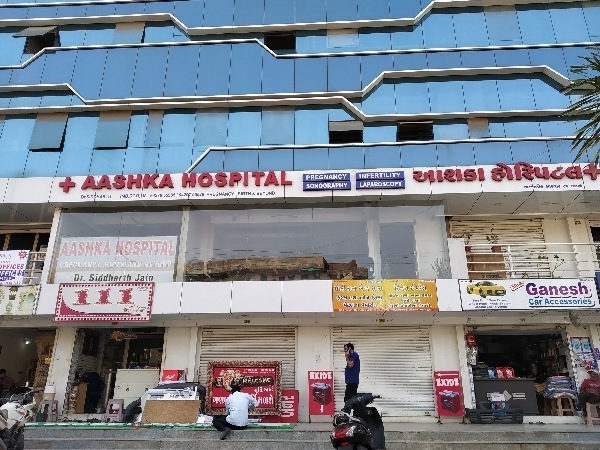
Aashka Hospitals FY26: A ₹190 Crore Hospital Where Other Income Keeps Trying to Steal the Show
Spotted a factual error — a wrong number, date, or fact? Tell us and we will check the source.
General information and entertainment, not investment advice. The author is not a SEBI-registered adviser or research analyst. No recommendation, no promised returns. Markets carry risk including loss of capital. Figures may not be current. Consult a registered adviser before acting.
1 — At a Glance
Aashka Hospitals closed FY26 with revenue of ₹23.01 crore, a full-year net profit of ₹3.34 crore, and EPS of ₹1.43. On the surface, a small Gandhinagar hospital quietly turning a profit. Look one line down and the tension appears: of the ₹3.95 crore of profit before tax, ₹2.86 crore of income came from Other Income, not from treating patients.
The second half of the year did the heavy lifting. The March 2026 half posted revenue of ₹12.57 crore against ₹10.28 crore a year earlier, and net profit of ₹2.56 crore versus ₹1.65 crore — a swing back to health after the Sep 2025 half managed only ₹0.78 crore.
The balance sheet has been on a diet: borrowings fell from ₹32.99 crore in FY19 to ₹8.24 crore in FY26. ROCE, meanwhile, sits at 4.05% — a hospital earning less on its capital than its capital could earn sitting in a fixed deposit.
A 150-bed hospital that makes real money on non-operating income and single-digit returns on capital is a curious object to price. The market pays about 57 times earnings for it. Whether that number is describing the hospital or something else entirely is the thread this entry follows.
2 — Introduction
Incorporated in 2012, Aashka Hospitals runs a multi-disciplinary private hospital, clinics and pharmacies out of Gandhinagar, Gujarat. It is a single-hospital, single-segment business — the audited results confirm there is only one reportable segment under AS-17 — which makes it unusually easy to read compared with the multi-city chains it shares a peer table with.
The company listed on the BSE SME platform and, per a January 2025 filing, moved toward the main board. FY26’s results were approved on 29 May 2026, carrying an unmodified audit opinion from Parimal S. Shah & Co., with the board simultaneously appointing internal and secretarial auditors for FY27.
The recent financial history is a story of contraction and repair. Revenue peaked at ₹40.69 crore in FY21, then collapsed to ₹18.94 crore in FY23, and has since climbed back to ₹23.01 crore. Over five years, that nets out to sales growth of roughly -11% compounded — a hospital that shrank and is now slowly regrowing rather than one that ever compounded upward.
The other running thread is debt reduction. Borrowings have fallen every year since FY19, and the interest bill dropped from ₹5.75 crore to ₹1.18 crore across the same span. Fewer lenders to pay is the clearest positive on the page.
3 — Business Model: WTF Do They Even Do?
Aashka runs one well-equipped building. 150 beds, of which 65 are ICU beds. Two cardiac operating theatres, four more OTs for other super-specialties, two procedure rooms, a flat-panel Cath Lab, CT scanner, and a pneumatic transfer system. The specialty list runs the full alphabet from Anaesthesiology to Urology — the brochure of a hospital that wants to be everything to a mid-sized city.
The revenue mix is where the model gets honest. Per the FY23 breakup, in-patient (IPD) income was around 64%, pharmacy around 16%, out-patient (OPD) around 4%, and — the number that raises an eyebrow — interest income on deposits and advances around 15%. The company’s own insights data puts IPD revenue share consistently near 77% in later years, with pharmacy around 15% and OPD near 5%.
So the operating business is beds first, medicine counter second, doctor visits a distant third. That’s a capital-heavy model: you build the ICU, you buy the ventilators, and you hope the beds fill. With 150 beds and FY26 operating revenue of ₹23 crore, each bed is generating modest turnover — the fixed cost of a fully-kitted hospital sits there whether occupancy is high or low.
Employee count has actually fallen, from 324 on roll in FY22 to 229 in FY25. A hospital doing more revenue with fewer people is either getting efficient or getting lean out of necessity; the data records the headcount, not the reason.
Does a 150-bed hospital earning ₹23 crore of operating revenue have a capacity problem or a demand problem?
4 — Financials Overview
Figures are standalone, in ₹ crore.
Metric
Latest Half (Mar 2026)
YoY (vs Mar 2025)
Prev Half (Sep 2025)
Revenue
12.57
+22.3%
10.44
Operating Profit
3.13
from -0.21
2.11
PAT
2.56
+55%
0.78
EPS (₹)
1.09
+54%
0.33
The March 2026 half is the strongest operating half in the recent record, with an operating margin of 24.9% versus a negative -2.0% in the year-ago half. The