General information and education, not investment advice. The author is not a SEBI-registered adviser or research analyst. No recommendation, no promised returns. Markets carry risk including loss of capital. Figures may not be current. Always consult a SEBI-registered adviser.
1. At a Glance
Suyog Telematics builds and rents passive telecom infrastructure: towers, poles and optical fibre. Standalone revenue for the three months to June 2026 was ₹65.27 crore, against ₹65.26 crore in the three months to March 2026. That is a sequential move of one lakh rupees on a base of ₹65 crore, which is a company standing very still. Year on year the line grew 2.16%. Operating profit was ₹39.11 crore. Net profit was ₹13.93 crore against ₹17.01 crore a year earlier, a fall of 18.1%. Earnings per share were ₹11.89.
The quarter’s activity arrived late and in a rush. Per the company’s exchange filing of 17 June, roughly 636 site orders came in from Vodafone Idea in multiple tranches. The Q1 FY27 investor presentation says 95 towers and 150 tenancies were installed against those orders by 30 June. The presentation notes the work was executed within 13 to 15 days.
The tower count at quarter-end was 6,103, with 7,468 tenancies and 6,709 km of fibre. Depreciation was ₹15.75 crore for the quarter, up from ₹14.34 crore a year earlier. Interest was ₹6.76 crore against ₹5.38 crore. Those are the two lines that grow whenever a tower company puts up more towers. Market capitalisation stands at ₹869 crore.
Also in the quarter: the company changed how it presents electricity reimbursements, and began buying batteries made of zinc bromide.
2. Introduction
Suyog Telematics was incorporated on 28 July 1995 as Suyog Telematics Private Limited. The investor presentation notes that makes the company older than much of the spectrum it now carries. It obtained its IP-1 licence from the Department of Telecommunications in 2008. IP-1 is the registration that lets a company own passive telecom infrastructure without running a network itself.
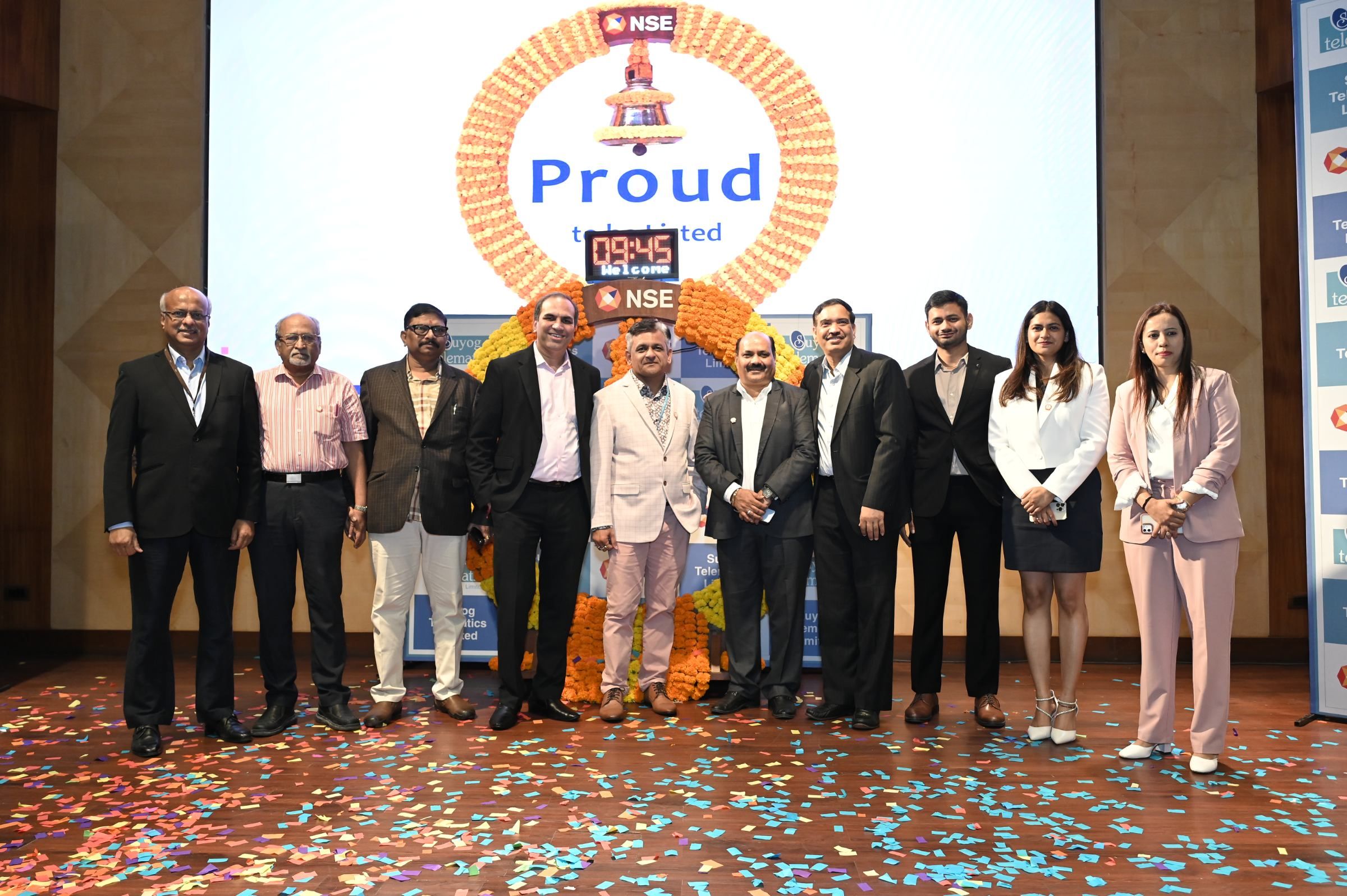
The company converted to a public limited company in 2013 and listed on the BSE in 2014. An NSE listing followed in 2024, a ten-year gap between the two exchanges.
The business is passive telecom infrastructure: installing, commissioning and servicing poles, towers and optical fibre cable systems. Per the About section, the company caters to telecom operators across 12 telecom circles. A circle is the licence area a telecom operator is permitted to work in. Crisil, a credit-rating agency, noted in its September 2025 rationale that orders now span 28 circles against 12 previously, with the benefits expected to materialise over the medium term.
In 2021 the company began expanding across India with High Power Small Cells, extending beyond Mumbai and Maharashtra. In FY25 it went inorganic. Per the December 2024 press release and the exchange filing of 31 March 2025, it acquired a 95% stake in Lotus Tele Infra Private Limited for ₹13.5 crore. Lotus was incorporated in 2016 and operates in the Delhi and NCR region. It owns 120 telecom sites and counts Bharti Airtel and Reliance Jio as major tenants. ₹13.5 crore is a price tag closer to a serviced office than an empire.
A 15-year pan-India Master Service Agreement with BSNL was signed, per the May 2024 filing. In February 2026 the company disclosed a BSNL service order to share 173 new 4G eNode-B sites in the Delhi Circle, with execution within three months.
The board disclosed on 11 September 2025 the death of promoter and Whole-Time Director Vivek Lature (DIN 02274098).
US
Now live
US Stocks terminal is live
13,000+ US tickers · EDGAR fundamentals · screener and filings feed — the same terminal, for American markets.
Explore →
3. Business Model: WTF Do They Even Do?
Suyog builds the boring metal thing a phone screams at.
Per the investor presentation, the model runs in four steps. An acquisition team identifies a site. The company leases the land from its owner. It erects the tower and connects power and fibre. It then rents that structure to telecom operators under Master Service Agreements.
Under those agreements the tenant brings its own antenna and base station, and Suyog brings the pole and the electricity bill. Average contract tenure is more than 10 years with an annual escalation of 2.5%. Co-locations run beyond seven years and carry exit penalties. Payment terms are monthly in advance. It is a landlord business wearing an engineering uniform.
The product menu reads like a wildlife guide: Ground Based Towers, Roof Top Towers, COW Towers and Camouflage Towers. A COW is a Cell on Wheels, which is a tower that drives. A camouflage tower is built to look like something other than a tower. There are also GBM monopoles.
Where these things go is the unusual part. Per the presentation, government tie-ups include MCGM wards, MMRDA, NHAI and BEST, alongside Monorail, JNPT and SEEPZ. In practice that means flyovers, skywalks, foot-over bridges, bus depots and CCTV poles. Government sites are described as low-capex, low-rental, prime-location and hard to terminate. A dedicated Slum Sites segment is described as