General information and education, not investment advice. The author is not a SEBI-registered adviser or research analyst. No recommendation, no promised returns. Markets carry risk including loss of capital. Figures may not be current. Always consult a SEBI-registered adviser.
1. At a Glance
Krishival Foods sells packaged nuts and dry fruits, and since 2024 it also sells ice cream. Revenue for the three months to June 2026 was ₹88.96 crore. That is 79.6% above the same quarter a year earlier. Operating profit was ₹10.49 crore, against ₹5.41 crore. Net profit came in at ₹5.60 crore, a rise of 12.4%. Three lines from the same twelve weeks, moving at three different speeds.
Two rows further down the account moved as well. Depreciation rose from ₹1.31 crore to ₹3.04 crore. Depreciation is the yearly charge for equipment and buildings wearing out. Interest went from ₹0.54 crore to ₹1.40 crore. The company has lately bought a great deal of freezer, factory and cold chain. Both rows fatten with the enthusiasm of a Labrador near an unattended plate.
Ice cream brought in ₹51.58 crore in the quarter. Nuts and dry fruits brought in ₹37.38 crore. The brand and the founding identity were built around cashews. The freezer division now takes the bigger half of the table.
The company placed 1,780 deep freezers in the quarter, mostly in Andhra Pradesh. The network now runs past 17,280 units. Thirteen products were launched: six in nuts and seven in ice cream. Andhra Pradesh was entered through three carrying-and-forwarding locations, the agents who hold stock for distributors. In August the board approved putting up to ₹35 crore of rights-issue money into the ice cream subsidiary.
Market capitalisation, the worth of the whole company on the exchange, is ₹1,160 crore. The market pays ₹52.70 for every ₹1 of yearly profit. For the industry the figure is ₹19.90.
2. Introduction
Krishival Foods was incorporated in 2014 and began in an unglamorous trade: processing nuts. Cashews, almonds, pistachios and figs were bought, graded, roasted, flavoured and packed. Revenue in the year to March 2019 was ₹49.98 crore. Revenue in the year to March 2021 was ₹28.13 crore. The record opens by going backwards, which is an unusual way for a smallcap story to start.
By the company’s own account, it turned from a private limited firm into a public one in the year to March 2021. It listed on the NSE Emerge platform, the exchange’s board for small companies, in the year to March 2022. Five acres of industrial land were acquired at Halkarni MIDC in Kolhapur. Then, in the year to March 2024, it went into ice cream through a subsidiary, Melt N Mellow Foods Private Limited. In the year to March 2025 it moved to the NSE main board and listed on BSE, effective 20 June 2025. A ₹100 crore rights issue, a sale of new shares to existing holders, was completed in the year to March 2026.
That is a company which changed exchanges, changed its capital structure and changed what it mainly sells. All of it inside about thirty-six months, roughly the pace at which most listed Indian companies change their logo font.
The rights issue was a saga in its own right. The board approved it on 27 October 2025 and deferred it on 28 October 2025. A one-day reversal is a rare document to find in a filing archive. It returned on 26 November, and again on 11 December with a record date. The issue opened on 26 December and allotment was completed on 8 January 2026. It covered 33,33,160 partly paid shares at ₹300, of which only ₹105 was called up. Partly paid means the buyer hands over the money in instalments, as and when the company asks. On 5 August 2026 the balance came in for 27,72,120 of those shares. They were converted to fully paid and listed from 18 August. The remaining 5,61,040 shares are still partly paid.
Recent filings include an investor meet intimation and a board meeting on 26 August approving the Melt N Mellow investment. Another board meeting is set for 2 September 2026. Its agenda covers annual general meeting approvals, a director reappointment, related party transactions and a dividend record date.
US
Now live
US Stocks terminal is live
13,000+ US tickers · EDGAR fundamentals · screener and filings feed — the same terminal, for American markets.
Explore →
3. Business Model: WTF Do They Even Do?
Two businesses sit inside Krishival Foods, and they could hardly be less alike.
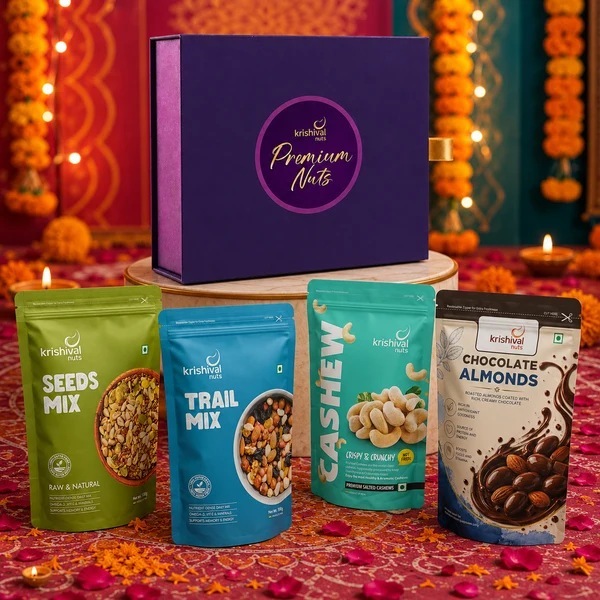
Krishival Nuts buys raw nuts from nine countries and turns them into flavoured snacks. India, Ghana, the United States and Guinea-Bissau are four of the sources. Cambodia, Indonesia, Benin and Ivory Coast are four more, and Tanzania is the ninth. The range runs to salted, pepper and chilli cashews, and salted almonds. There are roasted and salted pistachios, and makhana, the puffed lotus seed, in salted, cheese and peri peri. Company materials describe its Kaju Katli as “less sugar, more cashews”. That is the most confident sentence anyone has written about a mithai. The division carries more than 73 distinct packs and flavours. Two factories in Kolhapur, Halkarni and Shinoli, sit five to ten kilometres apart. The company notes that the short distance cuts logistics time. Sales split 55% to other businesses and 45% to consumers. There are 11,000 retail touchpoints, plus more than 300 across Singapore.
Management told the earnings call that buying nuts, branding them and selling them does not build a profitable long-term business. Their argument is that integrated sourcing and in-house processing are what make year-round consistency possible. The nut, it turns out, has opinions about who handles it.
Melt N Mellow makes ice cream, milk products and bakery goods at one plant in Aurangabad. Capacity is one lakh litres of ice cream a day. Milk products run to 20 tonnes a day and bakery to 10 tonnes. The kit includes automated extrusion and stick lines, cone filling and