General information and education, not investment advice. The author is not a SEBI-registered adviser or research analyst. No recommendation, no promised returns. Markets carry risk including loss of capital. Figures may not be current. Always consult a SEBI-registered adviser.
1. At a Glance
Hitachi Energy India sells the equipment that moves electricity: transformers, switchgear, substations and grid software. Revenue for the three months to June 2026 was ₹2,493.7 crore. A year earlier it was ₹1,478.9 crore, a rise of 68.6%. Profit after tax reached ₹294.2 crore, against ₹131.6 crore a year earlier. That is a rise of 123.5%. Operating profit came in at ₹363.5 crore. The order backlog closed at ₹32,222.1 crore, which the company describes as its highest ever.
The quarter carried the company’s first battery storage order, at Hebbatam in Andhra Pradesh. Such a system stores power and releases it when the grid needs it. The order covers 165 MW of power and 330 MWh of energy. The company also broke ground on a 20th factory at Karjan, Vadodara. The Gujarat Chief Minister attended, with more than 250 customers, per the company’s own slide. That is a well-attended pouring of concrete.
Order intake was ₹5,096.5 crore, against ₹11,339.2 crore in the same quarter last year. Management addressed the fall by presenting both periods without HVDC, where intake rose 26.1%. HVDC means high-voltage direct current, used to carry power over long distances. The company places that comparison at the top of its press release.
Revenue fell 9.5% from the March quarter, when it was ₹2,754.1 crore. The company attributes the drop to the higher base in that quarter. The chief financial officer says exports are running at around 25% of revenue.
2. Introduction
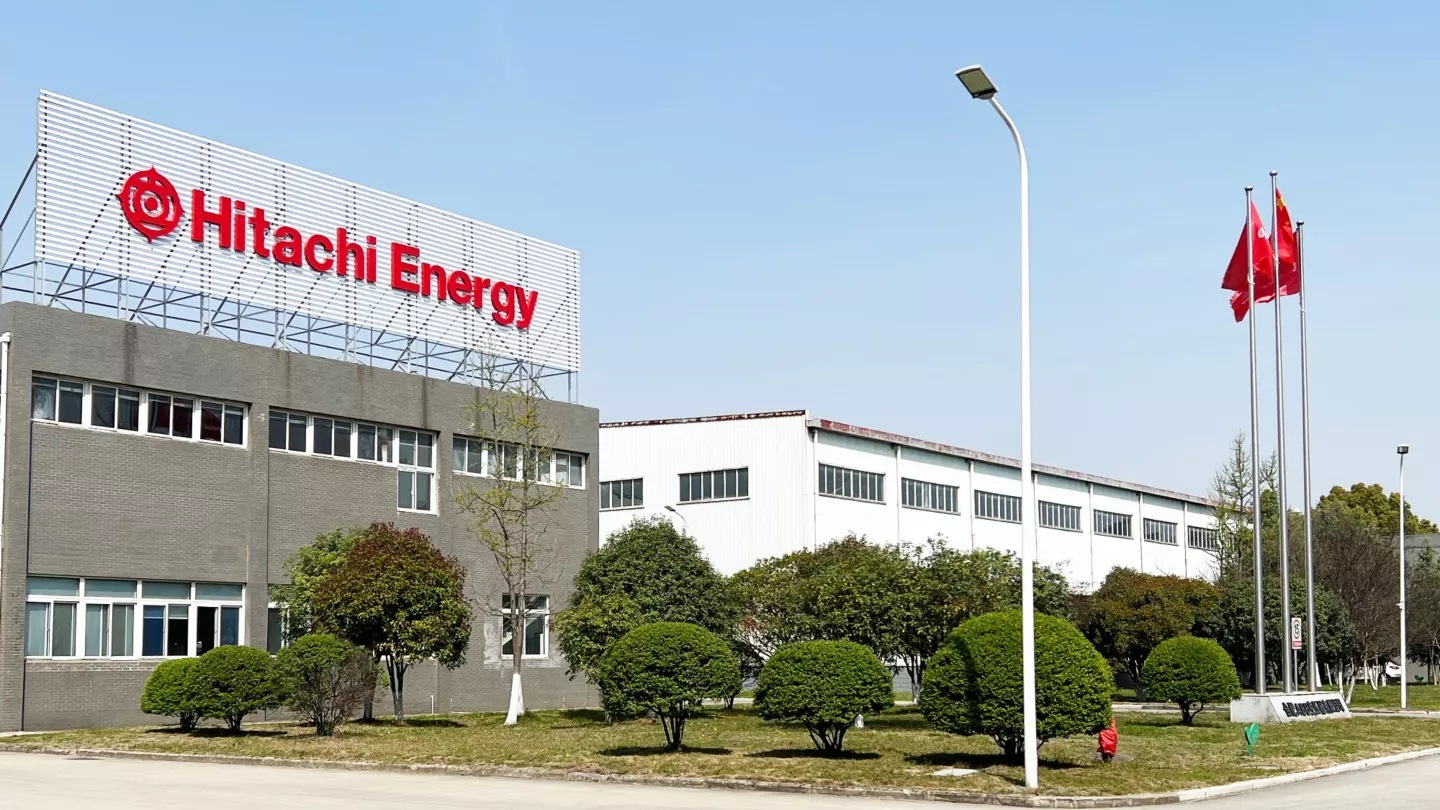
Hitachi Energy India Limited was incorporated in February 2019. It came out of the demerger of ABB India’s power grid business unit. It was formerly known as ABB Power Products and Systems India Ltd. It began as a joint venture between Hitachi and ABB’s Power Grids. The name has since been simplified to remove ABB entirely.
Hitachi Limited of Japan holds all of Hitachi Energy Ltd, Zurich. That Zurich company in turn holds 71.31% of the Indian entity. Hitachi Ltd operates across four sectors: Digital Systems and Services, Energy, Mobility, and Connective Industries. It also runs a Strategic SIB Business Unit. It has 618 consolidated subsidiaries and about 2,80,000 employees worldwide. The Indian company had no subsidiary, associate or joint venture as at 30 June 2026. One parent with 618 children, one child with none.
The company’s equipment powers 9 of India’s 17 HVDC links, the long-distance direct current lines. Its transformers power 1 in 3 Indian Railways locomotives. Its technology connects over 60 GW of renewable energy, and 80% of metros run on its solutions. It holds an installed base in over 140 countries and a presence in 60. That is supported by 12 sales offices and 7 sales touchpoints.
March 2025 brought a qualified institutional placement, which is a share sale to large institutions. The company issued 21,90,688 equity shares, raising approximately ₹2,520.82 crore. As at 30 June 2026, ₹1,841.66 crore of that remained unutilised. Of that sum, ₹1,755.00 crore sits as deposits with banks. Money raised for capacity is earning interest while the concrete cures.
The spending plan shows where the company is headed. October 2024 brought an investment plan of roughly ₹2,000 crore over four to five years. It included ₹300 crore to expand the Mysuru transformer insulation facility. That work doubles extra-high-voltage pressboard and laminated board capacity by the middle of 2027. June 2026 added another ₹2,000 crore for the Karjan large power transformer plant. Cumulative capital spending reaches ₹4,000 crore, with completion targeted for December 2028.
US
Now live
US Stocks terminal is live
13,000+ US tickers · EDGAR fundamentals · screener and filings feed — the same terminal, for American markets.
Explore →
3. Business Model: WTF Do They Even Do?
The company runs four verticals. Grid Automation covers substation automation, communication networks and grid automation services. It also covers grid edge solutions and enterprise software. Grid Integration spans transmission and substation applications, and has delivered more than 4,000 projects. High Voltage Products goes up to 1,200 kV for alternating current and 1,100 kV for direct current. Transformers covers power transformers, traction transformers, insulation and components. That vertical also carries digital sensors and transformer services. The safety slide leads with more than 450 lifesaving-rule inspections.
The physical output is unglamorous and enormous: gas-insulated substations, switchyard bays and busduct measured in kilometres. Execution in the quarter included a gas-insulated substation for an iron ore processing plant at Bacheli, Chhattisgarh. It also covered 220 kV switchyard bays with auxiliaries at Damonjodi, Odisha, and a 220 kV substation in Mumbai. The 1,000 MW Kudus-Aarey HVDC transmission project, also in Mumbai, was under execution. Management describes the scope as design, engineering, manufacturing and supply. It adds erection, testing and end-to-end commissioning to that. The sentence starts on a design screen and ends with someone in a hard hat.
Nineteen manufacturing facilities sit across 8 locations in India, with Karjan becoming the 20th. Revenue in the year to March 2026 split 75% domestic and 25% exports. The year before that it was 73% and 27%.
The order book for the year to March 2026 stood at