General information and education, not investment advice. The author is not a SEBI-registered adviser or research analyst. No recommendation, no promised returns. Markets carry risk including loss of capital. Figures may not be current. Always consult a SEBI-registered adviser.
1 — At a Glance
Goodluck India is a 39-year-old steel-products maker based in Ghaziabad. In three months it sold ₹1,287 crore of pipes, sheets, girders and forgings. Artillery shells joined that list this year. Revenue rose 30.9% against the same quarter a year earlier. Operating profit rose 46% to ₹134.88 crore. Net profit came in at ₹63.61 crore, up 59.5%.
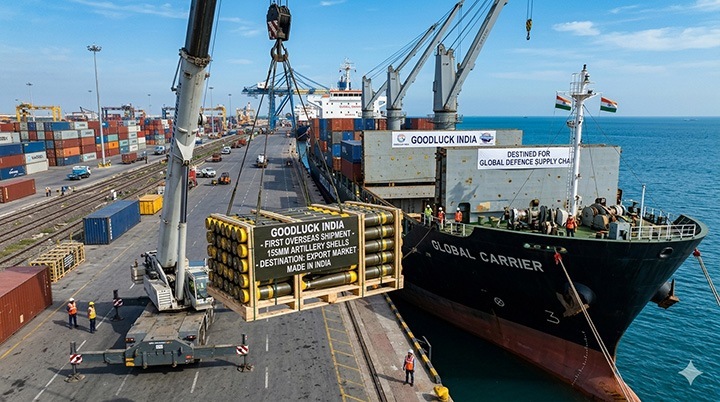
The line that changed shape is defence. Goodluck Defence and Aerospace Ltd, a subsidiary, began making 155mm shells in October 2025. It booked ₹80 crore of revenue in the quarter, the chief financial officer said on the August call. He put its margin before interest, tax and depreciation at 38%. That is 6% of the quarter’s segment mix. India Ratings, a credit-rating agency, counted ₹41.4 crore from that business across the whole year to March 2026.
Around it, the older machinery kept humming at 98% of capacity on an annualised basis. Sales volume was 1,22,718 tonnes, up 8.8%. Exports grew about 53% and made up about 29% of revenue.
The board proposed a bonus issue of two free shares for every one held. Shareholders approved it by postal ballot on 14 August 2026. The board also recommended a final dividend of ₹9.97 crore for the year to March 2026. The subsidiary’s own fundraising took up a good part of the investor call, and not always warmly. It is raising up to ₹285 crore from non-promoters, meaning shareholders outside the founding group.
2 — Introduction
Goodluck India is an engineering group built around steel. It makes sheets, pipes and engineering structures. It also makes fabricated structures, forgings and automobile tubes. The company was incorporated in 1986 and is headquartered in Ghaziabad, Uttar Pradesh. Mahesh Chandra Garg founded it and still chairs the board. He graduated from IIT Roorkee in the class of 1967.
Goodluck listed in 1995. Its first precision tube plant was commissioned in 1997, making welded and cold-drawn tube. The first forging plant followed in 2006, and the Kutchch plant in 2014.
The recent chapters are busier than the early ones. The company incorporated Goodluck Defence and Aerospace Ltd in 2022. In 2025 it opened a hydraulic tubes plant of 50,000 tonnes a year. The plant is aimed at replacing imported seamless tube, which is drawn without a welded joint. A dedicated defence facility followed in October 2025, able to make 1,50,000 artillery shells a year. The subsidiary holds an Industrial License under the Indian Arms Act, 1959, the government’s permission to make arms. It covers 105mm, 120mm and 125mm calibres, and 130mm and 155mm as well. Variants include HE M107, ERFB, ERFB BB and ERFB BT.
The last four months have been busy. In May 2026 the company won an order from Nepal worth 13.6 million US dollars. It covers 14,500 tonnes of transmission line structures. The defence subsidiary won a ₹52.2 crore order for 20,000 empty 155mm shells. A ₹255 crore domestic order for 155mm shells followed in June. In July the subsidiary cleared DGQA certification for 155mm M107 Ready-to-Fill shells. DGQA is the defence ministry’s quality-assurance directorate. The board approved the bonus issue the same month, alongside a ₹275 crore guarantee of the subsidiary’s borrowing. It also gave in-principle approval to merge Goodluck Green Energy Ltd into the company. On 14 July, India Ratings, a credit-rating agency, assigned grades to the parent’s ₹1,150 crore of bank facilities. The grades were IND AA- with a stable outlook, and IND A1+.
US
Now live
US Stocks terminal is live
13,000+ US tickers · EDGAR fundamentals · screener and filings feed — the same terminal, for American markets.
Explore →
3 — Business Model: WTF Do They Even Do?
Steel goes in one end. It comes out at the other as something with a specification sheet, and a customer who cares deeply about wall thickness.
Four segments carried revenue in the year to March 2026. CR Coils, Pipes and Tubes was the largest at 34%. It makes cold-rolled coils and sheets, corrugated sheets, hollow sections and galvanised pipes. It also makes support structures for road bridges, railways and other infrastructure. Buyers are state-owned equipment makers, central and state governments, and private equipment makers.
Precision Pipes and Auto Tubes took 27%. It makes cold-drawn, welded, engineering and boiler tubes. These go into construction and earth-moving equipment, fertilisers, oil and gas, and petrochemicals. Pressure vessels, thermal power, valves and wind energy take the rest. The customer list includes BMW, Audi, Tata Motors and Bajaj, alongside Toyota.
Engineering Structures and Precision Fabrication took 24%. It supplies steel and concrete girders, bridge and road structures, launching structures and boiler-and-turbine structures. ABB, Toshiba, L&T and NTPC buy them. Forgings took the remaining 15%, making flanges, gear rings, gear shanks and forged shafts. It also makes defence and aerospace components for DRDO, ISRO and HAL. GE and Indian Oil are on that customer list too. One company therefore sells to carmakers, to the space agency, to the power sector and to bridge builders.
Six plants across two states hold a combined 5,00,000 tonnes a year of capacity. Of that, 57% is