Beacon Trusteeship FY26: India’s Only Listed Trustee Turns ₹35 Cr of Fees Into a 24x Question
Spotted a factual error — a wrong number, date, or fact? Tell us and we will check the source.
General information and entertainment, not investment advice. The author is not a SEBI-registered adviser or research analyst. No recommendation, no promised returns. Markets carry risk including loss of capital. Figures may not be current. Consult a registered adviser before acting.
1. At a Glance
Beacon Trusteeship closed FY26 with revenue of ₹35.12 crore, up from ₹27.08 crore a year earlier, and consolidated profit after tax of ₹6.98 crore. It is a company that got itself onto the National Stock Exchange by being the one thing none of its rivals are: a listed trustee. That distinction is the whole pitch, and the market has priced accordingly, paying 24.2 times earnings against a company sitting on zero debt and ₹17.36 crore parked in mutual funds and equities.
The numbers carry their own small tensions. Operating margin sits at 35.45%, healthy for a fee business, yet depreciation nearly tripled to ₹2.84 crore as the company capitalised its technology platforms. The trusteeship book grew to 797 mandates from 739. Debtor days climbed from 73.9 to 91.2, meaning the money is booked faster than it is collected.
A fee-based, asset-light model tends to look cleaner than it is until you watch where the cash actually lands. The book grew, the profit grew, and yet the receivables grew faster than both.
Then there is the paperwork nobody frames on the office wall: a SEBI administrative warning received in January 2026, a ₹5 lakh penalty under appeal, and a promoter-group merger sitting before the NCLT. For a company whose entire product is trust, the governance file is worth reading before the P&L.
2. Introduction
Beacon Trusteeship was incorporated on 23 December 2015 and promoted by Pratapsingh Nathani, an ex-banker who still chairs the board and runs it as Managing Director. The company’s business is corporate trusteeship, the plumbing of the debt market: when a company issues bonds or debentures, somebody independent has to hold the security, monitor the covenants, and step in if things break. Beacon does that, and a spread of adjacent things around it.
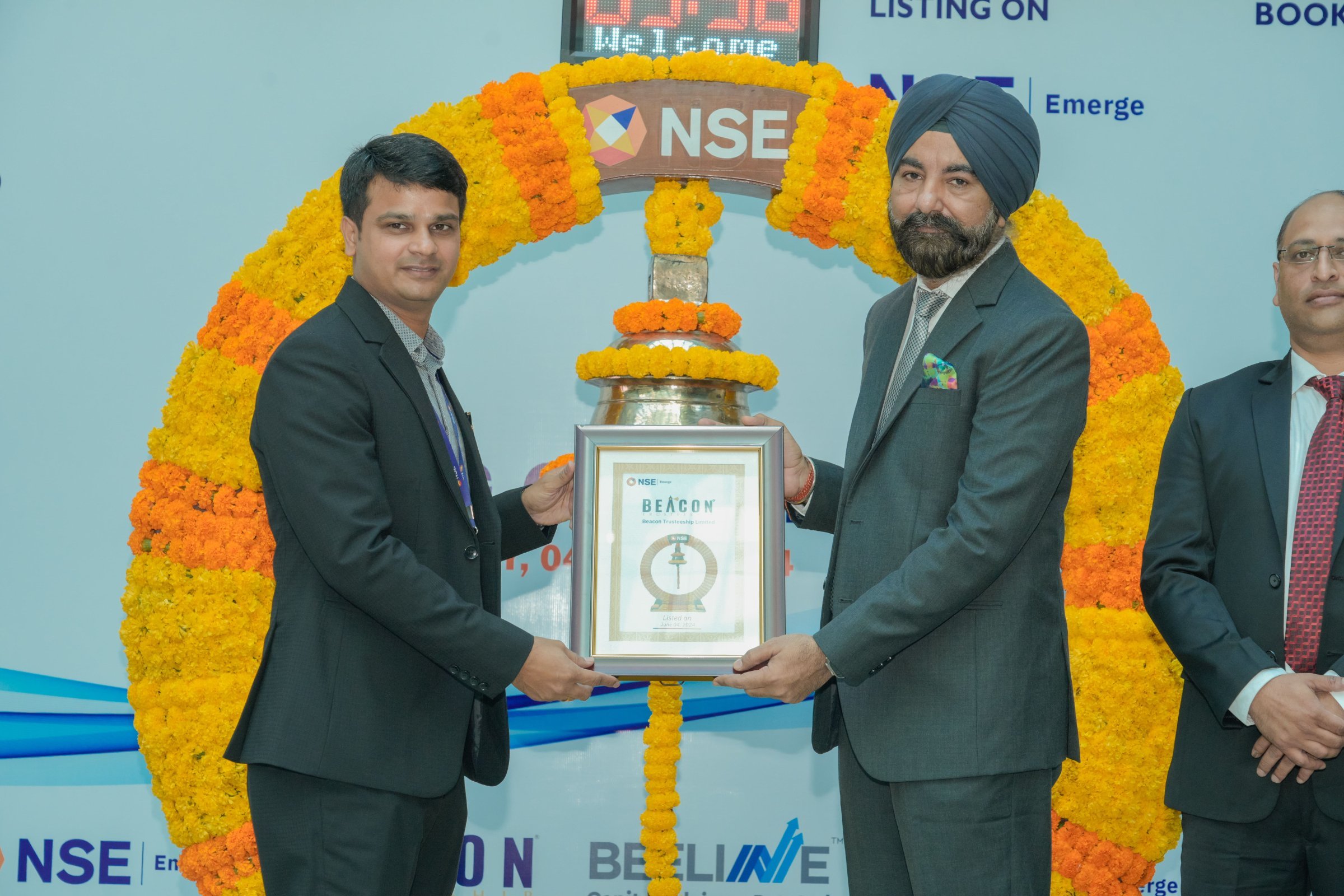
The company listed its equity shares on the NSE Emerge SME platform on 4 June 2024, describing itself as India’s first and only listed trustee company. That claim is the spine of every investor document it produces.
FY26 was busy off the balance sheet as much as on it. Anil Grover joined as CEO in January 2026 and was made an Executive Director by February. The Company Secretary changed twice inside the year. And the promoter group set in motion a scheme to fold three of its private companies into the listed entity, a move that has cleared NSE’s no-objection stage and, per the announcements, was heard by the NCLT on 1 July 2026 with the next hearing scheduled for 12 August 2026.
All of which is to say the trustee had a fairly eventful year holding other people’s trust deeds while rearranging its own house.
3. Business Model: WTF Do They Even Do?
Strip away the brochure and Beacon is a toll booth on the debt highway. It earns an upfront fee when a trust deed is signed and a recurring annual fee for as long as the mandate lives, indexed to assets under administration or deal terms. The revenue is roughly 93% domestic trusteeship, about 6% professional fees, and a sliver from SEZ units. No inventory, no factory, no borrowings, no working-capital furnace to feed.
The SEBI-regulated menu is long: debenture and bond trusteeship, AIF trusteeship, securitisation, REITs and InvITs, escrow, share-pledge trustee. The non-SEBI menu is longer still: security trustee, facility agent, private and family trusts, ESOP trusts, and safekeeping for everything from M&A to source code. It is the kind of service list that reads like a firm saying yes to every room in the building and then building more rooms.
On top of this sits a stack of proprietary platforms with names engineered for a pitch deck: Beacon 360 ERP, the ProSec securitisation platform, a covenant-monitoring tool, an investment-manager platform. The pitch is that software turns a headcount business into a scale business, letting volumes rise without staff rising in lockstep. The counter-evidence is on the cost line, where depreciation and amortisation jumped to ₹2.84 crore as those platforms got capitalised. The moat, it turns out, depreciates.
The genuinely distinctive fact is structural: Beacon runs trusteeship across domestic, GIFT IFSC and Mauritius, and through its subsidiary Beacon Investor Holdings now holds RTA and Depository-Participant registrations too. Whether a single-window trust supermarket cross-sells better than four specialists is the bet the whole edifice rests on. The mandate count says the shelves are filling.
Does a wider service menu make a trustee more trusted, or just more things to audit?
4. Financials Overview
Figures are consolidated, in ₹ crore.
Beacon reports half-yearly, so the table below reads the latest half (Oct 2025–Mar 2026) against the year-ago half and the immediately preceding one.
Metric
Mar 2026 (H2)
YoY (vs Mar 2025 H2)
Prev Half (Sep 2025)
Revenue
14.92
+18.5%
19.24
Operating Profit
4.66
+163%
6.83
PAT
2.42
+105%
4.46
EPS (₹)
1.39
—
2.47
The year-on-year comparison flatters because the year-ago half was weak: the Mar 2025 half posted an operating margin of just 14.06% against 31.23% in the latest half. The sequential picture is the honest one, and it shows the second half of the year came in softer than the first: revenue, operating profit and PAT all stepped down from the September half.
For the full year, the consolidated result was revenue of ₹35.12 crore, operating profit of ₹12.45 crore, and PAT of ₹6.98 crore. The board recommended no dividend, directing earnings back into technology and network expansion instead — the company’s stated reasoning in its Directors’ Report.