Agarwal Toughened Glass FY26: Revenue Nearly Doubles to ₹95 Cr, While Operating Cash Flow Turns Negative ₹8.5 Cr
Spotted a factual error — a wrong number, date, or fact? Tell us and we will check the source.
General information and entertainment, not investment advice. The author is not a SEBI-registered adviser or research analyst. No recommendation, no promised returns. Markets carry risk including loss of capital. Figures may not be current. Consult a registered adviser before acting.
1 — At a Glance
Agarwal Toughened Glass India closed FY26 with sales of ₹94.92 crore, up from ₹55.31 crore a year earlier — a 72% jump. Profit after tax reached ₹21.6 crore against ₹15.17 crore, and reported EPS came in at ₹12.22. Operating margin held near 30%. On the top line and bottom line, this was the loudest year in the company’s listed life.
Then the cash flow statement clears its throat. Cash from operating activities for FY26 was negative ₹8.5 crore, against a positive ₹14.7 crore the year before. Receivables climbed from ₹18.23 crore to ₹34.54 crore and inventory from ₹16.98 crore to ₹29.41 crore over the same twelve months — the arithmetic sits on the balance sheet. Profit that grows while operating cash leaves the building is the kind of tension this record exists to note.
A ₹236 crore company, promoter-held at 64.16%, that in April saw its credit rating revised down a notch and marked “issuer not cooperating.” A reader question to hold through what follows: does a doubling top line settle anything when the cash it generates went the other way?
2 — Introduction
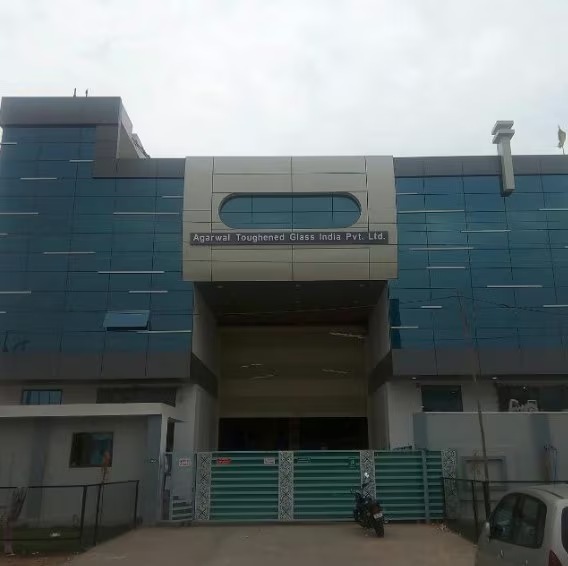
Incorporated in October 2009 and operating out of Jaipur, Rajasthan, Agarwal Toughened Glass processes float glass into toughened, laminated, insulated and specialty glass. Commercial operations began in May 2016; the equity shares listed on the NSE Emerge SME platform on 5 December 2024, after an IPO that raised ₹62.64 crore.
The listed chapter has been eventful. In January 2026 the company signed a two-year trademark licence and technical partnership with Saint-Gobain, effective through December 2027. In September 2025 it flagged installed machinery adding roughly 5 lakh square metres a year of jumbo glass capacity. And on 3 July 2026 the board allotted 16.51 lakh equity shares and 45.90 lakh warrants on a preferential basis at ₹109, a raise of up to ₹68.04 crore.
The IPO utilisation certificate shows most fresh-issue objects funded by March 2026, with ₹3.98 crore of the machinery allocation still unspent. The company reports standalone financials only, audited by Jethani & Associates, who issued an unmodified opinion on the FY26 numbers.
3 — Business Model: WTF Do They Even Do?
They take flat glass and make it harder to break — and then charge more for the versions that do interesting things. The FY25 revenue mix runs toughened glass 44%, DGU/insulated units 34%, laminated 22%. Toughened glass is also the input into the laminated and DGU products, so the company is partly its own supplier.
The end markets are wherever glass has to survive being looked at or leaned on: facades, windows, shower doors, hospital partitions, automotive safety glass. The client list names Yamaha, Saint-Gobain, Renault, Power Grid Corporation and Hyatt Regency, across 4,000-plus executed projects.
Three Jaipur facilities do the work. Unit 1 runs 612,000 sq. m of toughened capacity; Unit 2 adds 1,080,000 sq. m. Utilisation, per the company’s own disclosure, sits around 57% on Unit 1 toughened, 47% on IGU, and 47% on Unit 2 — which means the plants are already built to make roughly twice what they currently make. The pitch, then, is less “build more” and more “sell into what’s standing.” A glass processor whose main constraint isn’t the furnace but the order book is an honest kind of business to be in.
4 — Financials Overview
Figures are standalone, in ₹ crore.
The reporting is half-yearly. The latest half is the six months to March 2026 (H2 FY26).