Gujarat Intrux FY26: A 14.8x Debt-Free Foundry Where the Cash Went Somewhere
Spotted a factual error — a wrong number, date, or fact? Tell us and we will check the source.
General information and entertainment, not investment advice. The author is not a SEBI-registered adviser or research analyst. No recommendation, no promised returns. Markets carry risk including loss of capital. Figures may not be current. Consult a registered adviser before acting.
1 — At a Glance
Gujarat Intrux closed FY26 with revenue of ₹68.76 crore and net profit of ₹10.31 crore — sales up 5.3% on the year, profit down 2.6%. It carries no borrowings, holds ROCE of 21.3%, and pays a dividend yield of 5.62%, one of the highest in its peer set. The market pays 14.8x earnings for it, against an industry P/E of 26.9.
So far, so tidy: a small Rajkot casting foundry that mints cash, dumps most of it back to shareholders, and trades at half the multiple of its neighbours. But two lines on the ratio sheet refuse to sit quietly. Debtor days climbed from 61 to 96, and working capital days stretched from 122 to 236 — nearly doubling in a single year. The cash-and-bank line, meanwhile, shrank from ₹31.68 crore to ₹4.91 crore while receivables jumped from ₹10.88 crore to ₹18.12 crore.
A debt-free balance sheet is a clean room. This one has cash walking out one door and IOUs walking in another. The rest of this entry follows the money.
Does a 5.62% dividend yield answer a doubling of working capital days, or just distract from it?
2 — Introduction
Gujarat Intrux was incorporated in 1992 and listed on the BSE under code 517372. It began life dealing in copper and brass scrap and non-ferrous extrusion, then abandoned that trade — price fluctuations made it unworkable — and reinvented itself as a sand-casting foundry. Today it manufactures Stainless Steel, Non-Alloy Steel and Alloy Steel castings, aimed at valves, pumps and earth-moving equipment.
The operating footprint is a single plant on the Rajkot–Gondal highway at Shapar, and a single reported segment: manufacturing of steel and alloy-steel castings. The Chairman and Managing Director is treated as the sole operating decision-maker, so no further segment split exists.
The most recent corporate housekeeping came in late 2025. On 30 September 2025, MD Dhiraj Pambhar was re-appointed for the term 1 November 2025 to 31 October 2030 at ₹6,75,000 per month, and new statutory and secretarial auditors were brought in. On 29 May 2026 the board approved FY26 audited results and recommended a final dividend of 175% — ₹17.5 per ₹10 share. The statutory auditor, M A A K & Associates, issued an unmodified opinion.
That is the entire public storyline for the period. No orders announced, no acquisitions, no capex programme flagged. A company this quiet leaves the numbers to do the talking.
3 — Business Model: WTF Do They Even Do?
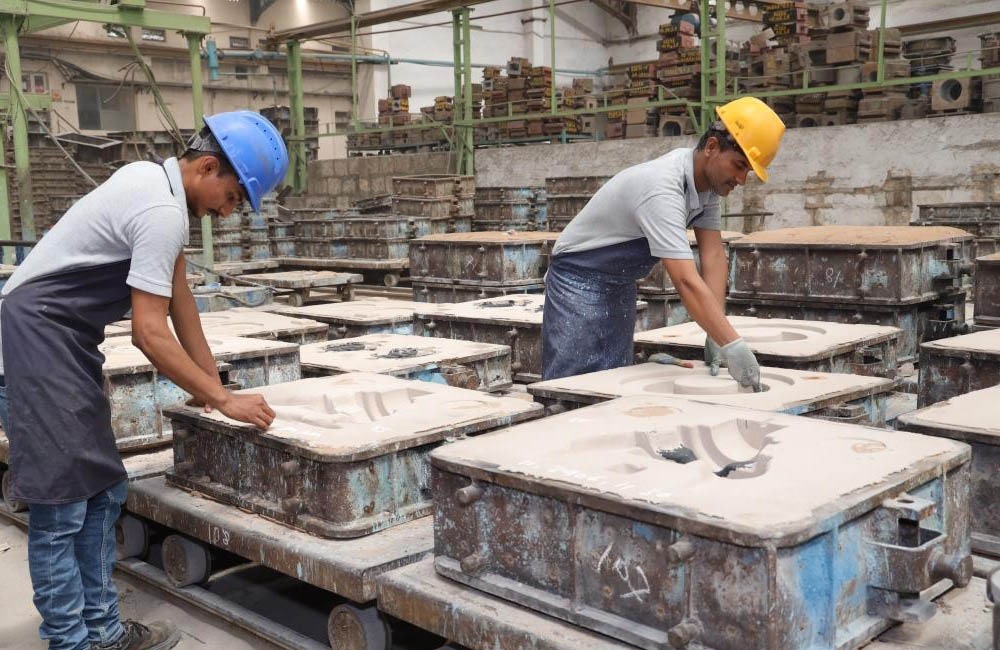
They pour molten metal into sand moulds and sell what hardens.
Stripped of romance, that is the business: Stainless Steel, Non-Alloy Steel and Alloy Steel castings, single pieces up to roughly 2,200 kg, feeding into valves, pumps and earth-moving gear. The associated investment-castings facility carries capacity of about 3,000 MT of alloy and super-alloy castings annually. On the sand-casting side, installed capacity sits at 1,800 MT per year, and production has bounced around — 1,502.92 MT in FY25 against 903.10 MT back in FY21, a plant that has run anywhere from half-full to nearly full depending on the year.
The revenue mix leans on exports. Export sales were roughly 40% of the total in FY25, down from 54% in FY21 — a business that sells abroad heavily but has been drifting homeward. That mix is the quiet risk under the whole enterprise: castings are a commodity dressed up as engineering, and a company that once fled copper because prices moved too much now sells steel castings into global valve and pump markets. The metal changed; the exposure to somebody else’s price chart did not.
What Gujarat Intrux does well is stay small and stay solvent. Sales have compounded at about 15% over five years off a low base, and the plant runs without debt. What it does not do is scale — one plant, one segment, 1,800 MT of sand-casting capacity, and a market cap of ₹153 crore. This is a workshop with a share code, not an industrial platform.
4 — Financials Overview
Figures are consolidated, in ₹ crore.
Metric
Latest Q (Mar 2026)
YoY
QoQ
Revenue
18.91
+11.9%
−7.5%
Operating Profit
3.13
−6.6%
−36.9%
PAT
1.98
−23.3%
−47.2%
EPS (₹)
5.76
−23.3%
−47.2%
The quarter tells a sharper story than the year. Revenue grew 11.9% against March 2025, but operating profit slipped and PAT fell