Kalyani Forge FY26: Record Profit, a Disclaimer of Opinion, and Borrowings That Doubled in Two Years
Spotted a factual error — a wrong number, date, or fact? Tell us and we will check the source.
General information and entertainment, not investment advice. The author is not a SEBI-registered adviser or research analyst. No recommendation, no promised returns. Markets carry risk including loss of capital. Figures may not be current. Consult a registered adviser before acting.
1. At a Glance
FY26 was the year Kalyani Forge posted its highest profit in roughly fourteen years — ₹9.32 crore PAT — and the year its own auditor declined to give an opinion on the numbers for the third consecutive time. Both of these are true, and they sit in the same set of audited results.
Revenue landed at ₹234.64 crore, essentially flat against the prior year’s ₹236.64 crore. Yet operating profit climbed to ₹28 crore from ₹24 crore, and the Q4 net margin crossed 10% for the first time. The market currently pays about 23x earnings for the company, against an industry P/E of 26.9.
Underneath the profit record, three things moved in the wrong direction: borrowings rose to ₹105.62 crore from ₹71.57 crore a year earlier, the credit rating outlook was revised to Negative, and debtor days stretched to 160. A company can improve its margins and its balance sheet strain in the same twelve months — this year, this one did.
The record profit is the headline. The disclaimer of opinion is the asterisk. This entry covers both.
2. Introduction
Kalyani Forge Limited was incorporated in 1979 and manufactures hot, warm, and cold-forged products from plants in Pune, Maharashtra. It carries the Kalyani name — founded by Dr. Neelkanth Kalyani — and is today run by Viraj Kalyani as Managing Director, with Rohini Kalyani as Executive Chairperson. The board he sits on approved his continued stewardship of a company that makes engine, driveline, and axle components for the automotive and industrial world.
FY26 was, by the company’s own framing, a reset year. Management pruned roughly ₹40 crore of what it called “non-fit” low-margin business, deliberately shrinking parts of the top line to lift the quality of what remained. The result was a rare combination: revenue that barely moved while operating profit expanded.
The year also carried a heavy churn of finance chiefs. CFO Nilesh Bandale resigned in November 2025; Jagdish Baheti was appointed in February 2026 and then resigned effective April 30, 2026, citing personal reasons. The company secretary also stepped down in February 2026. The forge kept running; the finance corner office kept changing occupants.
Three major order wins closed in Q4 — an OEM wheel hub program worth roughly ₹20 crore annually, plus wins with SKF and Schaeffler — all set to ramp from Q1 FY27. Separately, an EV high-volume axle win of about ₹20 crore annual revenue was booked. The forward book is being rebuilt around what management calls “good-fit” customers.
3. Business Model: WTF Do They Even Do?
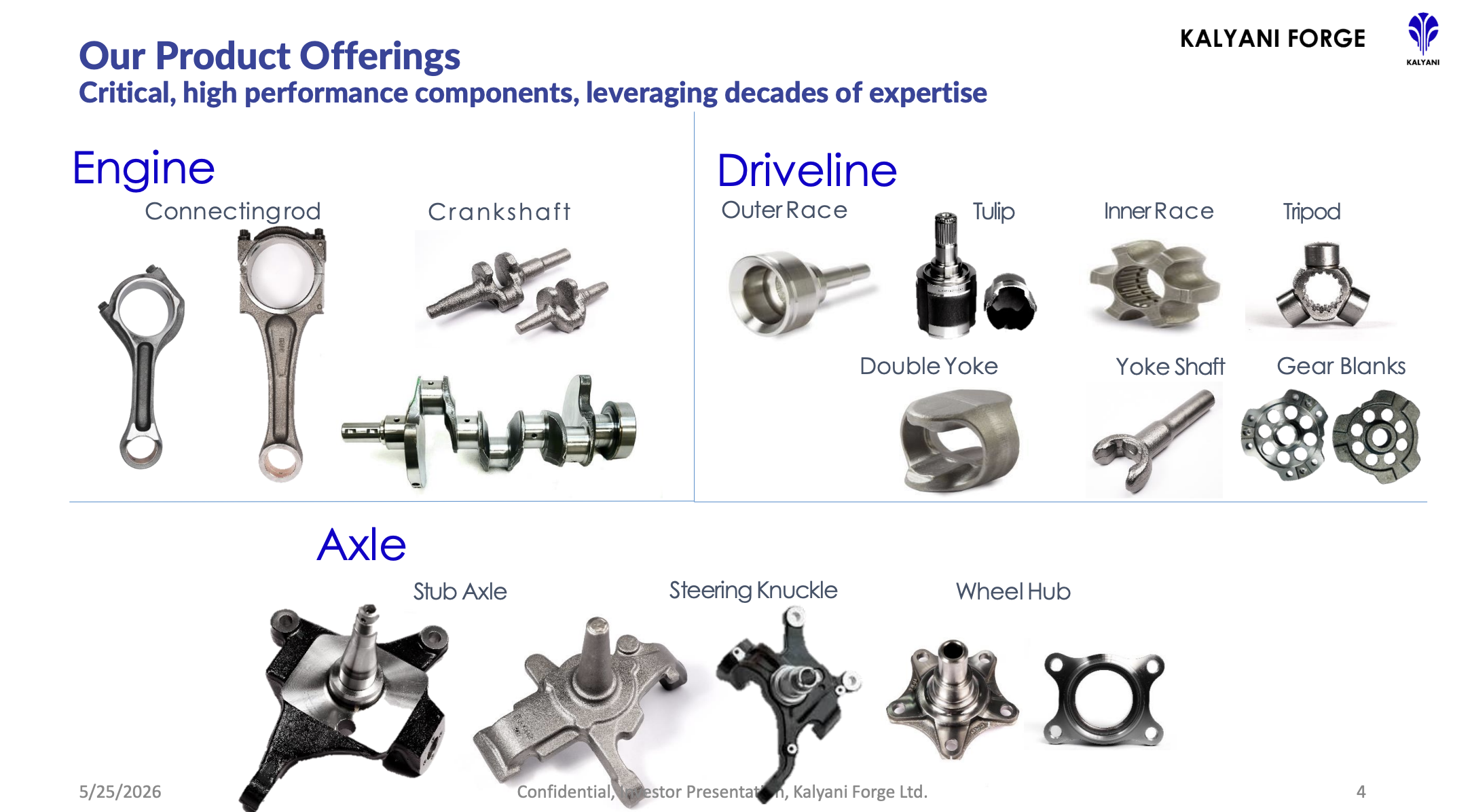
Kalyani Forge takes metal, heats it (or doesn’t), and hits it very precisely until it becomes a part that a truck, tractor, or car cannot run without. The trick they advertise is breadth: hot forging, warm forging, and cold forging under one roof, plus machining, heat treatment, die manufacturing, and testing. Management’s proudest claim is that it is the only forging company offering engine, driveline, and axle components together to OEMs — a “share of wallet” pitch built on decades of combined hot-and-warm forging capability.
The revenue mix tells the strategy. Engine components — connecting rods, crankshafts, gear blanks — make up about 57% of sales, concentrated in heavy commercial vehicles, off-road, and agro applications. Driveline sits near 18%, axle around 10%, and a shrinking “other” bucket at roughly 15% that management is deliberately tapering.
The customer list reads like an auto-industry roll call: Daimler, JCB, Tata, Honda, Cummins, MAN, Kirloskar. The auto sector contributes 60–70% of revenue, which is either diversification or a very elaborate way of being exposed to one cyclical end-market wearing several hats.
Driveline and axle products get positioned as “fuel agnostic” — applicable to electric vehicles, and therefore “future-proof.” It’s a sensible hedge for a forging company: whatever powers the vehicle, something still has to transmit torque to the wheels, and that something gets forged.
Does a “fuel-agnostic” axle business meaningfully insulate a forger from auto cyclicality, or just relabel the same cycle?
4. Financials Overview
Figures are standalone, in ₹ crore. The latest period is Q4 FY26 (quarter ended March 2026).