Rathi Steel & Power FY26: A ₹716 Crore Steelmaker Where the Courtroom File Runs Longer Than the Order Book
Spotted a factual error — a wrong number, date, or fact? Tell us and we will check the source.
General information and entertainment, not investment advice. The author is not a SEBI-registered adviser or research analyst. No recommendation, no promised returns. Markets carry risk including loss of capital. Figures may not be current. Consult a registered adviser before acting.
1. At a Glance
Rathi Steel & Power closed FY26 with revenue of ₹716.05 crore, up roughly 42% on the ₹503.15 crore it booked in FY25. Net profit came in at ₹12.86 crore against ₹13.95 crore the year before — a company growing its top line by two-fifths while its bottom line quietly slipped. The gap between those two numbers is the whole story of this steelmaker, and it is worth sitting with.
The fourth quarter carried the year. Q4 revenue of ₹244.44 crore rose about 63% year-on-year and 53% sequentially, and quarterly profit of ₹7.45 crore was nearly double the ₹3.80 crore of Q4 FY25. Management attributes the surge to the restart of the idled TMT bar mill, whose rolling volumes grew about 117% for the year.
Sitting alongside the results is a second file: a Rouse Avenue court order dated March 2026 declining to take cognizance of an Enforcement Directorate money-laundering complaint against the company and its promoters, and a scattering of GST and income-tax demands running through the year. The operating margin holds near 4%. The market pays 12.3x earnings against an industry 21.6x.
For a 55-year-old name that once ran a ₹500 crore-plus turnover before most of these troubles began, the question the year leaves open is which file grows faster.
2. Introduction
Incorporated in 1971, Rathi Steel And Power Ltd manufactures steel and steel-related products under the Rathi brand. Its plant sits on roughly 12.5 acres in Ghaziabad, in the NCR region, with a steel melting capacity of about 85,000 TPA and rolling capacity of 200,000 TPA.
The recent corporate history reads as a long convalescence. Per the investor presentation, an integrated steel unit commissioned at Sambalpur, Odisha, in 2008 became non-operative and was closed in 2012 after the state could not allocate the promised iron-ore mines, leaving bank-account NPAs and unsustainable debt at Ghaziabad. The turnaround leaned on asset sales, and on a ₹114.71 crore equity infusion through preferential allotment in February 2024. The company records reaching a zero-debt status by March 2024 — a status the FY26 balance sheet shows has since loosened.
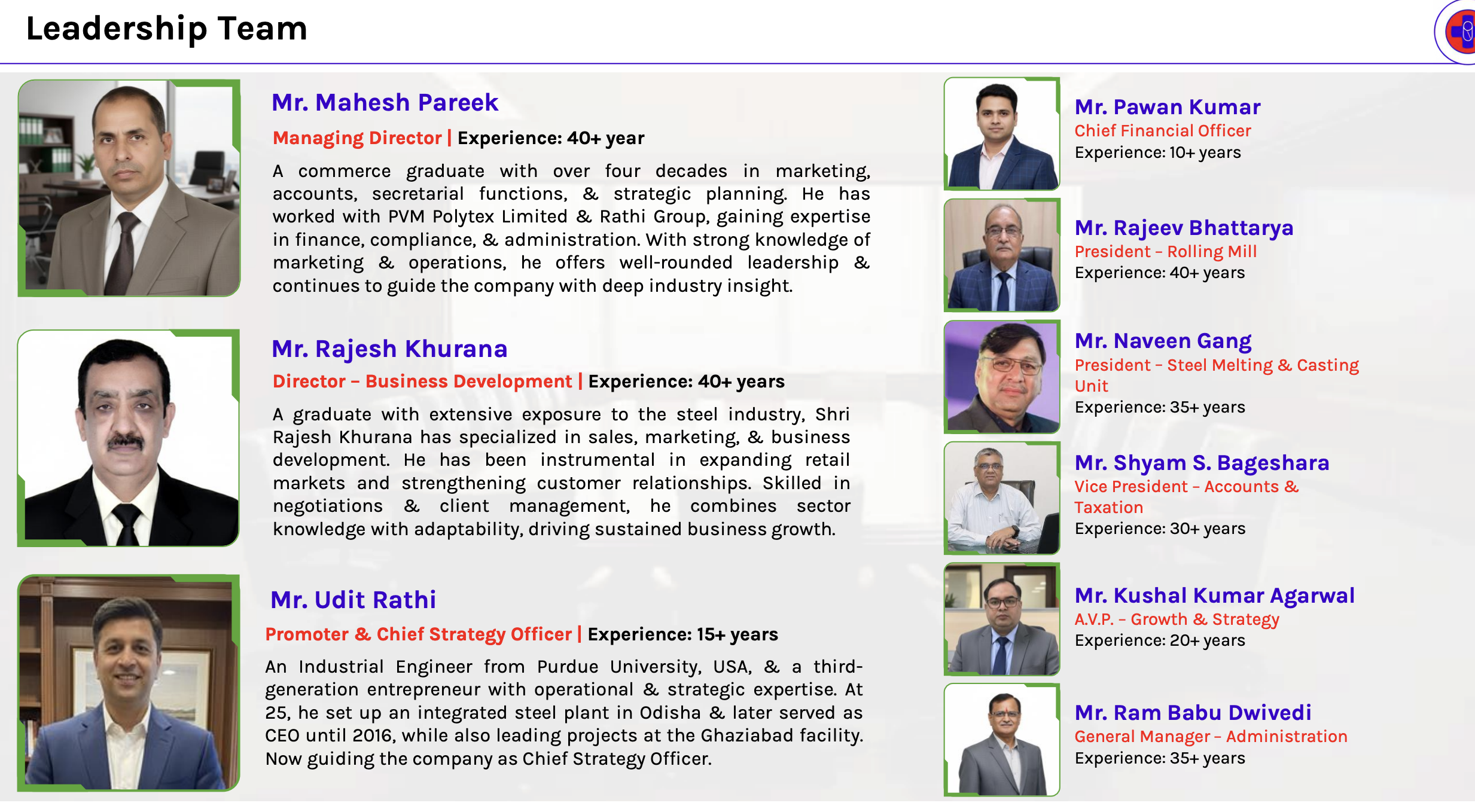
FY26 itself was busy on the announcement wire. The steel melting shop was temporarily closed from October 2025 under a Commission for Air Quality Management order and permitted to resume in November 2025. Pawan Kumar was appointed CFO in November 2025. Mahesh Pareek was appointed Managing Director in May 2025. And in June 2026 the company ran a trial of hot charging of MS billets to make Fe 550/550D TMT rebars.
Does a 42% revenue jump mean much when the profit beneath it went the other way? Hold that thought.
3. Business Model: WTF Do They Even Do?
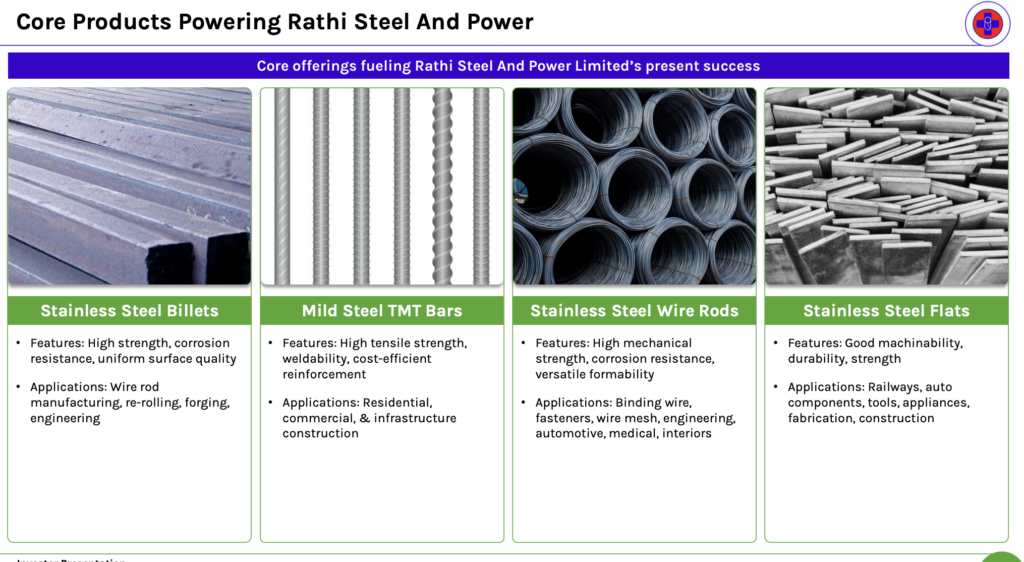
Rathi melts steel and rolls it into long products. The catalogue, per the company’s own materials, runs to stainless steel billets (feedstock for wire rods and forging), stainless steel wire rods (drawn into binding wire, fasteners, mesh, and engineering components downstream), stainless steel flats, and mild steel TMT bars for construction.
The split, per management’s concall commentary, is roughly 60% from the stainless-steel B2B business and around 40% from TMT bars. Stainless products are sold entirely through direct B2B channels; TMT bars go through a dealer network and direct sales, leaning on brand recall in NCR and North India. Management was candid that TMT bars travel poorly — freight economics keep them close to home, so the TMT business is essentially an NCR business.
The technology pitch is direct charging: hot billets moved straight from the caster to the rolling mill without reheating. Management describes the company as India’s only stainless-steel wire rod producer using this route, and in June 2026 extended a trial of it to the TMT line. Per management, the direct-charging route can save roughly ₹3,000–4,000 per tonne, or about 6–7% on the selling price of TMT bars including yield benefits — meaningful only on the tonnage actually routed that way, since rolling capacity exceeds what the melting shop can feed.
The honest description of this model: a legacy re-roller with a genuine efficiency edge on part of its volume, running two divisions each at barely half utilisation, trying to grow into a plant it already owns. There is no exotic product here. There is a lot of empty capacity and a brand that still opens doors.
4. Financials Overview
Figures are standalone, in ₹ crore.
Metric
Q4 FY26
YoY (Q4 FY25)
QoQ (Q3 FY26)
Revenue
244.44
+63.4% (149.57)
+52.8% (160.02)
Operating Profit
9.77
+23.7% (7.90)
+54.1% (6.34)
PAT
7.45
+96.0% (3.80)
+290% (1.91)
EPS (₹)
0.86
0.45
0.22
Revenue and operating profit both moved up sharply. The profit line moved even harder — Q4 depreciation of ₹0.77 crore sits