Highway Infrastructure Ltd — FY26: ₹608 Cr Revenue, 10.5x Earnings, and an Order Book That Trebled in Eighteen Months
Spotted a factual error — a wrong number, date, or fact? Tell us and we will check the source.
General information and entertainment, not investment advice. The author is not a SEBI-registered adviser or research analyst. No recommendation, no promised returns. Markets carry risk including loss of capital. Figures may not be current. Consult a registered adviser before acting.
1 — At a Glance
Figures are consolidated, in ₹ crore.
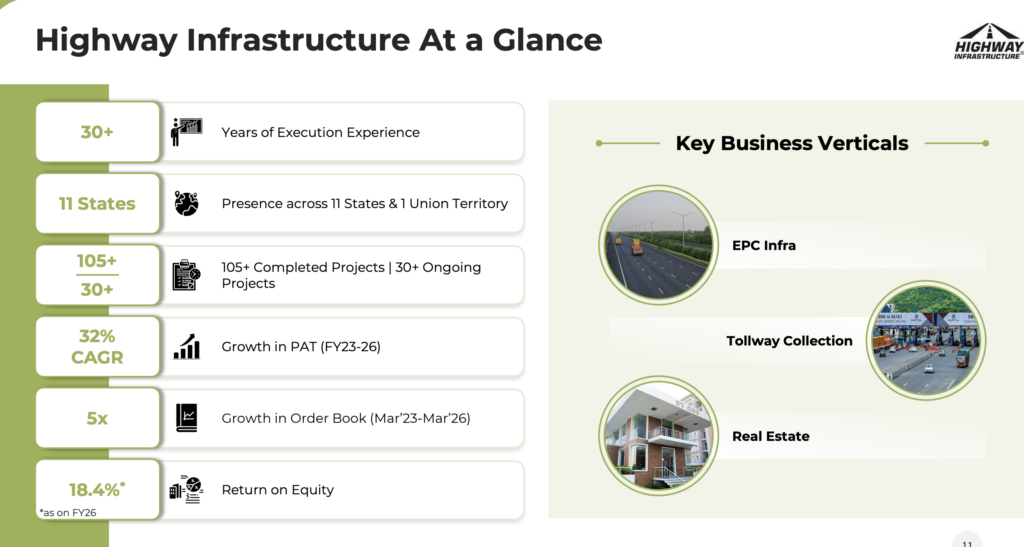
Highway Infrastructure Limited closed FY26 with revenue of ₹608 Cr, PAT of ₹32 Cr, and an order book of ₹1,133 Cr — roughly 1.9x annual revenue. The company operates across three verticals: tollway collection (73.7% of FY26 revenue), EPC infrastructure (19.8%), and real estate (6.5%).
The numbers carry a specific tension. On one side: PAT grew 63% over FY25, ROCE sits at 18.8%, and the order book grew 113% year-on-year. On the other: operating cash flow came in at negative ₹66 Cr for the year, working capital days widened from 56 to 78, debtor days expanded from 29 to 39, and the company’s margin profile is thin — EBITDA of ₹51 Cr on ₹608 Cr of revenue is an 8.4% margin in a business that reported 10% margins five years earlier.
The market currently pays 10.5x FY26 earnings, against a peer median of 20x. The peer group consists largely of infrastructure investment trusts and listed toll operators several times the company’s size; a ₹338 Cr market cap sits at the small end of the table.
One wisdom line for orientation: a business that collects tolls on someone else’s road and builds roads under fixed-price contracts is structurally a working-capital machine. When the machine is growing fast, the working capital grows faster — and the cash flow statement is where that story actually lands.
The order book is the data point most worth watching. Whether ₹1,133 Cr of contracted work converts to margins, or merely to revenue, is the open question that the income statement alone cannot settle.
2 — Introduction
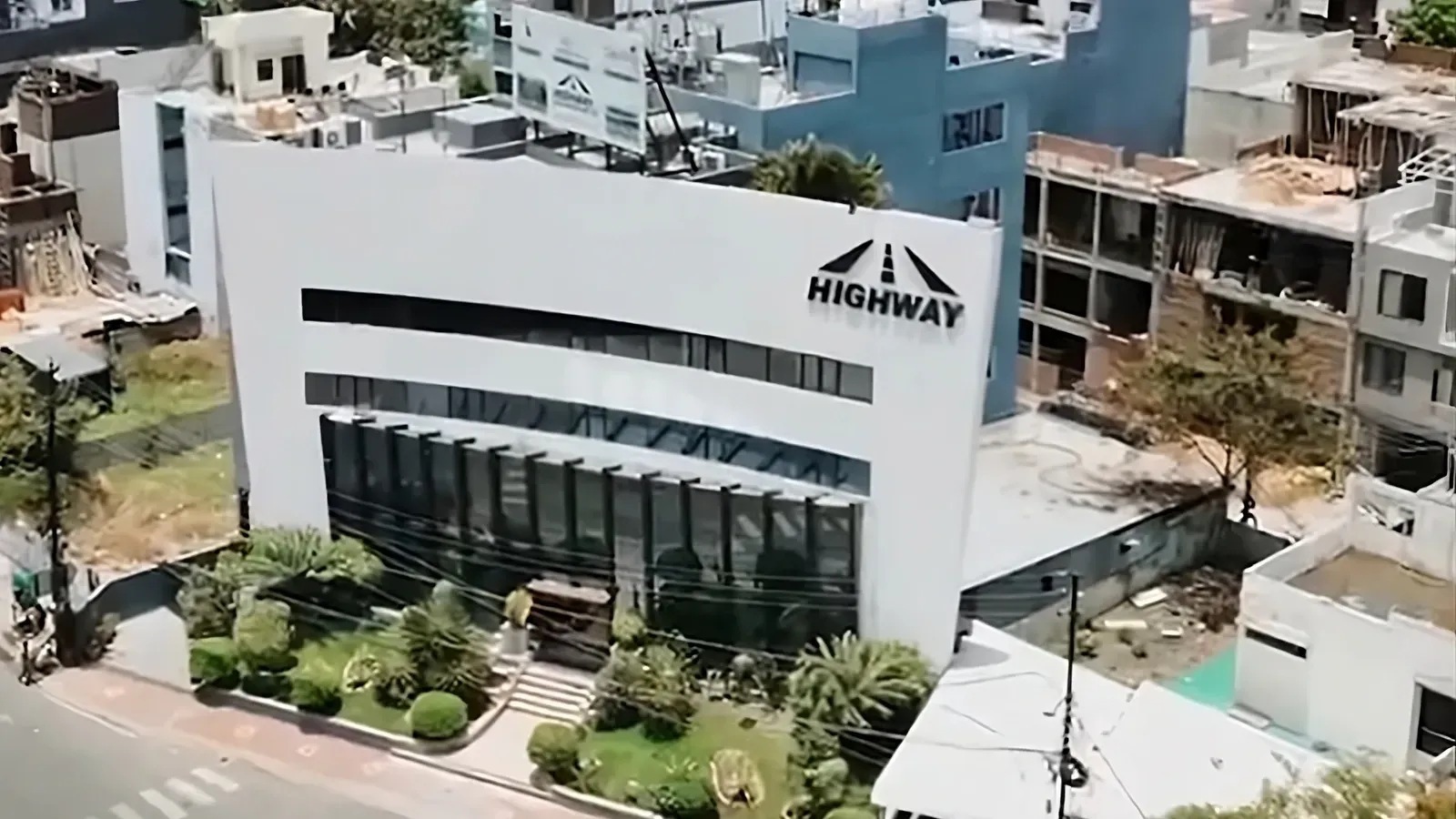
Highway Infrastructure Ltd was incorporated in 2006, with roots going back to a partnership firm founded in 1995. The company is headquartered in Indore, Madhya Pradesh, and lists on both BSE (code 544477) and NSE (symbol HILINFRA), having completed its IPO on August 12, 2025 — a fresh issue of ₹97.52 Cr at ₹70 per share, with promoters also offloading ₹32.48 Cr via an offer for sale.
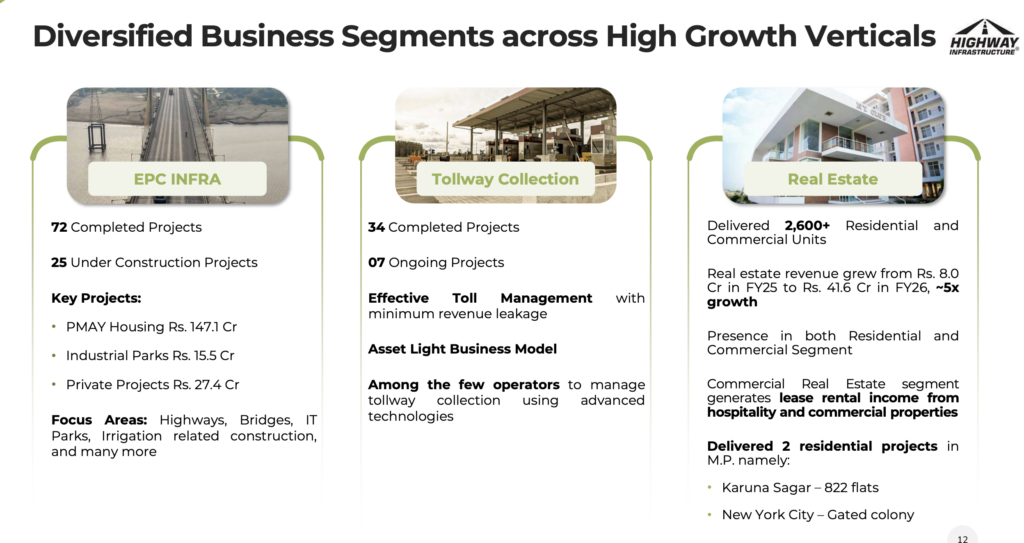
The business has three legs. Toll collection is the largest: the company wins short-duration contracts (typically 90 days to one year) to operate fee plazas on NHAI highways across multiple states. It uses RFID-integrated, ANPR-enabled systems and positions its technology stack as a differentiator for leakage control. EPC is the construction arm — roads, bridges, affordable housing under PMAY, industrial parks, and allied civil works, predominantly in Madhya Pradesh with expanding presence in Gujarat, UP, and Andhra Pradesh. Real estate is the smallest piece, delivering residential and commercial properties in and around Indore.
In FY26, the company announced several material contracts: a ₹328.8 Cr Kaza Fee Plaza contract in Andhra Pradesh (the largest single toll contract in its history), a ₹154.6 Cr Gujarat toll bundle, a ₹69.7 Cr IDA town-planning road in Indore, and a ₹82.7 Cr multi-storied residential building contract.
On the exits side, the company withdrew from the Venkatapalam Fee Plaza in Andhra Pradesh, incurring a penalty of ₹26.33 lakh, and handed over the Katiyara Fee Plaza in Bihar to NHAI after concluding it was not commercially viable, per filings. The Bhopal PMAY affordable housing contract at Plot Nos. 47 and 49 was cancelled by Nagar Palika Nigam, per the June 2026 announcement.
The board, at its June 6, 2026 meeting, approved the reappointment of MD Arun Kumar Jain and WTD Anoop Agrawal for three further years each, effective May 5, 2026, subject to shareholder approval.
3 — Business Model: WTF Do They Even Do?
Highway Infrastructure has the structural elegance of a company that does three things at once, none of which are identical, all of which involve highways.
The toll business is asset-light by design: the company bids for short-tenure contracts to operate fee plazas on existing NHAI highways. It does not own the road. It does not own the plaza. It wins the right to collect fees for 90 days to one year, remits most of the money back to NHAI, and keeps a spread. Management has described its edge as in-house technology — RFID, ANPR, digital payment integration — which reduces revenue leakage and makes operations auditable. The segment runs on roughly 5–7% margins per the CRISIL report, meaning it is a volume game. FY26 saw the company win its biggest single toll contract ever (Kaza Fee Plaza, ₹328.8 Cr, 365-day tenure), while simultaneously walking away from two contracts it judged to be below its return thresholds. The stated discipline is real: the announced penalty and the filed handover are documented facts, not strategy slides.
The EPC arm has 30+ years of accumulated execution history in Madhya Pradesh. The project list runs from rural road rehabilitation to PMAY housing to IT parks to industrial areas. Clients are overwhelmingly government bodies — NHAI, MPIDC, Indore Development Authority, MPRRDA, IMC — with a small private-sector tail. Management targets gross margins of 13–14% in EPC and states it will not pursue work below 10%, a threshold that puts it above where “industry people might go,” per the concall. The order book as of March 2026 had ₹591 Cr of executable EPC work, concentrated in Madhya Pradesh with newer projects in Gujarat and UP.
Real estate is the quiet overperformer of FY26. Revenue in this segment jumped from ₹8 Cr to ₹41.6 Cr, and management disclosed ~50% margins in the segment in the concall — by far the highest in the portfolio. The delivered residential projects (Karuna Sagar — 822 flats; New York City gated colony) are in Indore, and there is a growing commercial real estate component generating lease rental income from hospitality and commercial properties.
The business carries an interesting underlying question: three verticals with different margin profiles, different working capital intensities, and different contract structures, assembled under one balance sheet. The toll segment is high-revenue but thin-margin and cash-intensive (bank guarantees, earnest money, security deposits). EPC is medium-margin but working capital hungry. Real estate is high-margin but lumpy and illiquid. The mix shift in any given year determines the reported margins — and FY26’s OPM of 4.3% (operating profit divided by revenue) illustrates what happens when the toll segment, which generates revenue in large chunks on thin spreads, dominates the revenue mix.
Does the order book composition over the next 18 months resolve this margin question, or merely defer it?
4 — Financials Overview
Figures are consolidated, in ₹ crore. The result type is Quarterly (the company reports quarterly consolidated results); the latest period is Q4 FY26 (March 2026).
Q4 FY26 Summary
Metric
Q4 FY26
Q4 FY25
YoY
Q3 FY26
QoQ
Revenue
274.63
132.10
+107.9%
126.86
+116.5%
Operating Profit
13.51
15.13
-10.7%
8.04
+68.0%
PAT
8.82
11.89
-25.8%
6.41
+37.6%
EPS (full FY26)
₹4.47
—
—
—
—
Revenue in Q4 more than doubled year-on-year, largely reflecting the ramp-up in toll contracts including the Gujarat bundle and the Kaza plaza. Operating profit, however, declined — revenue grew but expenses grew faster, with COGS at ₹261.12 Cr against revenue of ₹274.63 Cr. PAT fell 25.8% year-on-year on the quarter.
The full-year EPS of ₹4.47 uses the full FY26 net profit of ₹32.06 Cr divided by 7.172 Cr shares (derived from equity capital of ₹35.86 Cr at face value ₹5). At a Q4 result, the full fiscal-year figure applies — no annualisation multiplier.