Radiant Cash Management Services Ltd — FY26: The Core Holds, the Subsidiaries Do Not
Spotted a factual error — a wrong number, date, or fact? Tell us and we will check the source.
General information and entertainment, not investment advice. The author is not a SEBI-registered adviser or research analyst. No recommendation, no promised returns. Markets carry risk including loss of capital. Figures may not be current. Consult a registered adviser before acting.
1. At a Glance
Radiant Cash Management Services closed FY26 with consolidated revenue of ₹429 crore — essentially flat on ₹427 crore in FY25, a 0.5% crawl that management attributed, per the earnings call, to two discrete client losses: several railway regions surrendered to competition and a large e-commerce logistics client absorbed by a larger acquirer. Those two events cost roughly ₹13–14 crore in annualised revenue, per management’s quantification on the concall.
The more pointed number is PAT. Consolidated profit after tax fell to ₹28 crore from ₹47 crore the prior year — a 40% drop — with the earnings call attributing the deterioration largely to losses in the fintech subsidiary Aceware and the valuables logistics arm Radiant Valuable Logistics. The standalone business, by contrast, delivered ₹38 crore PAT on ₹401 crore revenue, a more orderly 16% decline from ₹46 crore the year before.
A ₹3.13 crore fraud in Aceware, classified as an exceptional item, further weighted the consolidated line. The board approved a ₹2.5 per share final dividend despite the earnings compression — a payout ratio that, at 83% of consolidated PAT, strains the definition of “sustainable distribution.”
The core cash logistics franchise — 77,521 touch points, 870 armoured vans, ₹1,694 billion in cash handled — kept moving. Whether the subsidiaries follow in FY27 as management expects is the unresolved question this period leaves open.
2. Introduction
Radiant Cash Management Services was incorporated in 2005 and listed more recently as a mid-cap play on India’s physical cash infrastructure. The company operates from Chennai and describes itself as an integrated cash logistics player, with particular depth in Tier 2 and Tier 3+ geographies — roughly 82% of touch points and 84% of revenues originate outside metro cities, per the investor presentation.
FY26 arrived as the year the diversification thesis met operational reality. In FY24 the company had acquired a 56.93% stake in Aceware Fintech Services, entering the business correspondent and digital payments space — POS terminals, sound boxes, micro ATMs. In August 2023 it had also launched Radiant Valuable Logistics, targeting movement of diamonds, jewellery, gold, and high-value items. Both ventures remain loss-making as of March 31, 2026.
On the core business, FY26 saw two client exits that management described explicitly on the concall: loss of railway regions to competition (roughly ₹9–10 crore annualised) and the departure of a large e-commerce logistics client that was acquired by a larger player (roughly ₹4 crore annualised). Offsetting those, management cited 21% annual growth in the e-commerce vertical within core served sectors, along with strong performance in petroleum and organised retail.
The company added 118 new clients and 230 new end customers during FY26, and covered 14,844 pin codes by year-end. A new large project from an existing customer commenced April 1, 2026 — FY27 day one — which management on the concall suggested could add approximately 3–4% to FY27 revenue.
3. Business Model: WTF Do They Even Do?
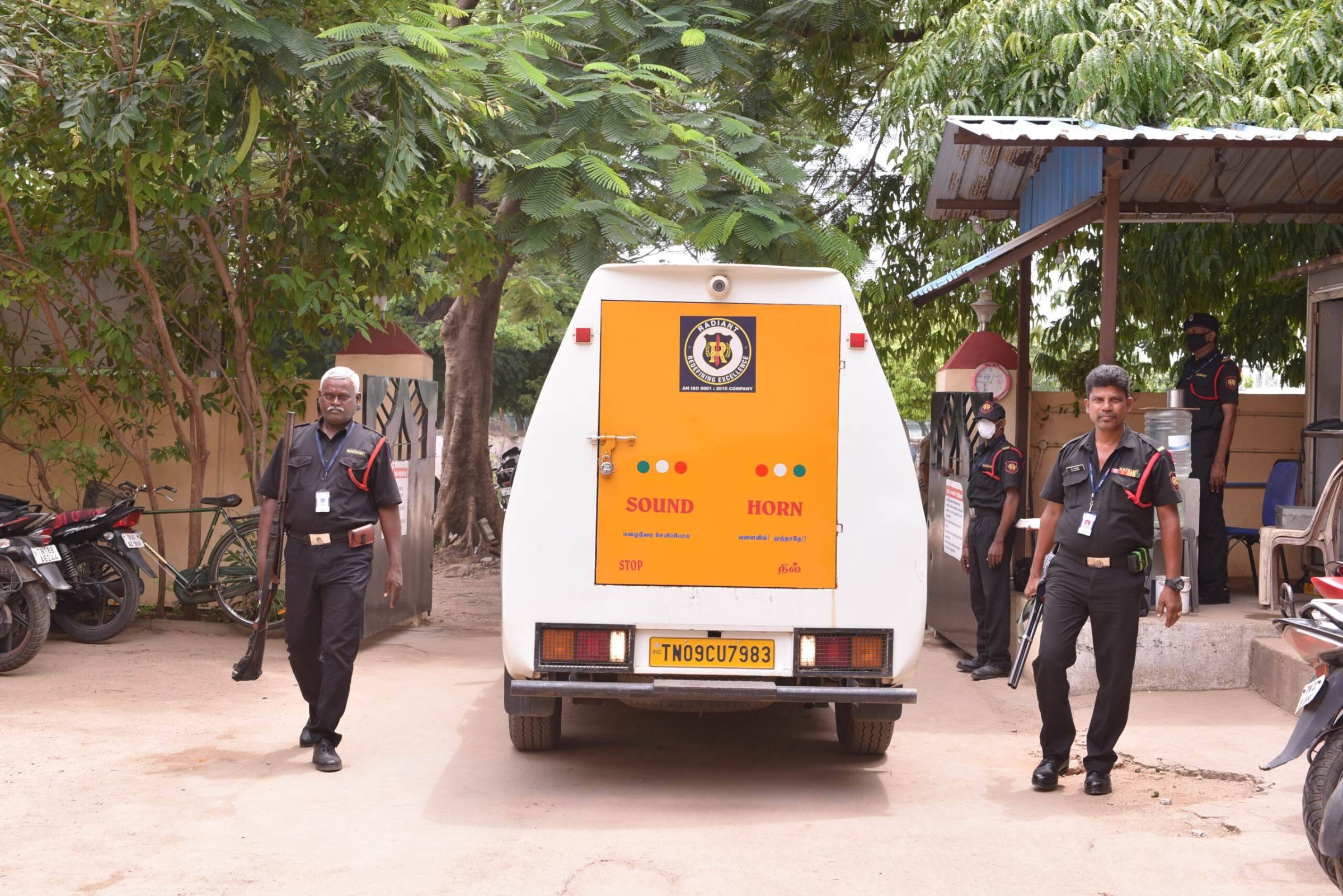
Radiant’s core business is deceptively simple: it picks up cash from wherever cash accumulates — a pharmacy in Gorakhpur, a petrol station in Tirunelveli, a jewellery shop in Ludhiana — and deposits it into the client’s bank account. It is, in the most literal sense, a company that drives around India with armoured vans collecting the country’s physical currency.
The five service lines from the investor presentation:
Cash Pick-Up & Delivery — the flagship, contributing 61% of FY26 revenues. Fixed per-point per-month fee depending on location and daily cash limit. Growth comes from adding points, particularly in Tier 3+ towns where banks have thin branch networks.
Network Cash Management — 21% of FY26 revenues. A value-added layer: Radiant deposits client cash into Radiant’s own bank account in locations where the client has no branch, then electronically transfers the funds. Revenue is variable, tied to volumes deposited. Effectively a float-plus-logistics play.
Cash Van Operations — 12% of revenues and growing. Armoured vans leased with full crew to banks for bulk inter-branch cash transfers. Fixed per-van per-month fees. Management noted on the concall that dedicated cash van contracts are a priority growth area, with “two, three more large contracts in pipeline” beyond a recently signed large contract.
Cash Processing — 5% of revenues. Cash counted and verified at point of pick-up rather than sealed-bag collection. Additional fee per service.
Others — 2%. Includes “Man Behind Counter” (uniformed staff stationed at high-footfall retail), and vault rentals.
By industry, BFSI is the dominant client at 34% of FY26 revenues, followed by organised retail at 19%, e-commerce at 19%, and petroleum at 4%. Railways slipped from 3.4% to 1.6% of revenues, per the presentation — a visible scar from the client loss.
The company runs this with 9,875 people, 870 fabricated armoured vans, 21% of total staff drawn from ex-armed forces backgrounds. Cash losses in FY26 were ₹3.33 crore against ₹1,694 billion moved — 0.002% of cash handled, which management on the concall described as “one of the best performance in the industry.”
Two subsidiaries now sit alongside this core. Aceware Fintech (58%+ stake), handling POS, sound boxes, and business correspondent services — ₹100 crore in revenue, ₹10 crore PAT loss in FY26, per management. Radiant Valuable Logistics (RVL), handling high-value goods movement — ₹6.07 crore in revenue, ₹6 crore EBITDA loss, per management.
The business model wisdom: scale in cash logistics is a distribution game, not a margin game. The company with the most points wins the contract; the company with the lowest cash-loss ratio keeps it.
4. Financials Overview
Figures are consolidated, in ₹ crore.
Annual Results:
Metric
FY24
FY25
FY26
YoY
Revenue
386
427
429
+0.5%
EBITDA
82
93
45
-52%
PAT
44
47
28
-40%
EPS (₹)
4.19
4.36
3.02
-31%
Note: EBITDA per Screener data (operating profit line). The investor presentation reports EBITDA of ₹54.35 crore for FY26, excluding the ₹3.125 crore exceptional item (Aceware fraud). The Screener operating profit line of ₹45 crore reflects the consolidated income statement including subsidiary losses at the operating level.
Latest Quarter (Q4 FY26, per the consolidated filing):
Metric
Q4 FY26
Q3 FY26
QoQ
Q4 FY25
YoY
Revenue
₹101 Cr
₹124 Cr
-18.7%
₹104 Cr
-3.4%
EBITDA
₹11.1 Cr
₹17.5 Cr
-36.6%
₹15.2 Cr
-27.0%
PAT
₹3.0 Cr
₹11.6 Cr
-74.5%
₹8.4 Cr
-64.7%
EPS (₹)
0.51
1.03
—
0.79
—
Q4 was the weakest quarter of the year. Management attributed the consolidated EBITDA margin of 10.7% in Q4 to losses in Aceware and RVL, per the concall. The standalone Q4 EBITDA margin stood at 15%, described as “continuing an improving trend” from cost reduction measures, management said.
Concall highlights (June 2026):
Management stated that consolidated FY26 PAT of ₹28 crore was “largely on account of losses incurred in the fintech subsidiary.” The CFO quantified the exceptional item impact at approximately ₹3.1 crore. On Aceware, management described the PIDF subsidy ending in December 2025 as the key Q4 headwind, and stated targets for