Pakka Limited FY26: ₹744 Crore Bet, ₹18 Crore Profit
Spotted a factual error — a wrong number, date, or fact? Tell us and we will check the source.
General information and entertainment, not investment advice. The author is not a SEBI-registered adviser or research analyst. No recommendation, no promised returns. Markets carry risk including loss of capital. Figures may not be current. Consult a registered adviser before acting.
1 — At a Glance
Pakka Limited closed FY26 with revenue of ₹356 crore — down 12% from FY25’s ₹406 crore — and net profit of ₹18 crore, a 68% collapse from ₹57 crore a year prior. Operating margins compressed from 19% to 12%. The company is simultaneously operating a ₹744 crore expansion project (Project Jagriti), has refinanced its debt through ₹540 crore of non-convertible debentures at an effective rate of 16.95%, and carries borrowings that ballooned from ₹204 crore in FY25 to ₹458 crore in FY26.
The numbers that demand attention: ROCE fell to 4.42% — against a 5-year average north of 18%. ROE sits at 3.65%. The company’s total assets have grown from ₹518 crore in FY24 to ₹1,152 crore in FY26, almost entirely on the back of capital work-in-progress, which jumped from ₹35 crore to ₹555 crore. Capital work-in-progress now accounts for roughly half the balance sheet.
One wisdom drop: a company in heavy capex is often trading today’s returns for tomorrow’s capacity. Whether the capacity materialises on schedule is, historically, the part that varies.
The central tension: Pakka is a ₹386 crore company carrying ₹744 crore of expansion ambition, funded at nearly 17% interest, with its CFO just resigned and its credit rating freshly downgraded to BB+. The next twelve months are either the setup for a very different P&L, or a very different debt conversation.
2 — Introduction
Pakka Limited — incorporated in 1981, formerly Yash Pakka Limited until July 2023 — manufactures specialty paper and packaging products at its facility in Ayodhya, Uttar Pradesh. The company operates two segments: Paper & Pulp (the dominant business) and Moulded Products (the “Chuk” branded bagasse tableware business). It exports to over 31 countries, with domestic revenue at roughly 75% of the mix as of FY24.
FY26 was not a year to file away quietly. The company undertook a planned shutdown of its manufacturing unit from June 16 to July 24, 2025, as part of Project Jagriti’s phased rollout. The shutdown — intended to be 20 days, extended to approximately 40 days per management — hit Paper & Pulp revenue hard, eliminating pulp sales during that window. The Wrap & Carry (Paper & Pulp) segment’s full-year volume fell 17%, with PBT dropping approximately 50%, per the investor presentation.
Simultaneously, the funding structure for Project Jagriti came undone. The original plan had included warrant proceeds alongside bank debt. When the share price fell below the warrant exercise price, one investor — Carnelian — did not honour warrants, creating a shortfall management described as approximately ₹300 crore, per the Q4 FY26 concall. The company refinanced by issuing ₹540 crore of NCDs through Neo Group at an effective interest rate of 16.95%.
In June 2026, the company allotted 27.2 lakh equity shares and 77 lakh warrants, raising up to ₹114.62 crore. On June 4, 2026, promoter Ved Krishna pledged 1,26,81,678 shares — 28.21% of capital — as security for the debenture holders, per the SAST disclosure. On June 9, CARE Ratings downgraded Pakka’s ₹630.94 crore of bank facilities to BB+/A4+ and moved them to Issuer Not Cooperating, citing non-availability of information. On June 16, CFO Neetika Suryawanshi resigned, effective June 30, 2026, citing personal reasons.
3 — Business Model: WTF Do They Even Do?
Pakka makes paper from bagasse — the fibrous residue left after sugarcane is crushed for juice. It is, in essence, a company that took something the sugar industry throws away and decided to build a specialty packaging business around it. The plant sits in Ayodhya, Uttar Pradesh, which also happens to be India’s sugarcane heartland, so raw material isn’t the problem. The problem is everything downstream of the bagasse.
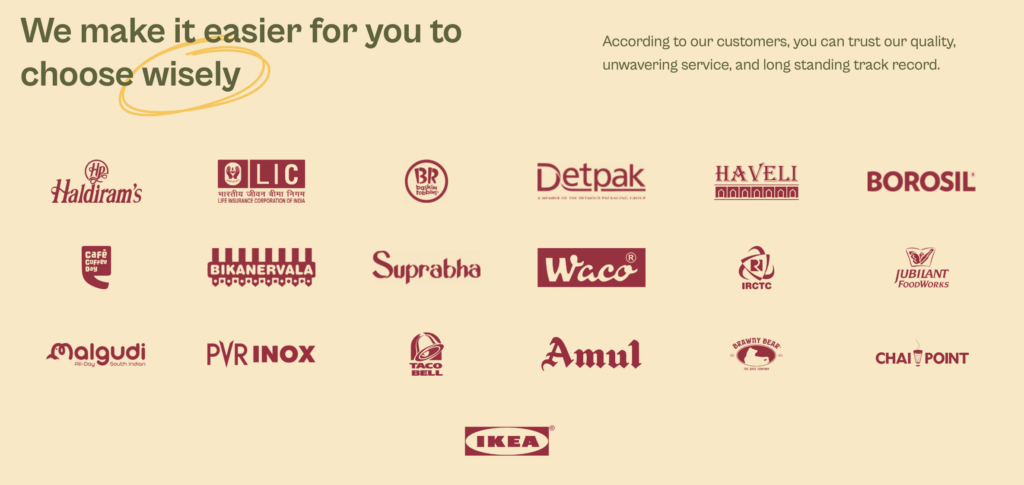
The Paper & Pulp segment produces machine-glazed agro-based paper — 30 to 100 GSM — in unbleached kraft, bleached kraft, and coloured kraft varieties. This paper goes into food carrying materials. The segment also produces agro pulp used in specialty papers: greaseproof, glassine, release base, parchment. Clients include names like Borosil, Haldiram’s, Chai Point, and Blinkit. It is not consumer-facing; it is the paper your food came wrapped in before you threw it away without noticing.
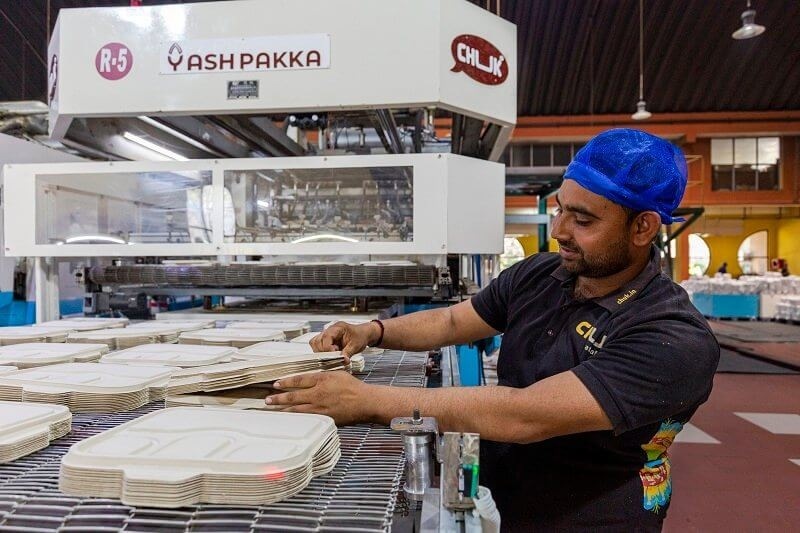
The Moulded Products segment — branded “Chuk” — makes compostable bagasse tableware: bowls, plates, trays, cups, cutlery. It entered this segment in 2018, and FY26 volume grew to 3,100 metric tonnes from 2,600 metric tonnes, according to the investor presentation. Revenue from food services reached ₹63 crore in FY26. The catch: the segment ran a loss of ₹10.84 crore for the year, driven by manufacturing/plant losses and one-off non-cash items, per management’s breakdown.
The integrated model is genuinely clever on paper: captive power plant (8.8 MW, rice husk-fired), in-house soda recovery plant (145 MTPD capacity recovering caustic soda), and domestic bagasse sourcing within a 100-km radius. CARE noted that Pakka’s cost of procurement is competitive against peers and industry trend. The efficiencies are real. The scale, however, is being tested by Project Jagriti — a capacity expansion from 136 MTPD to 246 MTPD — which has encountered cost escalation (total project cost revised to ₹744 crore), timeline extensions (commercial operation date now January 1, 2027), and debt refinancing at 16.95%.
Does a 2,700 bps operating margin swing over five years — from 15% in FY15 to 21% in FY23, then back to 12% in FY26 — reflect the difficulty of the model, or the disruption of a one-time expansion? The filings don’t settle which.
4 — Financials Overview
Figures are standalone, in ₹ crore.
Annual P&L Summary
Metric
FY26
FY25
YoY
Revenue
356
406
-12%
EBITDA*
~53
~93
-43%
PAT
18
57
-68%
EPS (₹)
4.04
12.61
-68%
*EBITDA approximated as PBT + Interest + Depreciation: ₹25 + ₹11 + ₹17 = ₹53 crore for FY26; ₹67 + ₹10 + ₹16 = ₹93 crore for FY25.
Q4 FY26 (Standalone)
Metric
Q4 FY26
YoY
QoQ
Revenue
102
+10.2%
+5.6%
Operating Profit
10.16
-44%
-35%
PAT
3.84
-69%
-58%
EPS (₹)
0.85
-69%
-58%
Concall Highlights (Q4 FY26, June 2026)
Management attributed the full-year revenue decline of approximately 13% primarily to the PM3 outage and the resulting disruption to pulp sales, per the concall. The PM3 shutdown — planned at 20 days, extended to approximately 40 days — management quantified as an ₹11 crore impact on PBT. Pricing pressure from new entrants was quantified as a ₹16 crore impact. Management said the PM3 modification was expected to complete in the