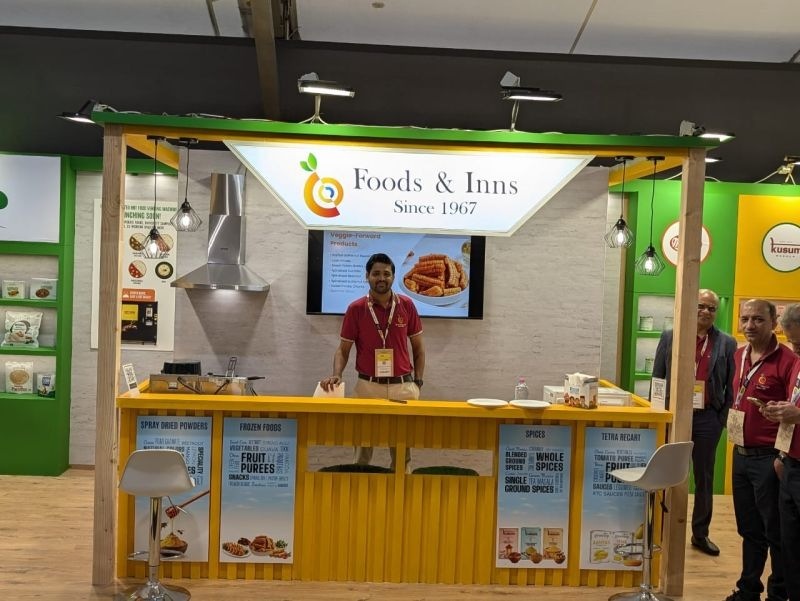
Foods & Inns FY26: The Seasonality Trap and the Missing ₹300-Crore Pivot
Spotted a factual error — a wrong number, date, or fact? Tell us and we will check the source.
General information and entertainment, not investment advice. The author is not a SEBI-registered adviser or research analyst. No recommendation, no promised returns. Markets carry risk including loss of capital. Figures may not be current. Consult a registered adviser before acting.
1. At a Glance
A mango pulp processor walks into a war zone.
The company’s FY26 revenue fell 12.5% to ₹868 crore, a collapse framed as inevitable: cheaper mango procurement courtesy of Middle East export disruptions, a failing tomato harvest, and inventory piling up with no customer sign-off. Adjusted for the cost-plus model, the real story is volumes—down 3.7% to 880 MT across FY25–FY26, while carrying costs spiraled. Operating profit dropped 13% to ₹100 crore. Net profit fell 35% to ₹28 crore.
The balance sheet reads like a season of delayed checkouts: inventory ballooned to ₹640 crore (up 31% YoY), borrowings held steady at ₹432 crore (up from ₹440 crore, a marginal win), and working capital days stretched to 334 (from 208 last year). The rating agency flagged this as “adequate” liquidity, but the footnote stings: 95% of stock is order-backed and zero margin for surprise.
The green flags: frozen foods grew 28% YoY to ₹92 crore (up from ₹71 crore), the Pectin JV began commercial production, and Tetra Recart orders sit at ₹8 crore. The question: can these three segments—currently ₹117 crore combined, or 13% of revenue—absorb enough fixed overhead to unwind the mango-pulp dependency and the seasonality trap? Management targets ₹300–400 crore from non-mango categories in 3–4 years without shrinking mango. The math says ₹868 crore × 40% upside would be ₹1,214 crore. The track record says 12.5% contraction.
2. Introduction
Foods & Inns has been pulping mangoes for over 50 years, beginning as a Coca-Cola canning operation in 1970 and pivoting into aseptic fruit processing in the 1980s. Today it is one of India’s largest mango pulp exporters and also claims leadership in frozen goods, spray-drying, spices, and—newly—pectin-from-waste.
The structure is clean: seven owned plants across Maharashtra, Gujarat, and Andhra Pradesh, plus a joint venture (Beyond Mango, 50% stake) manufacturing pectin in Chittoor. The company operates under a cost-plus contract model with marquee customers like Coca-Cola and PepsiCo, meaning raw material price swings are passed through with a negotiated markup every 15 months. Pricing power exists, but volume is king.
FY26 opened with inherited challenges. The Middle East conflict in March 2026 redirected table mangoes (normally earmarked for fresh export) into processing, flooding the input market with cheaper fruit. Simultaneously, unseasonal rains in Maharashtra and Karnataka spoiled the tomato harvest—the secondary pulp segment. Exports to the Middle East froze in Q4. Airline capacity constraints diverted more table fruit to local processors, compressing realizations. By June 2026, the CFO, Anand Krishnan, resigned, effective June 30.
The business remains resilient on the B2B side (Coca-Cola, PepsiCo hold contracted volume), but the seasonality trap is now the company’s public enemy no. 1.
3. Business Model: WTF Do They Even Do?
The core business is fruit and vegetable pulping.
Mango Pulp: The flagship. The company processes three varieties—Alphonso, Kesar, Totapuri—into aseptic pulp for mango-based beverages and dairy products. It procures ~200,000 MT of raw mango each season (April–August) from its farmer network in Maharashtra and Karnataka, the leading growing regions. Sales concentrate in December–June (60–65% of domestic volume), with export dispatch running from August through the following May. Carry-forward inventory each year is ~45% of season production. FY26 revenue from mango: ₹695 crore, or 80% of total.
Tomato Pulp & Paste: The off-season play. Tomato procurement runs September–December. FY26 volume tanked due to quality issues and unseasonal rain; management expects near-term guidance to remain uncertain.
Spray-Dried Powders: Converts liquids into shelf-stable powder (shelf life ~24 months). Dairy, fruit, vegetable, and natural color powders. Capacity expanded from 500 MTPA to 1,050 MTPA (doubled in FY24–FY25). FY26 revenue: ₹19 crore. Gas supply disruptions in March–April 2026 halted production for ~45 days; costs rose.
Frozen Vegetables & Snacks: Fruits (mango, papaya, pineapple), vegetables (peas, carrots, corn, okra), and snacks (samosas, spring rolls, flatbreads). Sold to modern retail, HORECA, and e-commerce channels under the “Green Top” brand. Volume grew ~28% YoY in FY26 to 99,453 MT (up from 98,399 MT in FY25—actually down 1% on tonnage, but revenue up to ₹92 crore from ₹71 crore due to value-added mix). The segment is being branded as the growth engine.
Spices & Masala: Kusum Spices (acquired FY19) sells 70+ ground, blended, and whole spice products to 12 countries. FDA-approved. Exports to US, UK, Oman, UAE. FY26 revenue: ₹19 crore.
Tetra Recart Packaging: A sustainable carton alternative to cans. Shelf life up to 2 years without preservatives. The Vankal plant (commissioned March 2023) has capacity of 3 MT/hr. FY26 revenue: ₹3 crore. Confirmed orders: ₹8 crore (400 MT). Management guided FY27 revenue at ₹20 crore. Adoption friction remains real: Tetra Recart is 25% more efficient to ship than cans but premium-priced; Indian consumers prefer cheaper retort pouches.
Pectin (Beyond Mango JV): Mango pulping wastes ~50% of fruit weight (skins, kernels). The JV converts this waste into natural pectin (gelling agent) for food, pharma, cosmetics. Commercial production started June 2026 (post–year end). India imports 95% of its pectin from Brazil, China, Mexico. The company claims 50% capacity utilization could yield ₹7–8 crore revenue; 70% gross margin. Key customers targeted: Coke, Pepsi, Unilever, Dabur. Import substitution play.
The model is B2B-heavy (60% of revenue to 10 customers, per management) but geographically diversified: 68% from exports (50+ countries) with Europe and US at ~20% of total, Middle East at 11%, and India at 31% (down from historical 40%, reflecting export growth).
4. Financials Overview
Figures are consolidated, in ₹ crore.
Metric
FY26
FY25
YoY Change
Revenue
868
992
-12.5%
EBITDA
112
129
-13.2%
PAT
28
42
-33.3%
EPS
3.77
5.71
-34.0%
The contraction reflects the pass-through model at work: cheap mangoes → lower realizations → same (or lower) volumes → fixed costs unabsorbed. Management reiterated on the concall that EBITDA margin % guidance is withheld because pricing is a pure pass-through; the business is volume-driven, not margin-driven.
From the concall (June 2026):
“Challenging operating environment” in FY26 driven by “pass-through of lower raw material costs.”
“Temporary disruptions in export markets”—Middle East exposure ~USD 2 million; management expects pent-up demand as conditions stabilize.
FY27 volume growth guidance: ~18% across the entire basket, anchored on frozen foods (30% CAGR last 3 years) and Tetra Recart ramp-up.
Mango/tomato realizations to remain suppressed into FY27–FY28 because “low cost season product” inventory will be sold.
5. Market Expectations & Historical Multiples
This section describes how the market is currently pricing the company and how that compares with its own history and peer group. It is descriptive, not predictive.