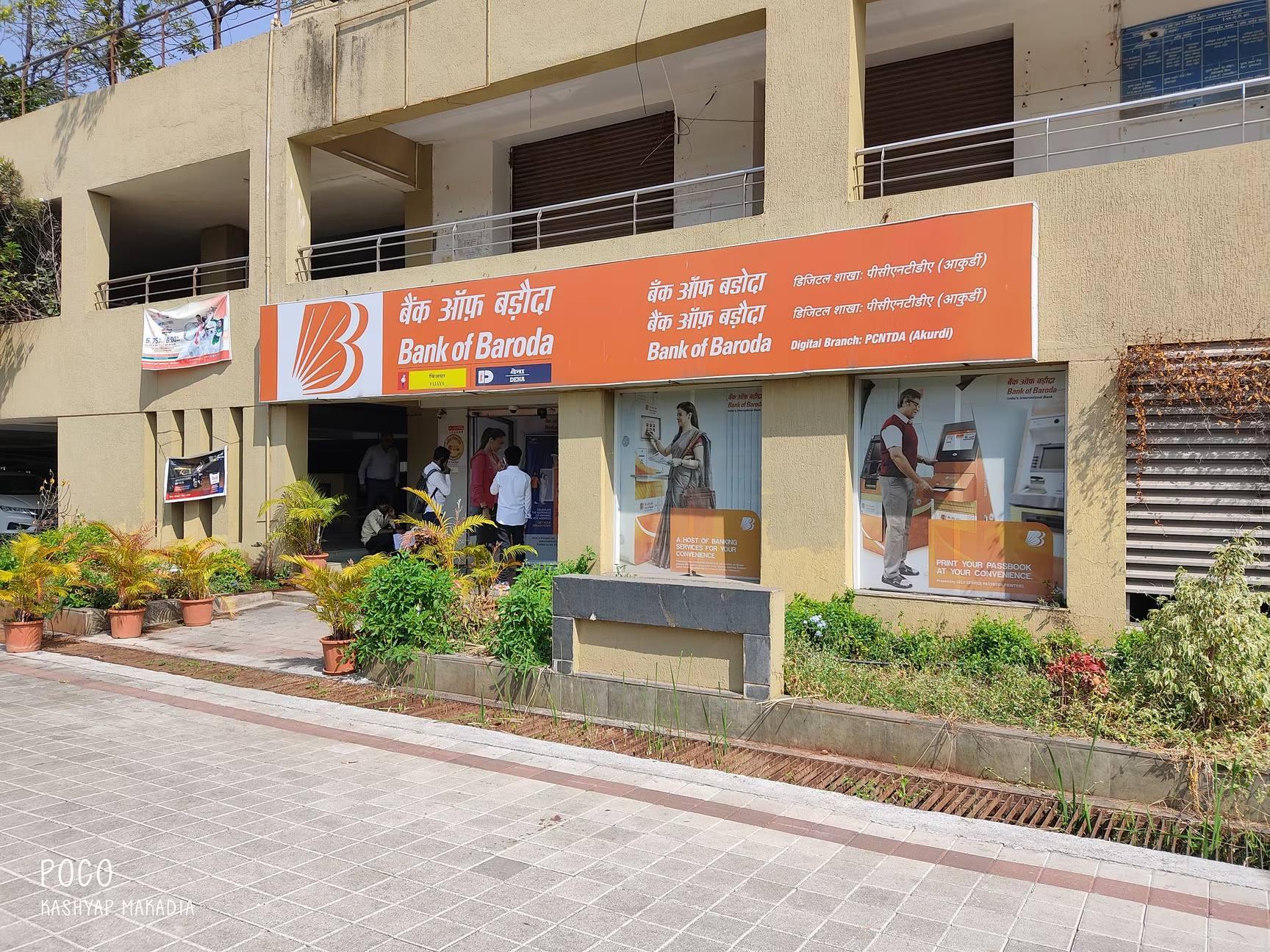
Bank of Baroda FY26: Record Profit, Margin Squeeze
General information and entertainment, not investment advice. The author is not a SEBI-registered adviser or research analyst. No recommendation, no promised returns. Markets carry risk including loss of capital. Figures may not be current. Consult a registered adviser before acting.
Prices referenced are not live; figures are consolidated in ₹ crore.
1. At a Glance
Bank of Baroda crossed ₹20,000 crore in annual net profit for the first time, hitting ₹19,846 crore in FY26 — a modest 2.2% climb from ₹20,716 crore a year earlier. The irony: a record headline that masks a profit growth running backwards on a full-year basis. Deposits expanded 12%, loan book 16.2%, but the net interest margin compressed to 2.89% from 3.08%, and cost of deposits rose to 4.87% from 5.10% in a tightening funding environment.
The bank sits at a 7.15x P/E against a peer median of 8.43x—cheaper, yes—but against a 1.89% GNPA ratio and 72% provision coverage that lag the sector’s premium asset-quality names. A state-owned franchise with 63.97% GoI backing, ₹30.78 lakh crore global business, and Q4 profit of ₹5,801 crore that matched its highest-ever quarterly beat.
Yet the spread story tightens.
2. Introduction
Bank of Baroda, India’s third-largest public-sector bank by net advances and sixth by deposits as of March 2026, runs 8,400 domestic branches and 11,563 ATMs across 82 overseas offices. The bank absorbed Dena Bank and Vijaya Bank in 2019, a reset that spent years stabilising balance sheets before clicking into growth. Now it hunts market share in retail and agriculture while managing a wholesale franchise weighted toward corporates at 39% of domestic advances.
The 64% government stake keeps it systemic. The rating agencies—India Ratings, CARE, ICRA, Fitch, Moody’s, S&P—have affirmed or assigned top marks (IND AAA, Baa3, BBB−, [ICRA]AAA). No downgrades. MD Debadatta Chand, extended through mid-2029, has spent three years narrating a recovery story: bad-loan cleanup, margin rebuilding, RAM (Retail-Agri-MSME) momentum. FY26 closes that act.
A pension fund sponsor appointment landed in May 2026. A primary dealer subsidiary (BOB Securities & Giltedge) went live April 2026 with ₹2,000 crore capital. It raised ₹10,000 crore in green infrastructure bonds at 7.10% coupon—the first PSB to do so domestically. The machine hasn’t stopped; it’s just running on tighter margins.
3. Business Model: WTF Do They Even Do?
A full-service bank with a public-sector anchor. Revenue splits roughly: 61% net interest (lending spread), 39% fee and treasury. The lending book is 61% RAM (₹3,00,598 crore organic retail; ₹1,91,063 crore agri; ₹1,59,786 crore MSME organic), leaving 39% corporate at ₹4,56,584 crore.
Deposits sit 38.9% CASA (current and savings), 61.2% term, with bulk deposits (₹3,19,379 crore, or 19% of term deposits) a tactical pain point. The cost of deposits keeps sticky: 4.78% in Q4 FY26, a 27 basis-point drop from Q4 FY25’s 5.05%, but still hard upward pressure year-on-year (5.10% full-year FY25 → 4.87% FY26 is noise; compare quarterly: 5.12% Q4 FY25 → 4.78% Q4 FY26 is real). The yield on advances fell too—7.44% in Q4 FY26 from 8.21% Q4 FY25—the repricing lag that strangles margins in rising-rate cycles.
The bank claims retail mortgage momentum (auto +20.6%, home +14.6% YoY), a 98.9% collection efficiency outside agriculture, and SHG (self-help group) accounts of ₹15,651 crore outstanding across 4,00,041 groups. Yet agriculture carries its own volatility: NPA additions in farm lending ticked higher in recent quarters despite management narrative of “normalized slippage” and monsoon-resilience.
Treasury income collapsed from ₹1,559 crore in Q4 FY25 to ₹44 crore in Q4 FY26. That’s a ₹1,515 crore swing—97.2% drop—attributed to management’s “first-of-its-kind” green bond placement and mark-to-market noise on securities. The concall disclosed ₹1,500 crore in “floating provisions” booked in Q4, funded from a tax-refund windfall, a liquidity buffer management says isn’t earmarked for ECL (Expected Credit Loss) modelling yet. The message: we’re hiding cash in reserves against unknowable regulatory futures.
4. Financials Overview
Figures are consolidated, in ₹ crore. Quarterly Results (Latest Period: Mar 2026)
Metric
Q4 FY26
Q4 FY25
YoY Change
FY26
FY25
YoY Change
Revenue
34,514
31,072
+11.1%
1,34,298
1,18,379
+13.5%
Net Interest Income
12,494
11,494
+8.7%
47,682
46,518
+2.5%
Operating Profit
9,069
8,132
+11.5%
32,259
32,435
−0.5%
Net Profit
5,801
5,048
+14.9%
19,846
20,716
−4.2%
EPS (Annualised)
11.22
10.16
+10.4%
38.38
40.06
−4.2%
The concall framing: “first time in many quarters the growth in interest income has been higher than interest expenses,” a signal that repricing kicked in. Interest income grew 3.8% YoY (₹1,26,994 crore vs ₹1,22,301 crore), yet interest expenses jumped 4.7% (₹79,311 crore vs ₹75,783 crore), eating the uplift. Non-interest income fell 0.2% YoY to ₹15,757 crore, dragged by treasury collapse (₹3,589 crore → ₹4,436 crore full-year was an offset, but Q4’s ₹44 crore ravaged the trend). Operating expenses rose 4.4% to ₹31,180 crore, with employee cost a surprise: