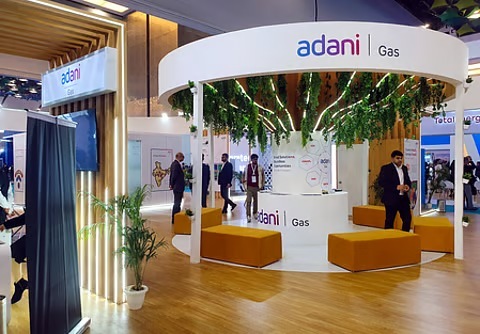
Adani Total Gas Q4 FY26: Volumes Racing, Multiples at Rest
General information and entertainment, not investment advice. The author is not a SEBI-registered adviser or research analyst. No recommendation, no promised returns. Markets carry risk including loss of capital. Figures may not be current. Consult a registered adviser before acting.
1 — At a Glance
The company reported net profit of ₹156 Cr in Q4 FY26, a 4% uptick from the prior year. For the full year, PAT fell 2% to ₹637 Cr despite a 17.6% jump in revenue.
Revenue grew sharply—₹5,864 Cr in FY26 vs ₹4,986 Cr in FY25. CNG volumes climbed 18% and domestic PNG connections swelled by 137,000 households, the highest annual addition ever. Yet profitability stumbled: the company’s net margin compressed to 10.9% from 13% a year earlier.
The stock trades at 125x earnings against a peer median of 15.4x. Every ₹1 of profit commands a staggering price; the market is either pricing in a future the company has not yet proven, or the valuation itself carries outsized tension.
2 — Introduction
Adani Total Gas Ltd (ATGL) operates India’s largest city gas distribution (CGD) network—delivering piped and compressed natural gas to homes, factories, and vehicles across 53 geographical areas touching 125 districts and 14% of the country’s population.
The company is a 50:50 partnership between the Adani Group and TotalEnergies. Promoters together hold 74.8% of the stock. TotalEnergies brings 1,00,000+ employees and 130-country footprint. Adani brings Indian logistics and utility muscle.
FY26 was the year disruption arrived in masks. In February 2026, geopolitical tensions in West Asia fractured global LNG supplies. Nearly 50% of India’s LNG flows through the Strait of Hormuz. The blockade hit. Global LNG prices shot up; supply tightened. The government, in turn, invoked a new order—the Natural Gas (Supply Regulation) Order of March 9, 2026—which prioritized CNG and domestic PNG at 100% of the prior six-month average consumption. Industrial gas got 80%.
ATGL’s business model thrives on this priority. It is also what will test its cost discipline.
3 — Business Model: WTF Do They Even Do?
ATGL owns four distinct verticals, though CGD dominates the P&L.
City Gas Distribution (CGD): The core. The company supplies piped natural gas (PNG) to domestic, commercial, and industrial users, plus compressed natural gas (CNG) to vehicles. At year-end FY26, ATGL ran 705 standalone CNG stations plus 464 through its JV with Indian Oil Corporation (IOAGPL). It connected 1.1 million homes to piped gas—a 14% addition in one year alone. Its industrial and commercial customers numbered 10,000+.
The network itself is a beast: 15,572 inch-km of steel pipeline and 8,300+ km of medium-density polyethylene (MDPE) on the standalone side. Management claims to lay 3 km of pipe per day, connect 400+ homes per day, and open one CNG station per week. The network is young, not yet densely utilized—a structural advantage if execution holds.
E-Mobility (ATEL): A wholly owned subsidiary running EV charging. As of March 2026, 5,100 charge points live across 26 states and 226 cities. It won tenders for another 200+ sites and 1,000+ chargers. It serves B2B clients—Maruti, Mahindra, Tata, Flipkart, IndiGo—and dominates airport charging with 100+ points across 21 terminals. It is immature, cash-burning, and utterly tied to EV adoption speed in India. Management targets 10,000 charge points near-term without naming timelines.
Biomass (ATBL): Compressed biogas from agri-waste and municipal solid waste. Barsana plant operates at 6.9 TPD of biogas. Management won concessions in Ahmedabad and Rajkot for large MSW-to-CBG plants. It launched “Harit Amrit,” an organic manure brand, and sold 2,000 tons in Q4. It is marginal to the bottom line and immaterial to the investment thesis.
Gas Metering: A joint venture called Smart Meters Technologies. Mechanical and smart meters. Also immaterial.
The business works via distribution licenses granted by the Petroleum and Natural Gas Regulatory Board (PNGRB) in specific geographical areas. Each GA is a fortress—the company has the right to distribute and profit from volumes within that territory for 25 years. New GAs grow slow; margins rise as network utilization climbs and capex per unit volume falls. The play is infrastructure—long duration, low volatility, but also low early returns.
4 — Financials Overview
Figures are consolidated, in ₹ crore.
Metric
Latest Quarter (Q4 FY26)
YoY
QoQ
Revenue
1,549
+15.9%
+6.9%
Operating Profit
299
+3.5%
+1.6%
PAT
156
+4.3%
-1.4%
EPS (₹)
1.42
—
—
Revenue rose 15.9% YoY, driven by CNG volume growth of 18% and PNG growth of 6%. CNG volumes stood at 663 MMSCM in FY25 and jumped to an estimated 780+ MMSCM in FY26. PNG moved to 330 MMSCM from 294 MMSCM.
Operating profit in Q4 was ₹299 Cr, up 3.5% from Q4 FY25’s ₹289 Cr. Yet the operating margin collapsed to 19% from 25% a year prior. The culprit: higher input gas costs after the government’s supply constraints and the cost floor imposed by spot LNG pricing.
PAT in Q4 was ₹156 Cr, up just 4.3% from ₹150 Cr in Q4 FY25. Interest expense nearly doubled YoY to ₹35 Cr from ₹29 Cr, a signal of mounting capex financed by debt.
Full Year FY26:
Metric
FY26
FY25
Change
Sales
5,864
4,986
+17.6%
EBITDA (OPL + D)
1,121
1,335
-16.0%
PBT
863
868
-0.6%
PAT
637
648
-1.7%
EPS (₹)
5.79
5.89
-1.7%
The full year story: revenue engines fired on all cylinders. Volume growth was there. But every percentage point of volume growth demanded more expensive gas to source. EBITDA contracted 16% despite a 17.6% revenue jump. PBT stayed flat; PAT fell 1.7%.
Management attributed this margin pressure to the transition away from Administered Price Mechanism (APM) gas toward higher-cost alternatives: pool gas, spot LNG, and NWG. In April 2025, APM allocation fell from 49% to 37% of CNG needs. NWG and intervention gas backfilled, but at a cost.