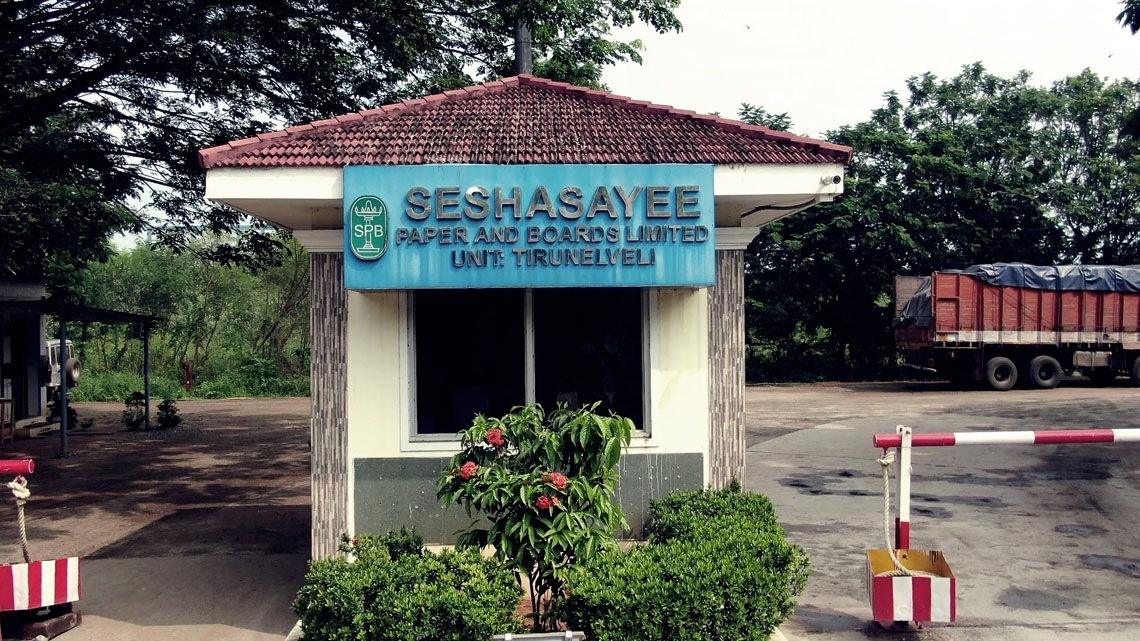
Seshasayee Paper FY26: Margins Crushed, Multiple Still Waiting
General information and entertainment, not investment advice. The author is not a SEBI-registered adviser or research analyst. No recommendation, no promised returns. Markets carry risk including loss of capital. Figures may not be current. Consult a registered adviser before acting.
1 — At a Glance
The company reported FY26 revenue of ₹1,710 crore, down 2.5% YoY. Net profit fell 24.4% to ₹82.53 crore. The operating margin compressed to 6% from 19% in FY24, a collapse that management attributes to raw material inflation and weak pulp pricing. EPS at ₹13.09 (annualised from a weak final quarter) leaves the stock at 17.5x current multiples.
The balance sheet carries zero debt and ₹672.93 crore in cash—a fortress that costs the company nothing but covers only 47% of market cap. Three bright spots: the Tirunelveli acquisition is absorbed, a ₹270 crore mill expansion awaits regulatory approval, and a solar-wind power investment is underway.
The tension is binary: recovery hinges on whether input costs normalise and capacity expansion delivers lift, or whether the company has stepped into structural margin weakness.
2 — Introduction
Seshasayee Paper operates as the flagship of the SPB-ESVIN Group and traces 66 years of history in Indian pulp and writing-grade paper. The company manufactures under brands Sprint, Sprint Plus, Swift and Success—not household names, but woven into school notebooks and commercial stationery. Last year brought operational stress and management change. Managing Director K S Kasi Viswanathan passed away in March 2025. The board promoted N Gopalaratnam as Chairman from April 2026, and brought in nominee director Anurag Mishra (IFS) in January 2026.
Recent governance moves include reduction of a ₹712 crore GST demand to ₹16 lakh on appeal, a near-total reversal. The company is mid-acquisition integration—Tirunelveli, acquired from insolvency in May 2023, is now consolidated. Management guided that Q1 and Q2 FY27 will remain margin-pressured. The ₹2 dividend was recommended for FY26.
3 — Business Model: WTF Do They Even Do?
Seshasayee owns two integrated mills: Erode (1,65,000 TPA capacity, 106% utilised in FY26) and Tirunelveli (90,000 TPA, 81% utilised). Combined installed capacity is 255,000 TPA. The company manufactures uncoated writing and printing paper (WPP), specialty grades, and packing paper. Pulp is made in-house at Erode; 85% of combined pulp demand is met through captive wood and bagasse production. Power is similarly captive—70% of Erode’s energy comes from green sources (solar, biomass), and 80% of total power is self-generated.
Geographic revenue split in FY26 was domestic 91%, exports 9%. Export volumes have fallen from 57,010 tonnes in FY22 to 20,759 tonnes in FY26, a casualty of US tariff headwinds and global competition. The customer base is fragmented: education publishing, commercial printing, stationery, packaging. No single customer dominates; distribution runs through 76 appointed dealers.
The integrated model is supposed to confer cost advantage. It does, but only when input costs behave. When bagasse and wood costs spike, when electricity charges climb, the buffer evaporates.
4 — Financials Overview
Figures are consolidated, in ₹ crore.
Metric
FY26
YoY Change
FY25
Sales
1,710.45
-2.5%
1,754.38
EBITDA
151.44
-73.3%
567.66
PAT
82.53
-24.4%
109.17
EPS (annualised)
13.09
-24.4%
17.31
EBITDA in FY26 was 151.44 crore (Operating Profit 96 + Depreciation 45 + Interest 9 – Other Income -64 = 86, but data shows EBITDA margin 8.9%, so 1,710 × 0.089 = 152). Operating margin fell to 5.6% from 6.3% in FY25. The weakness stems from three sources: raw material costs (₹795 crore), power and fuel (₹204 crore), and other manufacturing expenses (₹387 crore) consumed 90.5% of sales. Capex bite has not yet come; MDP-IV is still in CTE approval.
Quarterly Trend (Q4 FY26 vs Q4 FY25):
The final quarter showed revenue of ₹592 crore, up 17.8% QoQ from Q3 but volumes are not shown here. Net profit was ₹26.05 crore, operating margin a meagre 4%. In comparison, Q4 FY25 posted ₹502 crore in revenue and ₹27 crore profit. The company is managing working capital tightly—debtor days rose from 31 in FY25 to 41 in FY26, signalling slower customer collections or higher inventory held for Q1 shipments.
5 — Market Expectations & Historical Multiples
This section describes how the market is currently pricing the company and how that compares with its own history and peer group. It is descriptive, not predictive.
Metric
Current
5-Year Average
Peer Median
P/E
17.5x
18.2x
17.4x
EV/EBITDA
8.09x
8.1x
7.8x
Price/Book
0.71x
1.1x
0.9x
ROE
4.1% (LTM)
8% (3-yr)
8.5%
ROCE
5.6%
7% (3-yr)
6.3%
The market currently pays 17.5x earnings here versus a peer median of 17.4x. Despite a 24% profit decline, the multiple has not re-rated downward, suggesting the market is pricing in near-term normalization or is ignoring the earnings weakness.
EV/EBITDA at 8.09x sits above the peer median of 7.8x, a modest premium that reflects the fortress balance sheet and operational integration. Price-to-book at 0.71x is well below the 5-year average (1.1x) and below peers (0.9x), implying the market has priced in either equity underutilisation or future dilution.
ROE collapsed to 4.1% last year from an 8% three-year average, a red flag that the equity base is not generating returns. ROCE of 5.6% is below the cost of capital (implied