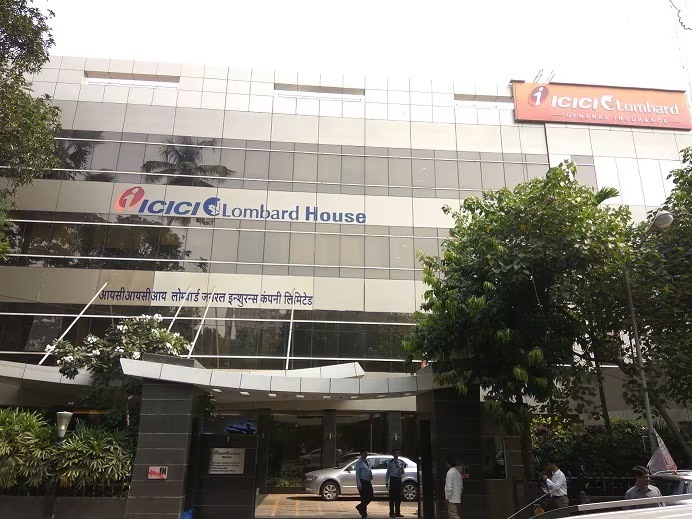
ICICI Lombard FY26: 11% Profit Growth, but the Multiple Sits Flat
General information and entertainment, not investment advice. The author is not a SEBI-registered adviser or research analyst. No recommendation, no promised returns. Markets carry risk including loss of capital. Figures may not be current. Consult a registered adviser before acting.
1. At a Glance
The largest private general insurer reported net profit of ₹2,772 cr in FY26, up 11% from ₹2,508 cr in FY25. Revenue grew 13% to ₹26,994 cr. But the market pays 33.7x on this earnings, a tick below the peer median of 42.3x—a flat frame despite the profit tailwind.
Return on equity held near recent levels (17% in FY26 vs 17% in FY25). Solvency stayed comfortable at 2.67x the regulatory floor of 1.5x. The company holds zero borrowings. One tension sits beneath the headline: can the Motor segment hold its pricing discipline when the industry’s loss ratios scream pressure?
2. Introduction
ICICI Lombard was born in 2001 as a 50-50 joint venture between ICICI Bank and Fairfax Financial Holdings. Fairfax exited entirely in 2019. Today, ICICI Bank holds 51.28% as of March 2026.
FY26 began with the company serving 37.6 million policies, up from 32.7 million a year prior. The agency network had grown to 147,408 individual agents and 312 corporate agents. Distribution channels span direct, bancassurance, brokers, and digital. The IL TakeCare app crossed 21 million downloads by year-end.
In the calendar year 2025, auto sales tilted sharply higher in the second half. Private car sales rose 16.3% in Q4 and two-wheelers jumped 24.7%—a decadal high, per management. This tailwind rippled into motor insurance demand for the insurer in H2 FY26 and would carry into FY27.
3. Business Model: WTF Do They Even Do?
The company writes all the buckets: motor, health, fire, crop, marine, travel, liability, and others. As of FY26, the mix had shifted toward Health and away from Motor.
Motor accounts for 40.2% of gross direct premium income (GDPI) as of FY26, down from 50.1% in FY21. This is not contraction—it’s deliberate dilution of a commoditized segment into a portfolio with higher margin products.
Health exploded to 31.6% of GDPI in FY26 from just 21.6% in FY22. Retail health alone surged 51.1% in FY26 (management said it grew from a smaller base but on new retail indemnity business, the company “sourced 2x growth”). This is where the company finds pricing power.
Fire has held steady around 11.9% of GDPI. Crop sits at 5%, marine at 3%, and the rest—travel, PA, liability, cyber—add up to 11%.
The distribution story: no single channel dominates. Bancassurance, agents, and corporate partners share the load. This is the bind of a large, regulated insurer—reach requires splitting the commission pie across channels.
4. Financials Overview
Figures are consolidated, in ₹ crore.
Metric
FY26
FY25
YoY Change
Revenue
26,994
23,961
+12.6%
EBITDA
3,731
3,407
+9.5%
PAT
2,772
2,508
+10.5%
EPS (Annualised)
55.61
50.60
+9.9%
The top line grew 12.6% in FY26, moderating from the prior year’s 13.8% growth. Expenses (insurance and operating) rose 12.8%, so margin compression was marginal. Operating profit—a proxy for underwriting income—grew 9.5% to ₹3,731 cr.
Quarterly performance showed marked improvement near year-end. Q4 profit came in at ₹547 cr, a 7.3% jump on Q4 FY25. Sales in Q4 were ₹6,825 cr.
Other income contributed ₹93 cr in FY26, down from ₹39 cr in FY25—a red herring in profit translation. The real story sits in underwriting. Combined ratio (a measure of claims-plus-expense as a percentage of premiums) remained at 102.4% for FY26 vs 102.6% in FY25—essentially flat. This means the company earned ~98 paise of profit on every rupee of premium, after claims and overhead.
Tax ran at 24%, leaving a net margin near 10.3% of revenue. Dividend payout was set at 25.7% of profit, proposing a final dividend of ₹7 per share.
5. Market Expectations & Historical Multiples
This section describes how the market is currently pricing the company and how that compares with its own history and peer group. It is descriptive, not predictive.
Metric
Current
5-Year Average
Peer Median
P/E
33.7x
—
42.3x
EV/EBITDA
24.0x
—
—
ROE
16.6%
17.1%
—
ROCE
21.9%
23.8%
—
The market currently pays 33.7x earnings here versus a peer median of 42.3x. On the RoE metric, the company sits at 16.6% against a five-year average of 17.1%—a tick below its own long-run baseline. ROCE of 21.9% rests below its five-year mean of 23.8%, signaling that capital reinvestment is not generating the same returns it once did.