Kothari Industrial: Burning Capital, Building Dreams
General information and entertainment, not investment advice. The author is not a SEBI-registered adviser or research analyst. No recommendation, no promised returns. Markets carry risk including loss of capital. Figures may not be current. Consult a registered adviser before acting.
Kothari Industrial lost ₹72 crore on ₹181 crore of revenue in FY26. The company operates across a wildly scattered portfolio—fertilizer, footwear, drones, food, logistics, media—in what looks like a board member’s wish list rather than a coherent business. The sole bright spot: it claims to be building a footwear ecosystem in Tamil Nadu with global brands lined up. The entire operation sits under an entrepreneurial promoter with Qatar royal family backing.
Current price ₹164 values it at ₹1,775 crore—a market cap 7x its trailing revenue. The company has no traditional earnings support; it runs on capital raises and hope.
Does a scattered portfolio with a loss-making core and ambitious capex plans add up to a salvageable narrative, or just expensive ambition?
2. Introduction
Kothari Industrial, incorporated in 1970, was born a fertilizer maker. For decades it manufactured Single Super Phosphate at Ennore, Chennai. That business is dead—leased to Coromandel since FY21. The asset sale of the Ennore facility to Coromandel in FY24 for ₹50 crore is where the company briefly appeared solvent (it booked a ₹32 crore profit that year). Since then it has pivoted into trading and new ventures.
Today’s KICL is an entity in a state of radical transformation. It owns stakes in footwear makers, runs restaurants, sells fertilizers (now through trading, not production), flies drones, rents logistics, and recently bought a media publication. The FY26 loss of ₹72 crore is the second straight loss year. The company raised equity capital aggressively in FY25—₹189 crore through three tranches—and yet still reports negative cash flow from operations of ₹123 crore.
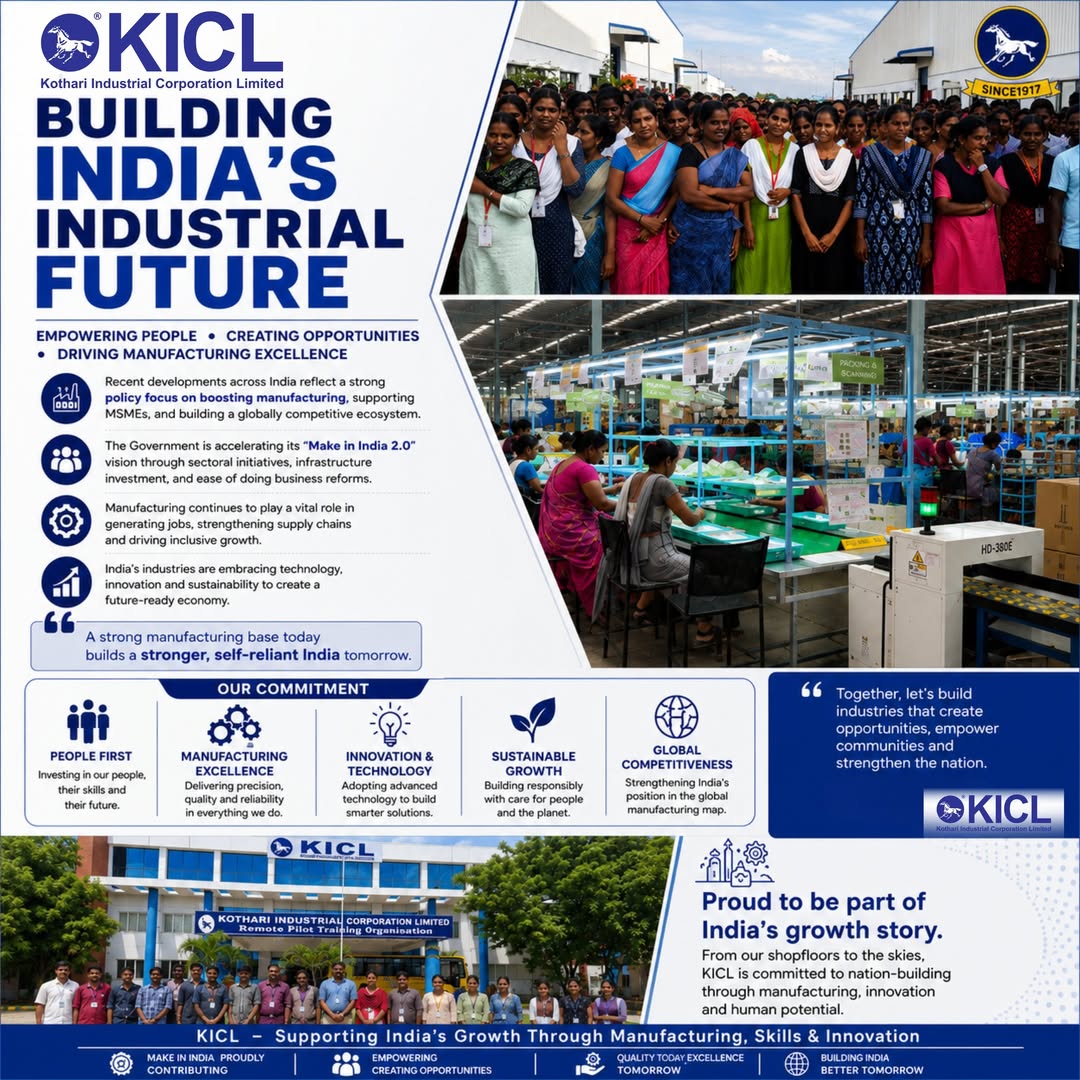
Management’s narrative is Vision 2030: a footwear cluster in Perambalur, Tamil Nadu, making 60 million pairs per year, with Adidas and other global brands committing capacity. The company bought a 30% stake in Phoenix Kothari Footwear in late FY25 for ₹39.9 crore and claims 19 MOUs signed for supply ecosystem partners. Whether this cluster lands or becomes a capital graveyard is the entire story.
3. Business Model: WTF Do They Even Do?
KICL operates as a holding company riding a diversification strategy that reads like the founder’s business card collection.
Fertilizer Division (11% of FY26 revenue): Trading SSP, NPK mixtures, and claiming to launch 28 micronutrient products. The narrative is “India needs fertilizers for food security.” The reality is KICL doesn’t manufacture—it buys and sells. Competition is brutal; margins are thin. Dealer network is 30,000 strong but mostly inherited from past operations.
Footwear (57% of revenue, but subsidiary loss of ₹90 crore consolidated): The strategic anchor. KICL holds 30% of Phoenix Kothari, which manufactures for global labels like Crocs and Adidas. The footwear cluster at Perambalur is the bet—21 machinery and material suppliers signed MOUs to build a 3M ecosystem (Materials, Mould, Machinery). Capacity target: 60 million pairs by 2027. Investment target: $292 million across partners. Employment claim: 50,000 jobs. This is either a decade-defining success or a beautiful way to burn ₹200 crore.
Logistics (3% of revenue): Acquired Parveen Roadways in FY25 for ₹24 crore. 100+ vehicles, railway-focused. Contribution: profit of ₹37 lakh in Q2 FY25. Small, nascent.
Hotels & Restaurants (11% of revenue, loss of ₹95 crore): Two brands—Pattukottai Mess (south Indian) and Unavilla (ultra-premium fine dining). Industrial catering serves 2 million people. The restaurants bled ₹95 crore in FY26. This is not a sustainable operation at scale.
Drones (1.5% of revenue, loss): Geospatial and agricultural spraying. Established a drone police unit with Tamil Nadu Police (the only such unit in India, the company claims). Training center in Madurai. Loss of ₹45 lakh in FY26.
Media (0.1% of revenue): Acquired Industrial Economist, a 50-year-old publication, in FY25 to “revive journalism.” Contribution immaterial.
Branding (entry via Royer Group partnership): Launched Kickers footwear in India and 8 other countries under a 30-year license. Stores in malls. No material revenue yet.
The portfolio is entrepreneurial. It is also incoherent. Management argues cross-subsidization and scale; the numbers suggest a founder chasing sectors and losing focus. The P&L validates this—segment results show only fertilizer and logistics turning operationally profitable; everything else bleeds.
4. Financials Overview
Figures are consolidated, in ₹ crore, audited.
Metric
FY24
FY25
FY26
YoY (FY26 vs FY25)
Revenue
136
87
181
+106%
EBITDA
41
-15
-78
N/A
PAT
32
-16
-72
N/A
EPS (₹)
25.38
-1.74
-6.68
N/A
Key movements:
Revenue nearly doubled YoY, driven by footwear (₹102 crore segment revenue), fertilizer trading (₹32 crore), and food/logistics entries. But EBITDA fell deeper negative—from ₹-15 crore loss to ₹-78 crore. Why? Margin collapse. Footwear segment loss ballooned to ₹90 crore (from ₹34 crore loss in FY25). Hotels lost ₹95 crore. The revenue growth is offset entirely by operational burns in new verticals.
Operating margin (OPM) was -44% in FY26 (down from -16% in FY25). Every rupee of revenue eats into equity. The