Som Distilleries & Breweries: When Margins Crumble and Licenses Vanish
General information and entertainment, not investment advice. The author is not a SEBI-registered adviser or research analyst. No recommendation, no promised returns. Markets carry risk including loss of capital. Figures may not be current. Consult a registered adviser before acting.
Som Distilleries & Breweries (SDBL) entered FY2026 as a company that had just scaled revenues 77% in two years. It exits FY2026 having watched them collapse 15%, tangled with an excise suspension at its flagship Bhopal plant, and posted a consolidated net profit of ₹9.4 crore—down 91% from ₹104.5 crore the prior year.
The company’s market cap sits at ₹1,603 crore on a price of ₹77.09 (prices referenced are not live). Its current P/E of 112 sits atop a reported FY26 EPS of ₹0.45—a denominator so small it is less useful than a financial ratio and more useful as a warning signal.
The central tension: a business that built momentum through FY25 (beer volumes +10%, revenue +13%, net profit +20%) has been stopped in its tracks not by market conditions alone, but by a regulatory intervention that removed 50% of its production capacity from operation from February through at least March.
Beer remains 92% of revenue and 84% of consolidated sales. A greenfield plant in Uttar Pradesh is arriving. But near-term, the company is running on two of three cylinders and hoping one of them comes back online.
2. Introduction
Som Distilleries, incorporated in 1993, is the flagship of the Bhopal-based Som Group, which also operates in real estate and infrastructure. The company manufactures beer and Indian Made Foreign Liquor (IMFL) across three states: Madhya Pradesh (Bhopal), Karnataka (Hassan), and Odisha (Cuttack).
Promoter Jagdish Kumar Arora and family hold 39.4% as of June 2026. FII and DII ownership has remained marginal—just 1.2% and 0% respectively at the same date.
The company is listed on BSE (507514) and NSE (SDBL). Its stock price fell 52% over the past 12 months and 7% over three years, returning 33% over five years. But five-year returns matter less when you’re down 52% in one.
In November 2025, Infomerics downgraded SDBL’s credit ratings from IVR A- to IVR BBB+ (long-term) and A2+ to A2 (short-term) due to the license suspension at Bhopal. The agency flagged execution risk on the UP capex project and the working-capital-intensive nature of operations.
3. Business Model: WTF Do They Even Do?
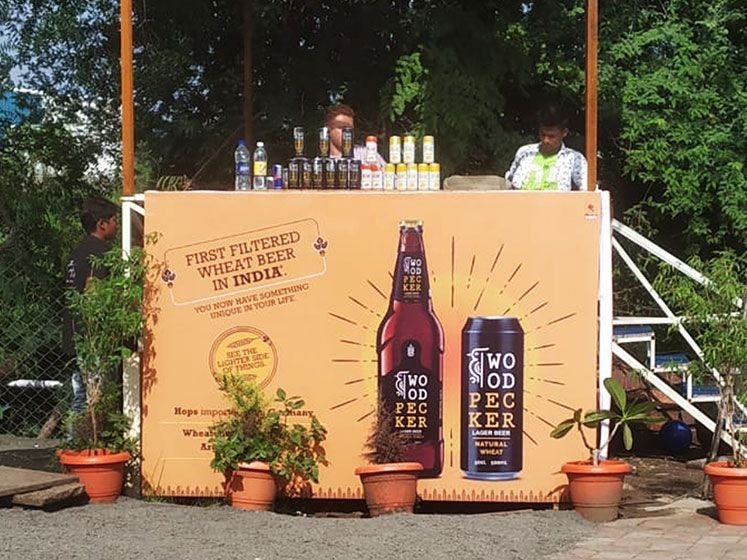
SDBL sells beer under brands Hunter, Black Fort, Power Cool, Woodpecker, and Legend. It sells IMFL under Black Fort and other house labels. The company also serves contract manufacturing for third parties—Radico Khaitan uses SOM’s Hassan plant to bottle IMFL; White Owl Brewery and 7 Ink Brews contract SOM for production.
Beer realization in FY26 was ₹556 per case (up from ₹534 in FY25). IMFL realization was ₹963 per case (down from ₹991 in FY25). The blended realization was ₹608 per case.
Beer is the workhorse—234 lakh cases sold in FY25, falling to 187 lakh cases in FY26 (down 20% YoY). IMFL volumes went from 11.4 lakh cases to 15 lakh cases (+32% YoY). The IMFL bump is not enough to compensate for beer collapse.
Installed capacity (consolidated, as of March 2026): beer 38.2 million cases per annum; IMFL 2.4 million cases per annum. But Bhopal’s shutdown in February stripped away 50% of supply capability, so installed capacity became a museum piece.
The company’s geographic mix in FY25: Madhya Pradesh 40%, Karnataka 27%, Odisha 17%, others 16%. Excise duty hikes in Karnataka from Q4 FY25 onwards hurt volume offtake there—a key market. Management expects recovery in six to seven months after Bhopal normalizes, but that claim is anchored to an event not yet certain.
Mahavat Whisky, launched in July 2025, is positioned in the mid-premium segment (₹1,000–1,100) and has drawn encouraging early response in Madhya Pradesh and Delhi. But it is a nascent product and a rounding error on consolidated volumes. Management plans to expand the premium whisky portfolio into scotch and single malts—a multi-year play.
4. Financials Overview
Figures are consolidated, in ₹ crore.
Result Type: Quarterly. Basis: Consolidated. Unit: ₹ crore.
Metric
Q4 FY26
Q3 FY26
Q2 FY26
Q1 FY26
Revenue
180.81
269.59
528.38
338.97
EBITDA
-44.17
40.09
70.35
41.76
Net Profit
-55.48
19.05
42.06
22.73
EPS (₹)
-2.67
0.92
2.02
1.10
Full Year FY26 vs FY25:
Metric
FY26
FY25
YoY Change
Revenue (₹ crore)
1,229.32
1,442.90
-14.8%
EBITDA (₹ crore)
89.7
176.20
-49.2%
Net Profit (₹ crore)
9.38
104.50
-91.0%
EPS (₹)
0.45
5.08
-91.3%
Q4 FY26 was a bloodbath. Revenues sank 46.4% YoY to ₹182 crore. The Bhopal facility, which normally supplies Madhya Pradesh, Delhi, Jharkhand, and CSD, was non-operational from February onwards. Management sold off finished goods inventory but could not manufacture new volume. EBITDA turned negative at ₹-429 million. Net profit swung to ₹-57 crore.
Management attributed the Q4 collapse to two forces: (1) the Bhopal license suspension, which is characterised as “temporary” and stemming from a 2012 case and “miscommunication”; (2) subdued demand in Karnataka and Odisha, blamed on excise policy changes and market conditions.
Full-year FY26 revenue of ₹1,229 crore still outpaced FY24 (₹1,281 crore) but lagged FY25 (₹1,443 crore) by ₹214 crore—a 15% drop.
Concall Attribution (Management’s Own Framing):
Management stated that Bhopal was supplying roughly 50% of the company’s volume before suspension. Without it, the company could not serve Delhi (which they supplied until February), and other markets were not cost-effective to serve from Hassan or Odisha. So volume simply did not happen.
For margin pressure, management cited glass bottles, aluminum cans, barley, and logistics—all under inflationary pressure due to geopolitical uncertainty, elevated energy costs, and supply chain disruptions.
On the Bhopal recovery timeline, management oscillated between optimism and evasion. The COO stated early in the call that resolution “could get resolved in the next couple of weeks is our estimate.” Later, the CEO said “expecting that even within the next week to 10 days, it should be sorted out. But I can’t give you a specific date.”
This is management hedging at the moment of maximum pressure.
5. Market Expectations & Historical Multiples
This section describes how the market is currently pricing the company and how that compares with its own history and peer group. It is descriptive, not predictive.
Metric
Current
5-Year Average
Peer Median
P/E
112.0
25.0
42.1
EV/EBITDA
20.0
—
—
P/B
2.06
—
2.32
ROE
1.87%
10.3%
11.91%
ROCE
5.68%
—
12.43%
The market currently pays 112x earnings here versus a 5-year average of 25x and a peer median of 42x. The denominator (FY26 EPS of ₹0.45) is the culprit—it is so depressed that any non-zero price becomes an outlier multiple.