KN Agri Resources FY26: The Refinery That Ran out of Margin
General information and entertainment, not investment advice. The author is not a SEBI-registered adviser or research analyst. No recommendation, no promised returns. Markets carry risk including loss of capital. Figures may not be current. Consult a registered adviser before acting.
1. At a Glance
Revenue grew 5.3% year-on-year to ₹1,814 crore in FY26, yet net profit fell 14.4% to ₹31.68 crore — a divergence that tells the story of margin compression in commodity agri-refining.
The operating margin contracted to 2.8% from 3.0% the prior year. Net profit margin hit 1.75%, down from 2.15% the year before.
The company sits almost debt-free at ₹34 crore in borrowings against a net worth of ₹384.7 crore, giving it dry powder in a volatile input market.
Yet the market multiple has stayed remarkably flat: at ₹204, the stock trades at 16.1x annualized earnings versus a peer median of 19.3x.
The real tension: an agri processor caught between soyabean price swings and customers (Adani Wilmar, Cargill, Bunge) with pricing power. Does scale survive when margins don’t?
2. Introduction
KN Agri Resources began in 1987 as a family effort by three brothers—Vijay, Dhirendra, and Sanjay Shrishrimal—in Raipur, Chhattisgarh.
The company went public on the NSE SME platform in March 2022 at ₹152.85. It now has a market cap of ₹509.93 crore with 2.5 crore shares outstanding.
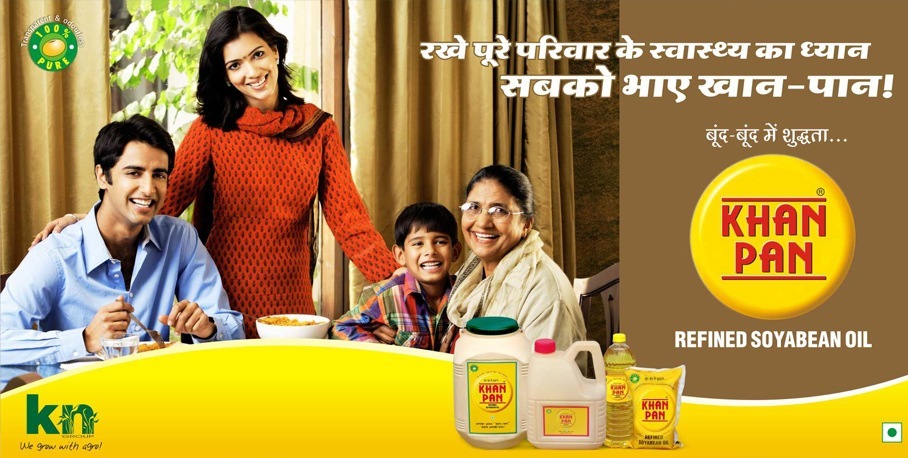
The business runs three plants in Madhya Pradesh, all feeding a single supply chain: crush soybeans, extract oil, refine it, package it, sell it. The company sells under brand names Khanpan and Classic to domestic markets, and as bulk commodities to global food traders.
It also runs a small wind-power business (4.6 MW installed) and has recently set up two subsidiaries—KN Retail and Sharaad KN Bio-Organic (incorporated Jan 2025)—signaling a retail push. On June 5, 2026, it announced no pledged equity, a hygiene signal.
3. Business Model: WTF Do They Even Do?
At the core: solvent extraction. Buy raw soyabean at ₹X per quintal, crush it, separate the meal (soya de-oiled cake, or DOC) from the crude oil, refine the oil to food-grade, pack it into retail bottles under the Khanpan or Classic label, or sell it in bulk to industrial users.
The margin is thin because the input and output are both commodities. If soyabean prices spike 20%, the refinery can’t pass it on instantly—customers shop around. The rating agency CRISIL noted the company “has managed this risk over the years” but also flagged the “exposure to adverse change in government regulations”—minimum support prices on inputs, import duties on refined oil, and bans on GMO seed imports all swing profit by 50 bps to 150 bps.
The product mix is narrow: soya meal (the protein-rich byproduct) goes to poultry and aquaculture. Soya oil goes to food and industrial use. The company markets in 15 states and claims 6% market share in packed edible oil in Madhya Pradesh alone—respectable for a ₹510 crore market cap company, but still small in a ₹50,000+ crore industry.
Installed capacity is ₹3.75 lakh TPA for solvent extraction, ₹60,000 TPA for refining, ₹60,000 TPA for flour milling (expanded from 21,000). These constraints limit upside when margins recover.
4. Financials Overview
Figures are consolidated, in ₹ crore.
Metric
FY26
FY25
YoY Δ
Revenue
1,814
1,711
+5.3%
EBITDA
61
64
–4.7%
PAT
31.68
37
–14.4%
EPS (reported)
12.67
14.82
–14.5%
Quarterly detail (FY26):
Quarter
Sales
Operating Profit
PAT
OPM %
Q1 (Dec 24)
475
13
7
3%
Q2 (Mar 25)
496
22
16
4%
Q3 (Sep 25)
442
8
5
2%
Q4 (Dec 25)
513
10
5
2%
FY26
1,814
51
31.68
2.8%
The Q4 (Mar 26) quarter saw operating margin collapse to 2% as input prices—likely soyabean—spiked relative to output. Q2 was the company’s best quarter, a reminder that the business is driven by inventory and input-price timing, not underlying operational excellence.
5. Market Expectations & Historical Multiples
This section describes how the market is currently pricing the company and how that compares with its own history and peer group. It is descriptive, not predictive.
Metric
Current
FY26 P&L Average (5 yrs)
Peer Median
P/E
16.1
12.8
19.3
EV/EBITDA
9.3
—
—
ROE (reported)
8.61%
9.99%
10.68%
ROCE
13.3%
13%
12.27%
PAT Margin
1.75%
2.2%
2.98%
The market currently pays ₹16.10 per rupee of annualized earnings, against a peer median of ₹19.30. The gap suggests either that KNAGRL’s profit volatility scares buyers or that peers like Marico (60.3x), Patanjali Foods (23.0x), and Gokul Agro (18.6x) command