General information and entertainment, not investment advice. The author is not a SEBI-registered adviser or research analyst. No recommendation, no promised returns. Markets carry risk including loss of capital. Figures may not be current. Consult a registered adviser before acting.
1. At a Glance
Revenue crawled to ₹148 Cr in FY26 — a modest 6% climb from ₹141.6 Cr in FY25. Net profit edged up to ₹24.96 Cr, the highest in the dataset, yet the business feels flat. Capacity utilization hit 92% (from 89% in FY25), suggesting the company has squeezed existing assets, not deployed new ones.
At a P/E of 22.6 — sitting comfortably below the peer median of 27.4 — the multiple offers no drama. The real friction point: working capital. Cash conversion sits at 458 days, inventory days at 434 — the company is cash-locked.
The balance sheet is fortress-like. Net worth jumped ₹40 Cr to ₹241 Cr (reserves ₹236 Cr), debt shrank to ₹0.87 Cr. Zero leverage, zero ambition.
Tension: How does a hydraulic equipment maker with 50+ years behind it and an empty debt sheet grow when the industry plays 15% CAGR and VDL manages 6%?
2. Introduction
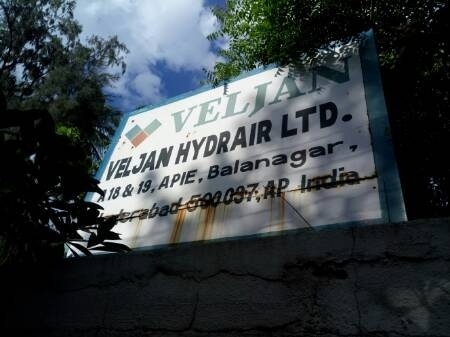
Veljan Denison was born in 1973 as a joint venture with Denison Hydraulics of the USA. Once part of Sweden’s Hagglunds, it’s now a standalone listed player in precision hydraulic components — pumps, motors, valves, custom power packs, manifold blocks.
Chairman emeritus V.C. Janardan Rao, the founder’s legacy, passed away in February 2025. Sri Krishna Uppaluri, the current Managing Director, took over the helm. The transition is clean on paper; the proof is in execution.
On May 30, 2026, the board appointed two additional independent directors — Prof. Sunaina Singh and Ramesh Kumar Nimmagadda — for five-year terms, subject to shareholder approval. The same day, it approved an ₹8.50 dividend per share for FY26 (₹3.82 Cr payout, 15% of net profit).
One shadow: Company Secretary Narahari Bellamkonda resigned in December 2024. No clarification issued. Secretarial compliance filings arrived late — prior fines of ₹4.4 lakh, ₹40,000, and ₹37.6 lakh documented.
3. Business Model: WTF Do They Even Do?
VDL manufactures seven product families: gear pumps, vane pumps and motors, hydraulic valves, hydraulic filters, cylinders, power packs, and marine equipment (steering gears, fin stabilizers, HPUs, control systems).
Revenue mix: pumps, motors, valves, and spares account for ~98% of sales (~₹147 Cr in FY26); interest on deposits and other income make up the 2% remainder.
Distribution is a network of 12,400 direct retail partners. The company maintains 1,450 SKUs — a product depth that sounds impressive until you realize margins are getting wrung by global titans. Bosch Rexroth, Danfoss, Kawasaki Heavy Industries hold the majority share. VDL sits in the cracks, serving midmarket OEMs and niche applications where Swiss precision isn’t worth the premium.
Capacity: The Hyderabad plant, the manufacturing spine, ran at 92% utilization in FY25-26 (after a temporary partial shutdown in March 2024 due to supply chain breakdown). The company also holds a UK subsidiary, Adan Holdings Limited, acquired in August 2022 for GBP 1.4 million. Contribution to consolidated revenue remains “on the lower side” — a polite rating agency euphemism for negligible.
4. Financials Overview
Figures are consolidated, in ₹ crore.
Metric
Latest Year (FY26)
YoY Change
3Y Ago (FY24)
Revenue
147.99
+4.6%
124.25
EBITDA
42.94
+4.8%
34.75
PAT
24.96
+11.0%
20.37
EPS (₹)
55.5
+22.5%
45.27
Revenue growth remains anemic at 4.6%. EBITDA margin held at 29.0% (FY25: 28.9%) — stable but uninspiring. PAT margin improved to 16.9% from 16.0% in FY25, a modest 90 bps lift. EPS jumped because of dividend taxation changes and a 1:1 bonus issued in May 2024, which doubled the share count and halved the reported per-share number; FY25 EPS of 49.96 annualized becomes 99.92 post-bonus basis, making the YoY comparison a tangle.
On the March 2026 quarter: Net profit was ₹6.57 Cr on sales of ₹40.83 Cr — the strongest quarter in the dataset. Operating margin hit 23.4%, a notch above the year’s 25.2%. Tax rate settled at 27.1%, down from 28% in FY25, a minor benefit.
5. Market Expectations & Historical Multiples
This section describes how the market is currently pricing the company and how that compares