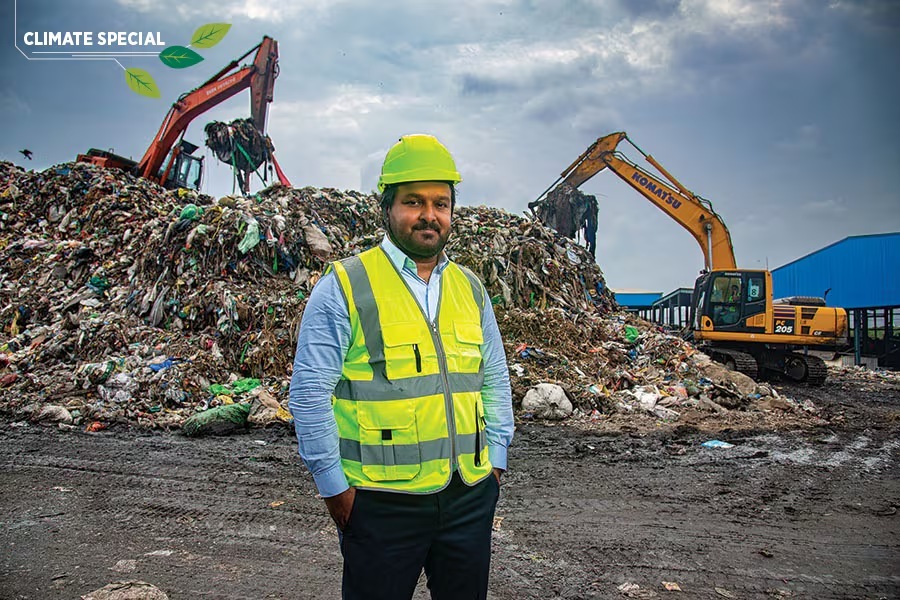
Antony Waste Handling Cell: A ₹1,053 Cr Revenue Company With a ₹18,000 Cr Order Book
General information and entertainment, not investment advice. The author is not a SEBI-registered adviser or research analyst. No recommendation, no promised returns. Markets carry risk including loss of capital. Figures may not be current. Consult a registered adviser before acting.
Revenue climbed to ₹1,053 crore in FY26, a 12% jump from ₹934 crore prior year.
The company’s net profit stood at ₹75 crore in FY26 (reported), against ₹85 crore in FY25—a decline despite higher sales.
An order book valued at ₹18,000 crore underpins medium-term visibility, representing ~17x FY26 revenue.
The balance sheet shows net debt of roughly ₹335 crore (gross debt ₹459 crore less cash ₹123 crore), a leverage of 0.62x on equity.
Debtor days stretched to 112 in FY26, up from 104 in FY25, reflecting municipal payment delays—a recurring headwind.
A maiden 10% dividend on face value ₹5 was announced, signalling confidence after 25 years as a private entity.
2. Introduction
Antony Waste Handling Cell operates across municipal waste collection, processing, and the emerging waste-to-energy space in India. The company is one of five major players in municipal solid waste management, with a two-decade track record and presence across nine states.
A pivot into waste-to-energy began in earnest with a 14 MW plant in Pimpri-Chinchwad, Maharashtra, which came online in October 2023. In FY26, the Pimpri plant delivered 69 million units of green power despite a 56% plant load factor owing to planned shutdowns.
The Andhra Pradesh story arrived in FY25: two ~15 MW waste-to-energy projects worth ₹3,200 crore, awarded on a 20-year concession. Management has secured Japan’s JFE Engineering as a technology partner, a move framed as validation of execution capability.
Municipal contracts in Mumbai also expanded in the reporting period. The company won two seven-year Collection & Transportation contracts worth ₹1,330 crore from the Brihanmumbai Municipal Corporation, moving into Borivali and Dahisar wards.
The merger of wholly-owned subsidiary AG Enviro Infra Projects into Antony Waste was approved by the NCLT in December 2025, effective retroactively from April 1, 2025, streamlining corporate structure.
A legal win arrived in May 2026: the Supreme Court dismissed an appeal by Bhiwandi Nagarpalika Municipal Corporation, directing payment of ₹15 crore on an arbitration award within three months, plus 9% interest on delay. Management cited this as reinforcement of contractual enforceability across its arbitration portfolio.
3. Business Model: WTF Do They Even Do?
The company’s revenue streams split three ways: collection and transportation of municipal solid waste (61% of FY26 revenue), waste processing and treatment (27%), and contracts and others (12%).
Collection & Transportation: Door-to-door waste pickup, movement to processing plants or landfills. The company runs 17 C&T contracts with an average tenure of 7.7 years across cities like Greater Noida, Jhansi, Nagpur, Nashik, Navi Mumbai, Panvel, Pimpri-Chinchwad, Thane, and Varanasi. In FY26, C&T volumes stood at 2.12 million tonnes, up 9% year-on-year.
Processing & Disposal: The crown jewel is Kanjurmarg in Mumbai—one of Asia’s largest single-location waste plants, handling 5,800 tonnes daily across bio-reactor landfill (6,500 TPD capacity), sanitary landfill (250 TPD), material recovery and composting (1,000 TPD), and a 0.97 MW gas-to-energy unit. In FY26, processing volumes hit 3.6 million tonnes, up 19% year-on-year.
Waste-to-Energy: The Pimpri plant, commissioned in October 2023, ran at 56% plant load factor in FY26 due to planned maintenance of 90 days. Post-maintenance, it consistently operated at ~86% PLF.
Mechanised Sweeping: Four contracts across Greater Noida, Pimpri-Chinchwad, and Nagpur.
Construction & Demolition: Mumbai facility maintains a 96% recycling rate. C&D revenue in FY26 was ₹9 crore, below management expectations, though volumes improved sharply after the BMC mandated routing through authorized processors.
The fleet includes 2,599 vehicles and equipment—1,574 small tippers, 85 electric vehicles, 582 compactors, 47 dumper placers, 111 big tippers, 58 hook loaders, 130 drain silt machines, and 12 power sweeping machines.
The company’s geography is purposefully diversified—no municipal corporation contributes more than 25% of total revenue, mitigating concentration risk from regulatory shifts or incumbent politics.
4. Financials Overview
Figures are consolidated, in ₹ crore.
Metric
Mar 2024
Mar 2025
Mar 2026
Q4 FY26
Sales
866
934
1,053
286
EBITDA
173
195
205
57
EBITDA %
20%
21%
20%
20%
PAT
100
85
75
33
EPS
30.4
30.1
26.6
—
Comment on FY26 Reported Earnings: Net profit declined to ₹75 crore from ₹85 crore despite 12% revenue growth. FY25 included one-time income of ₹24 crore; after adjustment, the underlying PAT improvement was modest at ~7%.
Management attributed profit softness to incremental vehicle deployment in Nagpur, Noida, and Pimpri-Chinchwad to handle higher tonnage, raising hire and operating costs. C&D seasonality also weighed—extended monsoon suppressed volumes until November.
Concall Highlights (Jun 2026 Earnings Call):
The company disclosed core operational revenue (excluding project revenue) crossed ₹1,000 crore for the first time. EBITDA margin held steady at ~22% for both Q4 and the full year, cited as “in line with guidance,” underpinned by cost discipline and contractual escalation clauses.