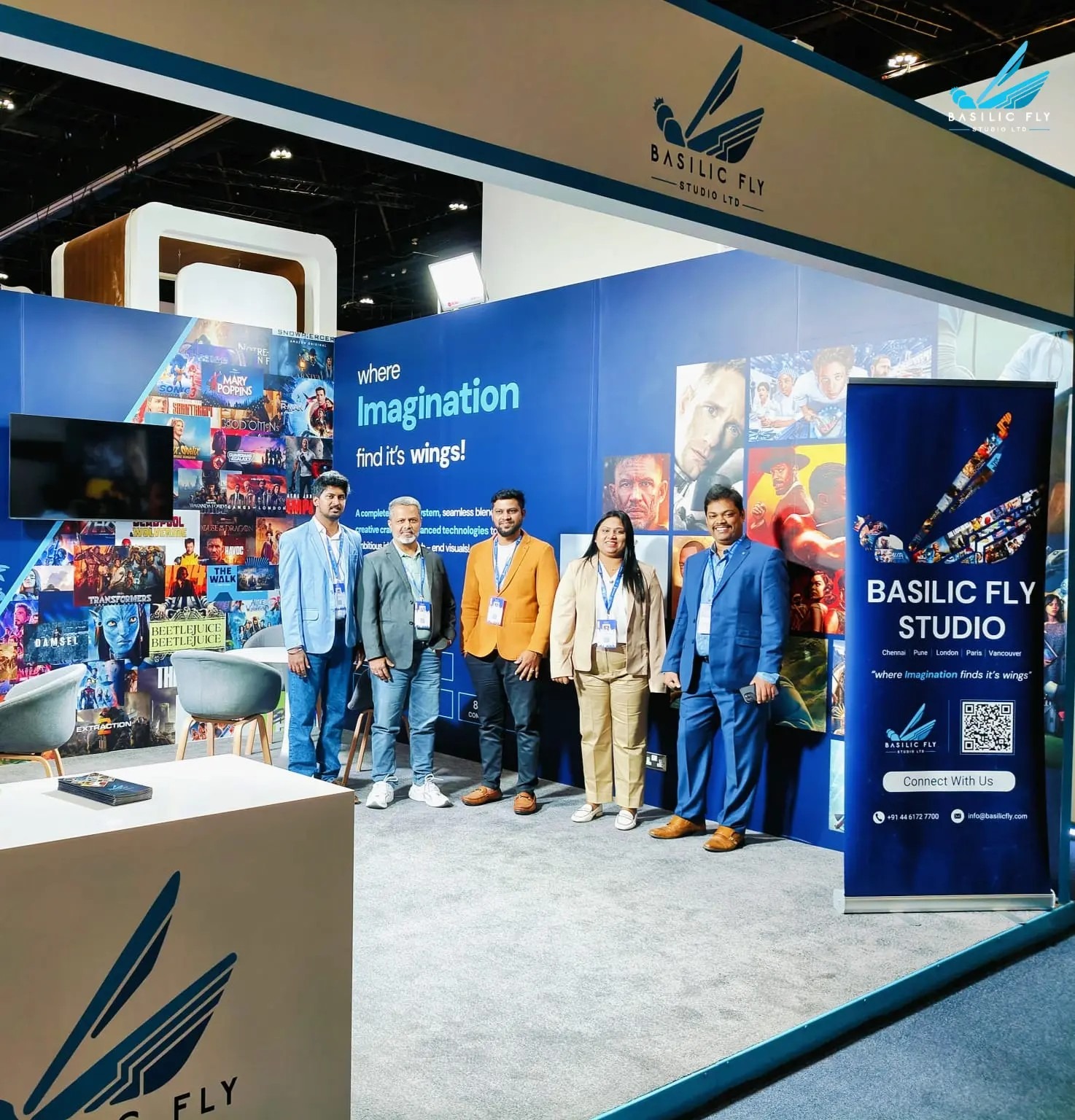
Basilic Fly Studio FY26: Revenue Scaling, Margin Compression, and the ₹232 Cr Bet
General information and entertainment, not investment advice. The author is not a SEBI-registered adviser or research analyst. No recommendation, no promised returns. Markets carry risk including loss of capital. Figures may not be current. Consult a registered adviser before acting.
1. At a Glance
Basilic Fly Studio delivered a year of size and stress. Revenue climbed 34% to ₹408 crore; PAT inched 13% to ₹51 crore. Margins contracted — operating margin fell 240 basis points to 20.9%, PAT margin to 12.1% — a combination of senior leadership hires landing mid-year, technology capex capitalized (not yet expensed), and the timing of project revenue shifting into FY27.
The company sits on ₹232 crore in order book and a ₹456 crore bid pipeline. Leverage increased: borrowings doubled to ₹106 crore against total debt/equity of 0.32x. Cash pile held at ₹74 crore.
The stock trades at 10.2x trailing earnings, against a peer median of 40.9x — a 75% discount. The number that matters: does the margin cleanup and capex payoff outrun the 34% revenue CAGR that FY26 captured?
2. Introduction
Basilic Fly Studio is a Chennai-headquartered visual effects studio that has been operating for a decade. It serves global streaming platforms, studios, and broadcasters — Netflix, Amazon, Warner Bros., Sony, Disney — across film, episodic television, commercials, and short-form digital content. The firm operates delivery hubs in Chennai, Pune, London, Paris, and Canada.
In 2025 (FY25), the company acquired a 70% stake in One of Us, a UK-based VFX studio with a ₹350 crore revenue run-rate. Later that year, it raised ₹85 crore via QIP at ₹419.72 per share — capital earmarked for M&A, geographic expansion, AI infrastructure, and domestic market entry. The QIP was oversubscribed, a signal of investor appetite for the offshore services and tech narrative.
By March 2026, the company was repositioning itself: pulling senior hires from top-tier studios (ex-Netflix, ex-ILM), building USD (Universal Scene Description) pipeline infrastructure, investing in production-grade AI workflows, and eyeing mainboard listing eligibility (expected September 2026).
3. Business Model: WTF Do They Even Do?
Basilic Fly Studio is a software-heavy, labor-leveraged services business.
The core: VFX — visual effects for cinema and streaming. Rotoscopy (frame-by-frame motion capture), 3D modeling and asset generation, compositing, digital painting, previs, on-set supervision. The company has completed 11,300+ projects, includes 1,150 films, 2,200 web series, 8,100 commercials across its portfolio.
Revenue geography: Europe and North America account for 80%+ of sales; the USD:EUR:other mix is roughly 21:60:19. Export-heavy — nearly 100% of revenue stems from cross-border delivery.
The cost structure was tilted toward labor. Employee cost for FY26 ran ₹260 crore, roughly 64% of operational revenue — a ratio that looks high until you realize offshore arbitrage is the moat. India operations carry a structural cost advantage of 30–40% versus traditional London–New York delivery centers. A recent studio expansion into Bangalore aims to deepen that edge.
The business was maturing into more complex work: larger order sizes, multi-format projects (film + episodic + episodic + commercials in one contract), and higher per-artist utilization through AI-assisted workflows (de-aging, texture generation, asset creation) now live in production pipelines.
Technologically, the company relies on Autodesk Maya, Nuke, Houdini, Zbrush, and now integrates AI systems for human-hours reduction. A newly built hybrid compute model (keeping rendering and computation on-premises instead of cloud-only) was targeting a unit-cost reduction to 62% of prior cloud-heavy baseline.
4. Financials Overview
Figures are consolidated, in ₹ crore.
Metric
FY26
FY25
YoY
Revenue
407.8
304.1
+34.0%
EBITDA
85.2
71.6
+19.0%
PAT
50.6
44.7
+13.2%
EPS (FY annualized)
19.32
16.11
+19.9%
Quarterly Trajectory (Q1–Q4 FY26)
Quarter
Revenue
PAT
Q2 & Margin Notes
Q1 FY26 (Jun 25)
94.9
9.7
10% PAT margin; project shift to H2 began
Q2 FY26 (Sep 25)
95.2
14.6
Sequential flat revenue; margins stabilized
Q3 FY26 (Dec 25)
105.0
10.4
10% PAT margin; capex/senior hire cost absorption
Q4 FY26 (Mar 26)
113.4
15.3
13.5% PAT margin; recovery in late-year project execution
Management cited project timing as the main culprit: material revenue that was expected in FY26 shifted into FY27. Additionally, 14 senior hires (onboarded Oct ’25–Mar ’26) incurred full-year guidance burden in FY27 even as FY26 captured only partial-year cost. Technology capex of ₹73 crore was heavily capitalized (₹59 crore as intangible assets under development); amortization of this will flow through P&L as execution accelerates.
EBITDA margin compressed from 23.5% to 20.9%; PAT margin from 14.6% to 12.1%.
5. Market Expectations & Historical Multiples
This section describes how the market is currently pricing the company and how that compares