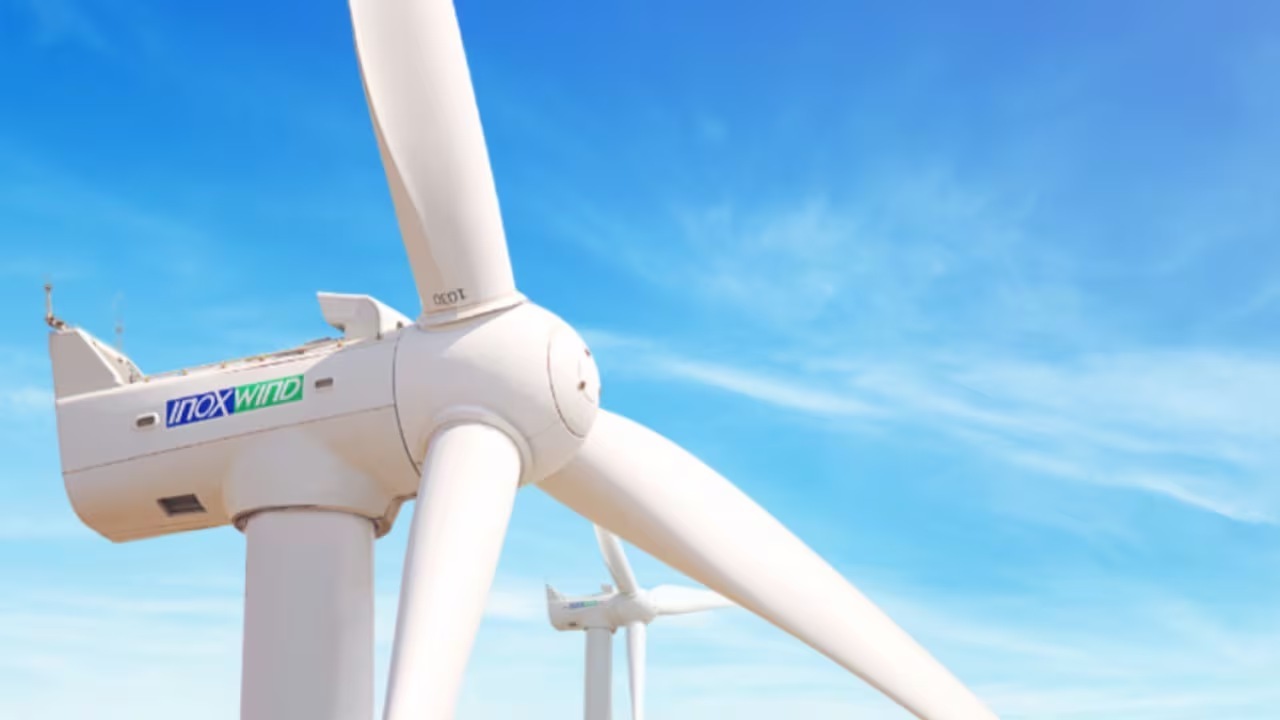
Inox Wind Q4 FY26: 3.1 GW Order Book, Working Capital Pivot, and the Equipment Supply Bet
General information and entertainment, not investment advice. The author is not a SEBI-registered adviser or research analyst. No recommendation, no promised returns. Markets carry risk including loss of capital. Figures may not be current. Consult a registered adviser before acting.
1. At a Glance
Inox Wind shipped ₹1,244 Cr in Q4 FY26 revenue—essentially flat year-on-year—while full-year sales landed at ₹4,397 Cr, up 24% from FY25’s ₹3,557 Cr. Net profit fell sharply: Q4 PAT collapsed 50% to ₹91 Cr, but full-year PAT recovered to ₹405 Cr, turning modest breakeven into profit after years of losses.
The order book stands at 3.1 GW, providing 24+ months of revenue visibility. Management executed a strategic pivot: the mix shifted from 100% turnkey EPC projects two years ago to 75% equipment supply now. This swap trades EPC’s fat margins for working capital relief—a bet that lower receivable days will matter more than margin points.
The balance sheet weathered a ₹1,250 Cr rights issue in August 2025 and debt has compressed; net cash stands at ₹583 Cr (debt minus cash). Yet working capital—debtor days at 353, inventory at 268 days—remains stretched at 443 days cash conversion, despite a 15-day quarterly improvement.
The tension: Revenue is surging, margins held firm, but the company is fighting a working capital crisis inherited from EPC-heavy execution. The pivot buys time; execution will show whether the tradeoff was worth it.
2. Introduction
Inox Wind started from rubble. From FY23’s ₹733 Cr revenue and ₹709 Cr loss, the company limped forward for two years—narrowly positive in FY24 (₹-48 Cr PAT) and then recovered with ₹448 Cr profit in FY25. The FY26 result (₹405 Cr PAT, ₹1,244 Cr quarterly sales) shows the recovery holding, but profit growth flattened—a 11.8% year-over-year earnings decline despite 24% revenue growth signals margin compression and higher finance costs from working capital borrowing.
Management attributed Q4’s softer profit to imported ECS (Electrical Control System) supply delays tied to geopolitical shipping disruptions, plus sticky receivables from PSU customers holding back on milestone payments. The 1.5 GW CESC order (largest single contract in Indian wind history, awarded Feb 2024) continues execution; it is a mix of turnkey and equipment supply—exactly the hybrid model management wants to exit toward.
In 2025, the group completed a transformative rights issue (₹1,250 Cr net new equity), deployed ₹560 Cr to redeem preference shares, and cemented Inox Green (O&M arm) as a scale platform via 6.5 GW of asset acquisitions. The parent company—freshly merged with Inox Wind Energy Limited—now holds consolidated assets of ₹12,068 Cr versus ₹8,792 Cr a year ago.
3. Business Model: WTF Do They Even Do?
Inox Wind manufactures wind turbine generators (WTGs) in two size classes: 2 MW and 3 MW (3.3 MW variant), with a 4.X MW platform launch scheduled for CY26. The company is fully integrated: it makes nacelles, hubs, and blades in-house across four plants in Gujarat, Madhya Pradesh, and Himachal Pradesh.
The revenue recipe has three slices. Manufacturing & equipment supply: the company ships WTG components to IPPs, PSUs (NTPC, NLC), and commercial-and-industrial players (Aditya Birla, Jakson, Amplus, continuum). EPC (Engineering, Procurement, Commissioning): historically the company handled full project turnkey—land, transmission evacuation, site prep, erection, grid tie. O&M (Operations & Maintenance): subsidiary Inox Green now manages 13+ GW of renewable assets (wind + solar) under 5–20 year contracts, earning steady recurring fees.
The business operates in a dual-currency world. Steel, aluminium, and composite blade materials are procured globally. Overseas suppliers demand long lead times (hence 268-day inventory) and impose pricing discipline; when commodity spikes hit (steel in 2021–22), margin squeezes follow. Domestic erection and commissioning tie cash to customer milestones: supply, erection, commissioning, grid connectivity. Delays at any milestone stack up receivables.
The company’s moat is half-built. Common evacuation infrastructure (substations, transmission corridors) that Inox Green and EPC arm Inox Renewable Solutions own across Gujarat, Rajasthan, and Madhya Pradesh gives the parent an edge on site selection and cost. New capacity (1.2 GW nacelle/hub plant opened Dec 2025, new transformer shop) provides backward integration. But the wind OEM sector is crowded: Suzlon, Vestas, and GE Vernova all operate in India, though only Inox designs for low wind-speed Indian sites.
The group strategy—”ONE INTEGRATED”—leans on captive demand. Parent Inox Clean (the renewable IPP arm) targets 14 GW by FY29, with 20–30% wind component. That’s 2.8–4.2 GW of internal wind orders per year through FY29. Such recurring demand smooths factory utilization and, management hopes, improves working capital via group-company payment discipline.
4. Financials Overview
Figures are consolidated, in ₹ crore.
Metric
Q4 FY26
Q4 FY25
YoY
FY26
FY25
YoY
Revenue
1,244
1,275
-2%
4,397
3,557
24%
EBITDA
200
282
-29%
891
757
18%
PAT
91
135
-33%
405
438
-7%
EPS
0.53
0.71
-25%
2.34
2.86
-18%
The full-year story differs from the quarter. FY26 revenue sailed past FY25 (24% growth), but PAT dropped 7% despite higher EBITDA, signaling a sharp tax provision jump (₹210 Cr vs FY25’s ₹102 Cr) and elevated finance costs (₹200 Cr vs ₹169 Cr). Deferred tax asset drawdown contributed; management’s cash PAT—PAT plus depreciation plus deferred tax reversion—stood at ₹1,032 Cr (up 28% YoY), painting a healthier cash story than reported earnings.
Q4 detail: The quarter saw ₹1,244 Cr revenue, down 2% YoY despite executing on a massive order book. The reason: Q4 FY25 benefited from Q3/Q4 spurt in 3 MW turbine ramp (new platform transition). Operating margin in Q4 FY26 was 16%, below full-year 20%. Other income (₹61 Cr) included treasury gains and value-added service fees from O&M wing. Interest burden (₹65 Cr) crept higher, reflecting working capital debt for inventory and receivables.
Concall insights: Management guided FY27 revenue growth at 75% (to ~₹7,695 Cr). That assumes full ramping of the CESC 1.5 GW order, plus acceleration in new customer wins. EBITDA margin guidance: 20–22%, implying operating performance stabilizes despite continued input volatility. Management reiterated their pivot: higher equipment-supply share (75%+) reduces EPC margin drag but frees cash and shortens receivable cycles.
5. Market Expectations & Historical Multiples
This section describes how the market is currently pricing the company and how that compares with its own history and peer group. It is descriptive, not predictive.